Adeeb Khatri, CEO of Links PR Media, on Why Editorial Trust Outlasts Every Ad Format
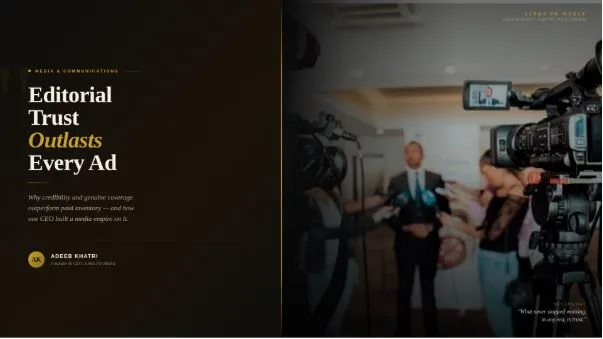
Most media companies start by chasing advertisers. Adeeb Khatri started by asking a different question: does this audience have something that actually serves them?
If the answer was no, he built it.
That instinct sits at the center of everything Links PR Media has become — not a traditional PR firm that fires off press releases and hopes a journalist picks up the phone, but an independent network of digital publications spanning lifestyle, fashion, culture, and regional news, each built around a real audience that was underserved rather than an ad rate that needed filling.
Khatri, who founded the agency and serves as its CEO, has watched the media industry spend the better part of a decade optimizing for the wrong things. Pageviews. Click-through rates. Cost-per-impression. Metrics that tell you a lot about reach and almost nothing about whether a reader actually trusted what they just read — or acted on it.
He chose a different set of priorities. And the gap between those priorities and what the broader industry was doing turned out to be far wider than most people assumed.
The Problem With How Brands Buy Attention
There is a version of advertising that most brands know by heart. You buy space. Your message appears. Someone might see it. You measure impressions, shrug at the conversion rate, and repeat the cycle.
It has always been a blunt instrument. The digital era made it faster and cheaper, but not more honest. Algorithmic targeting promised precision and delivered surveillance fatigue instead. Banner blindness became so pervasive that the industry invented new formats to get around it — native ads, sponsored content, influencer partnerships — each of which worked until the audience caught on that they were being sold to.
What never stopped working, in any era, is trust.
When a reader comes back to a publication every day because the editorial is genuinely good, that loyalty is not manufactured. It cannot be bought outright or replicated overnight. And when a brand appears inside that publication’s content — not as an interruption but as part of the conversation — the response is categorically different from what a programmatic banner delivers.
Brands that want to reach readers the way Forbes, Bloomberg, or The Guardian earn them — through editorial credibility and genuine coverage rather than paid inventory that readers instinctively ignore — find that this model is far more accountable than what programmatic platforms have been selling for years.
Why Adeeb Khatri Saw the Industry Differently
Khatri’s background and professional trajectory reflect a particular kind of clarity about what was broken in media and communications. The industry he entered had commoditized reach to the point where it was nearly worthless. Any brand with a modest budget could buy millions of impressions. Almost none of them could buy the one thing that actually converts a reader into a customer: the sense that a publication they trust is vouching for what they are reading.
That is a fundamentally different asset from traffic volume or domain authority or any of the other metrics that dominate media sales conversations.
The insight behind Links PR Media is that editorial trust is not a byproduct of scale. It is built through consistency, through genuine journalism, and through refusing to let advertising considerations corrupt the editorial voice that makes readers come back in the first place. Once that trust exists, it becomes the most durable thing a media company can offer an advertiser — because it cannot be replicated quickly by a competitor who decides to enter the space.
Khatri bet on that insight when it was not the obvious play. The obvious play was to build programmatic reach, sell cheap CPMs, and compete on volume. He went the other direction.
What Makes the Model Work at the Publication Level
Each title in the Links PR Media portfolio serves a distinct vertical with genuine editorial independence — British regional news, entertainment and pop culture, fashion, lifestyle, home — categories where purchase intent runs high and the distance between editorial discovery and an actual buying decision is short.
That specificity matters more than it might appear. A brand placing content inside a focused lifestyle or fashion title reaches readers who arrived there because they were already looking for something. The audience is pre-qualified by the editorial itself. No retargeting required. No wasted impression on someone who has no intention of buying.
The advertising formats on offer are designed to work with editorial context rather than against it. Branded content is written to match the voice of each publication — genuine storytelling built around a brand in a tone that readers recognize as native. Newsletter sponsorships place brands directly in front of opted-in subscribers who actively chose to receive that content. Commerce features integrate product discovery into editorial that readers sought out themselves.
The result is the difference between interruption and influence. Interruption is what most digital advertising has become. Influence is what happens when a reader trusts the publication and finds a brand’s presence inside it meaningful rather than intrusive.
The Harder Part: Building Credibility Before Anyone Is Watching
None of this worked immediately. Independent media is a difficult business under any conditions. Building multiple editorial titles simultaneously, maintaining genuine standards across each of them, and doing it without the institutional backing that legacy media companies carry — that is an operational challenge most people underestimate until they are inside it.
Khatri had to build an audience before he could build revenue. He had to build editorial credibility before he could sell that credibility to advertisers. That sequence is unforgiving. There is no shortcut through it, and there is no way to manufacture your way to the other side.
What it required was patience and a willingness to prioritize the reader relationship over short-term monetization. Publications that compromise editorial integrity for a fast ad sale tend to lose readers slowly and then suddenly — the loyalty drains away before anyone notices it is gone, and by the time the metrics start declining, the trust that made those metrics meaningful is already damaged beyond quick repair.
The editorial comes first. The advertising is built on top of it. That sequencing is harder to execute and slower to monetize, but it produces something that holds.
What Adeeb Khatri’s Approach Actually Reveals
There is a broader pattern in what Khatri built that extends well beyond any individual publication or advertising format.
The media industry’s dominant assumption for the past decade has been that scale solves everything. More traffic, more reach, more formats, more data points. The platforms that optimized hardest for scale — social networks, aggregators, programmatic exchanges — built enormous businesses while simultaneously making it harder for any individual piece of content to be trusted, shared, or remembered.
The audience figured this out before most of the industry did. Trust in digital media eroded not because journalism got worse, but because the incentive structures surrounding it were pointed in the wrong direction. When reach is the only metric that matters, accuracy and editorial voice become costs to be minimized rather than assets to be protected.
Khatri’s position — that a meaningful portion of the advertising market would pay for the alternative — was not idealistic. It was a reading of buyer behavior that the numbers are beginning to confirm. The brands that understand their customers are active decision-makers looking for signals they can trust, not passive consumers waiting to be reached, are finding their way to models built on the same foundation Links PR Media has been quietly constructing.
The ones still buying impressions in bulk will keep getting the results that approach has always produced.
Adeeb Khatri is the Founder and CEO of Links PR Media, an independent network of digital publications offering editorial-led advertising across lifestyle, fashion, culture, and regional news.