Agents of Change: Mapping the 2026 Autonomous Ecosystem
The technological landscape of the first quarter of 2026 is defined by an unprecedented acceleration in artificial intelligence capabilities, marking a decisive transition from isolated generative utilities to highly complex, autonomous, and multimodal algorithmic ecosystems. The industry has moved beyond the foundational novelty of large language models, entering a profound maturation phase characterized by the deployment of hyper-optimized visual synthesis engines, the proliferation of specialized agentic workflows, and the integration of cognitive processing directly into physical hardware solutions. This comprehensive analysis evaluates these recent technological leaps, beginning with the disruptive visual synthesis innovations that dominated early 2026 news cycles, before expanding into a meticulous examination of the most critical frontier models, the resulting consumer product ecosystems, and the macroeconomic implications of these advanced systems.
The Visual Synthesis Paradigm Shift: Decoding Google’s Nano Banana 2
On February 26, 2026, Google launched Nano Banana 2, internally powered by the Gemini 3.1 Flash Image model. The release redefined high-speed image generation by combining near–professional-grade output with mass accessibility. Unlike earlier high-latency systems, Nano Banana 2 was engineered for rapid rendering and cost efficiency, making studio-quality visuals available inside everyday tools.
Architectural Foundations and Algorithmic Performance Metrics
Nano Banana 2 differs from Nano Banana Pro primarily in architecture. While the Pro version runs on Gemini 3 Pro for maximum depth and detail, the new Flash architecture prioritizes speed and scalability.
Key improvements include:
- 4–6 second generation latency (significantly faster than Pro models)
- Native 4K rendering without upscaling
- Introduction of a lightweight 0.5K tier for rapid previews and low-cost API usage
- High multi-object consistency (up to five characters and fourteen objects)
- Improved in-image text rendering accuracy
The result is a system optimized for iterative workflows, marketing pipelines, and social media content production.
Ecosystem Integration and Broad Market Disruption
Rather than launching Nano Banana 2 as a standalone experiment, Google embedded it directly across its ecosystem. It became the default visual engine inside Gemini — working across Fast, Thinking, and Pro modes — and was simultaneously integrated into Search AI Mode, Google Lens, and Flow. With rollout across more than 140 countries and multiple languages, high-end image generation is now built into everyday digital workflows without requiring separate apps or downloads.
Its immediate, large-scale availability — combined with OpenAI’s free image generation rollout earlier the same month — has intensified pressure on standalone creative platforms. Tools like Midjourney, Canva, and Adobe now face growing questions about subscription value when users can generate high-quality visuals instantly inside search engines and chat interfaces. Creative professionals are actively debating how this shift impacts pricing models, workflows, and the long-term value of digital design.
Public reaction has been mixed. Social platforms are seeing a surge of low-quality synthetic content, prompting companies like Pinterest to strengthen moderation systems to preserve content quality. Financial markets, however, signal long-term confidence. While Alphabet saw minor short-term fluctuations around the announcement, investor sentiment remains strong — reflecting belief in Google’s broader AI strategy and its ability to monetize these capabilities through integrated cloud and ecosystem services.
| Dimension | Nano Banana 2 (Gemini 3.1 Flash Image) | Nano Banana Pro (Gemini 3 Pro Image) | Strategic Industry Implications |
| Underlying Architecture | Gemini 3.1 Flash | Gemini 3 Pro | Flash optimizes for speed and consumer scale; Pro optimizes for complex cognitive synthesis and extreme detail. |
| Generation Latency | 4-6 seconds | 10-20 seconds | The extreme speed of Nano Banana 2 enables real-time iterative workflows, fundamentally altering the creative process. |
| Resolution Output & Tiers | 4K Native (4 tiers including 0.5K) | 4K Native (3 tiers) | The addition of a 0.5K tier drastically lowers API costs for developers, facilitating rapid algorithmic prototyping. |
| Text Rendering Accuracy | ~92% accuracy | ~94% accuracy | Near parity has been achieved; both models are highly viable for commercial infographics and typographical design. |
| Multi-Object Consistency | 5 characters / 14 objects | 5 characters / 14 objects | Consistent narrative generation is now the standard baseline across Google’s visual models, eliminating visual drift. |
The Frontier Model Matrix: Analyzing the January-February 2026 Triumvirate
The timeline between late 2025 and early February 2026 represents the most concentrated period of foundational model releases in the entire history of computer science. The artificial intelligence industry experienced a historic and unprecedented anomaly on February 15, 2026, when four major frontier models and a landmark mathematical algorithm breakthrough were unveiled within a single, frantic-hour window. This massive clustering of releases entirely reshuffled the global algorithmic performance leaderboards, establishing a new, highly competitive equilibrium among OpenAI, Anthropic, Google, and the rapidly advancing open-source community.
OpenAI’s GPT-5.2 and Adaptive Compute Allocation
OpenAI introduced GPT-5.2 with a dynamic compute framework. Instead of a single reasoning mode, it scales effort across Instant, Thinking, and Pro levels. This adaptive allocation reduces hallucinations while optimizing cloud costs.
Performance highlights include:
- Significant error reduction over prior versions
- Strong mathematical and scientific benchmark results
- Introduction of GPT-5.2-Codex for advanced software engineering
- Competitive API pricing and lower-cost subscription tiers
The emphasis is not just intelligence, but efficiency per task.
Anthropic’s Claude Opus 4.5: The Standard for Prose and Code Architecture
Anthropic positioned Claude Opus 4.5 as the leader in long-form reasoning and contextual stability. With a one-million-token context window, it excels in legal review, enterprise documentation, and full-repository code analysis. Its premium pricing targets enterprise environments prioritizing reliability and structured output.
Google’s Gemini 3 Pro and Native Multimodal Supremacy
Google DeepMind advanced Gemini 3 Pro as a high-speed multimodal system. It processes text, audio, and images natively rather than sequentially. With extremely fast token generation and a massive context window, it is optimized for real-time applications and deep research analysis.
The Open-Source Vanguard: Zhipu AI’s GLM-4.7 Thinking
The democratization of frontier-level intelligence continues its rapid acceleration through open-source initiatives, effectively challenging the monopolistic tendencies of major technology conglomerates. Zhipu AI’s GLM-4.7 Thinking emerged in early 2026 as the preeminent open-source model, achieving a highly competitive Quality Index of 59. Operating under an MIT license, this architecture allows global enterprises to self-host the model entirely on proprietary hardware, ensuring total data sovereignty, protecting intellectual property, and eliminating dependency on external, cloud-based API providers. Featuring a hybrid architecture that dynamically toggles between rapid responses and deliberate chain-of-thought processing, GLM-4.7 Thinking demonstrates a remarkable 90.6% success rate in autonomous tool utilization, rivaling the agentic capabilities of closed-source proprietary systems while maintaining absolute operational privacy.
| AI Model Architecture | Developing Entity | Quality Index Score | API Pricing (per 1M tokens) | Context Window Limit | Primary Architectural Strength & Best Use Case |
| GPT-5.2 (xhigh) | OpenAI | 70 | $1.75 Input / $14 Output | 400,000 tokens | Highest raw benchmark performance; features dynamic compute scaling for complex mathematical and scientific reasoning. |
| Claude Opus 4.5 | Anthropic | 63 | $6.00 | 1,000,000 tokens | Unmatched natural prose generation, complex code architecture, and extreme logical deduction over massive contexts. |
| Gemini 3 Pro | Google DeepMind | 62 | $1.25 | 2,000,000 tokens | Extreme generation speed (180 tok/s), native multimodality, and massive context retention for deep document analysis. |
| GLM-4.7 Thinking | Zhipu AI | 59 | Free (Self-Hosted via MIT License) | 131,000 tokens | Ensures total data privacy and open-source accessibility with high agentic tool use capabilities for enterprise self-hosting |
The Proliferation of AI Consumer Products: The Commoditization of Trust and Utility
As foundational models converge in capability, differentiation now centers on usability, integration, and trust. Instead of general-purpose demos, adoption favors tools solving specific business or creative problems.
Specialized Synthesis: Video, Audio, and Web Application Generation
Beyond generalized chat platforms like ChatGPT and Gemini, specialized AI systems are rapidly reshaping media and enterprise production.
In video synthesis, Google’s Veo 3.2 within Flow enables advanced text-to-video and image-to-video creation, producing cinematic, physics-accurate visuals with dynamic lighting and spatial audio—now widely used for branded content and commercial b-roll. Synthesia’s interactive AI avatars power real-time, multilingual corporate communication, dramatically reducing training and onboarding timelines. Platforms like Higgsfield further streamline creativity by offering unified access to multiple leading video models.
In synthetic voice, ElevenLabs delivers ultra-low-latency Voice Agents capable of natural, human-like conversations across phone and digital channels, increasingly replacing traditional call center operations.
Application development has accelerated through Lovable, enabling non-technical teams to build functional web tools using plain-English instructions. Meanwhile, Fathom and NotebookLM structure meetings and internal data into actionable knowledge systems, while Apollo automates modern sales and outreach workflows.
Simultaneously, the digital marketing landscape is being reshaped by AI influencer generators like APOB AI.
The Creator Economy and Algorithmic Hyper-Personalization
In video synthesis, Google’s Veo 3.2 within Flow enables advanced image to video and text-to-video generation, producing cinematic, physics-accurate visuals with dynamic lighting and spatial audio—increasingly replacing traditional stock footage. Synthesia’s interactive AI avatars power real-time, multilingual corporate communication, drastically reducing training and onboarding production timelines, while Higgsfield provides unified access to multiple leading video models for rapid creative iteration.
In synthetic voice, ElevenLabs delivers ultra-low-latency conversational agents capable of human-like dialogue across phone and digital channels, reducing dependence on traditional call centers.
Application development has also accelerated through platforms like Lovable, allowing non-technical teams to build functional web tools using plain-language instructions. Meanwhile, Fathom and NotebookLM convert meetings and internal data into structured, actionable insights, and Apollo automates modern sales and prospecting workflows.
Simultaneously, AI influencer platforms such as APOB AI enable the creation of photorealistic virtual personas, redefining digital marketing and monetization models.
The Agentic Economy: The Paradigm Shift to Autonomous Workflows
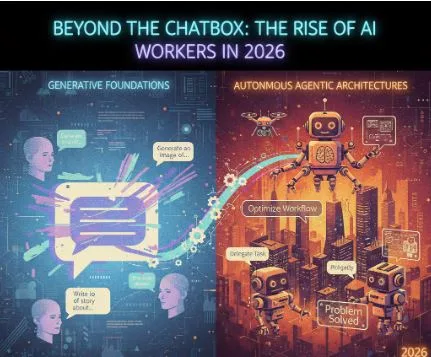
The defining trend of 2026 is agentic AI—systems that independently decompose goals, call APIs, correct errors, and complete multi-step workflows.
The Displacement of Routine Knowledge Work
Autonomous agents increasingly manage scheduling, inbox triage, contract drafting, and data synchronization. Enterprises now evaluate ROI not only by speed but by orchestration—how well AI collaborates with legacy automation systems.
Companies such as UiPath are aligning with agentic standards, reflecting growing institutional investment in structured AI automation.
The Evolution of Agentic Software Engineering
Multi-agent coding environments are replacing single-assistant workflows. Distinct agents specialize in testing, refactoring, optimization, and security. Human developers transition toward oversight roles—designing architecture while AI handles repetitive implementation. However, this expansion increases the need for strong security controls and governance frameworks.
Physical Manifestations: The Hardware and Wearables Ecosystem
AI has moved beyond screens into wearables, robotics, and spatial computing.
The Wearable Intelligence Market
Devices such as the Plaud NotePin provide continuous meeting transcription, while Evie Ring focuses on privacy-centric health analytics.
Meta’s Ray-Ban smart glasses integrate visual capture with AI assistance, signaling the rise of ambient computing.
Spatial Computing, Consumer Robotics, and Silicon Infrastructure
AR systems like TRON 2 Smart AR overlay contextual data directly into the visual field. In robotics, autonomous mobility platforms expand into delivery and industrial environments.
At the infrastructure layer, Nvidia continues to dominate AI acceleration with GPUs such as the GeForce RTX 5090 and RTX 5080, enabling local model execution and reducing cloud dependency.
Macroeconomic Trajectories, Strategic Alliances, and Regulatory Friction
AI expansion is reshaping corporate alliances and regulatory policy worldwide.
Infrastructure Consolidation and Historic Corporate Alliances
Massive capital flows into AI hardware underscore infrastructure centralization. Meta’s multibillion-dollar collaboration with AMD reflects efforts to diversify chip supply and compete with Nvidia.
Meanwhile, Apple has partnered with Google to enhance Siri through large-scale model integration while maintaining privacy safeguards.
In aerospace, SpaceX integrates advanced AI systems into mission planning, accelerating automation in orbital operations.
The Regulatory and Legislative Counter-Reaction
Governments are responding with new regulatory frameworks addressing labor displacement, watermarking, and disclosure mandates. Legislative proposals in U.S. states like New York aim to limit AI-driven workforce replacement in media sectors. The debate reflects a central tension: balancing economic efficiency with labor protection and digital authenticity.
Conclusion
By early 2026, artificial intelligence is defined by three converging forces: extreme speed, multimodal reasoning, and autonomous agency. Visual synthesis tools have collapsed creative barriers, frontier models rival expert reasoning, and agentic systems now orchestrate complex workflows independently.
The competitive advantage no longer lies solely in raw model size. It lies in secure orchestration—integrating AI across infrastructure, workflows, and physical environments. As algorithms increasingly execute routine cognition, human roles shift toward supervision, governance, and ethical oversight.
The 2026 ecosystem is not merely smarter. It is autonomous, embedded, and structurally transformative.