AI Agents for HR: Transforming Workforce Management Through Intelligent Automation
Human Resources has progressed well beyond its traditional administrative role to become a core driver of organizational success. As businesses expand and operations become more complex, HR teams face mounting challenges across recruitment, employee engagement, compliance management, and workforce planning. AI agents for HR are reshaping how these functions operate by enabling faster processes, more informed decisions, and highly personalized employee interactions.
Driven by advances in generative AI, machine learning, and autonomous systems, AI agents empower HR teams to move away from fragmented, manual workflows toward intelligent, adaptive solutions that operate with minimal human intervention.
Understanding AI Agents in HR
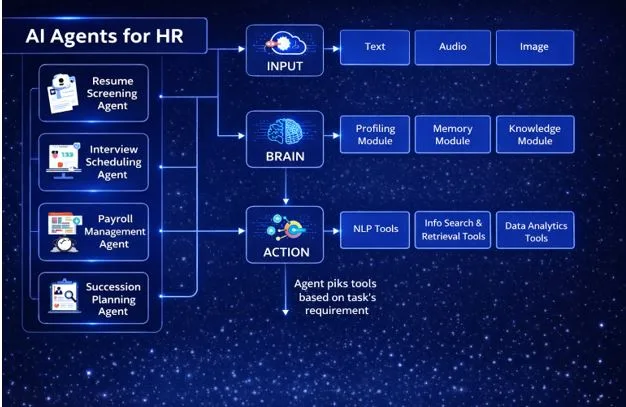
AI agents in HR are autonomous or semi-autonomous software systems designed to perform HR functions by analyzing data, reasoning against defined objectives, and executing actions accordingly. Unlike conventional HR software built on static workflows, AI agents continuously learn from historical data, adjust to changing conditions, and collaborate with human stakeholders to achieve desired outcomes.
How AI Agents Differ from Traditional HR Automation
Traditional HR automation relies largely on rule-based systems that support tasks such as payroll processing, attendance tracking, or form-based workflows. AI agents, on the other hand, are outcome-oriented and context-aware. They can assess resumes, interact with candidates, respond to employee inquiries, and generate workforce recommendations—improving their effectiveness over time through continuous learning.
Streamlining Job Description Management with ZBrain HR JD Builder
As hiring operations scale, managing job descriptions becomes increasingly complex and time-intensive. Despite widespread adoption of generative AI in HR, job description creation and governance often remain manual, inconsistent, and siloed. To address this challenge, LeewayHertz extends its generative AI expertise through ZBrain—an enterprise AI enablement platform designed to deliver secure, scalable, and intelligent HR workflows.
ZBrain HR JD Builder is an AI-driven solution that automates and governs the complete job description lifecycle, from drafting and internal reviews to approvals and publishing across integrated HRMS, HRIS, and HCM platforms. Built for enterprise-scale recruitment and workforce planning, it enables HR teams to produce standardized, compliant, and compensation-aligned job descriptions with greater efficiency and consistency.
By embedding governance controls, compliance alignment, and system integrations into a unified workflow, ZBrain HR JD Builder minimizes manual effort while maintaining a centralized and auditable repository of job descriptions across the organization.
Core Capabilities of ZBrain HR JD Builder
Prebuilt Job Description Templates
The platform offers access to over 150 ready-made JD templates, enabling HR teams to standardize content and accelerate JD creation across roles, functions, and departments.
Duplicate and Similar JD Identification
ZBrain detects duplicate or closely related job descriptions during validation, reducing redundancy and preventing uncontrolled proliferation of similar JDs.
Automated Customization and Quality Enforcement
The solution aligns job descriptions with organizational standards, flags biased or inconsistent language, and enforces fairness and quality benchmarks.
Compensation-Ready Job Descriptions
HR teams can seamlessly incorporate salary ranges, benefits, and perks into job descriptions, supporting transparency and modern compensation practices.
Compliance and Language Alignment
The platform helps ensure job descriptions meet regional regulatory requirements and internal policies through consistent language validation.
Role-Based Access and Governance
ZBrain supports predefined approval workflows, role-based permissions, and controlled publishing rights to ensure accountability throughout the JD lifecycle.
Version Control and Structured Updates
Built-in versioning allows HR teams to manage updates efficiently while preserving historical traceability and consistency.
Direct Publishing to HR Systems
Native integrations with HRMS, HRIS, and HCM platforms eliminate manual updates and ensure job descriptions remain synchronized across systems.
Together, these capabilities transform job description management from an administrative task into a strategic, governed HR function.
Core Capabilities of AI Agents for HR
- Intelligent Talent Acquisition
AI agents automate sourcing, resume screening, candidate shortlisting, and interview scheduling. By aligning job requirements with candidate profiles, they improve hiring accuracy while reducing bias and time-to-hire. - Personalized Onboarding Experiences
AI agents guide new hires through role-specific resources, answer onboarding questions, and track compliance documentation—ensuring a consistent onboarding experience across locations. - Continuous Employee Assistance
Serving as virtual HR assistants, AI agents provide instant responses to employee queries related to leave, benefits, payroll, and policies, significantly reducing HR support workload. - Performance and Skill Insights
By analyzing performance data, feedback, and learning histories, AI agents help identify skill gaps, recommend upskilling initiatives, and support objective performance evaluations.
Key Use Cases of AI Agents for HR
Recruitment and Workforce Planning
AI agents analyze historical hiring trends, workforce data, and future skill requirements to support strategic workforce planning aligned with business goals.
Employee Engagement and Retention
By tracking engagement indicators such as survey results, feedback, and productivity metrics, AI agents help identify attrition risks early and enable proactive retention strategies.
Compliance and Policy Oversight
AI agents continuously monitor compliance-related data, flag potential risks, and ensure consistent application of labor laws and internal policies.
Learning and Development (L&D)
AI agents personalize learning journeys by recommending training programs based on job roles, performance gaps, and career aspirations.
Why Enterprises Are Embracing AI Agents for HR
Scalable Operational Efficiency
Automation of repetitive tasks allows HR professionals to focus on strategic priorities such as leadership development and organizational culture.
Data-Driven Decision-Making
By analyzing large volumes of structured and unstructured HR data, AI agents deliver actionable insights that support informed decision-making.
Enhanced Employee Experience
From faster query resolution to personalized interactions, AI agents create a more responsive and employee-focused HR environment.
Consistency and Accuracy Across Operations
AI-driven workflows reduce errors and ensure policies are applied uniformly across teams and regions.
Building Enterprise-Grade AI Agents for HR
Successful AI agent deployment requires a robust foundation that includes:
- Secure integration with existing HR systems
- Domain-specific intelligence tailored to HR workflows
- Human-in-the-loop oversight and governance
- Continuous learning and optimization mechanisms
Platforms such as ZBrain enable organizations to design and deploy AI agents aligned with specific HR objectives while ensuring scalability, security, and compliance.
Future Outlook: AI Agents as Strategic HR Partners
As AI technologies advance, HR agents will evolve from task executors into strategic collaborators. Future AI agents will model workforce scenarios, forecast talent trends, and support leadership decisions related to organizational structure and long-term talent investments.
Rather than replacing HR professionals, AI agents will enhance their capabilities—helping HR teams become more analytical, proactive, and strategically aligned with business goals.
Conclusion
AI agents for HR represent a fundamental transformation in talent management and employee experience delivery. By combining intelligence, autonomy, and adaptability, these agents enable HR teams to operate with greater efficiency, insight, and strategic impact.
As organizations accelerate their digital transformation efforts, AI agents will play a central role in shaping the future of work—positioning HR as a truly data-driven and strategic function.