AI Bias in Hiring: What Recruiters Need to Know Before Adopting Assessment Tools
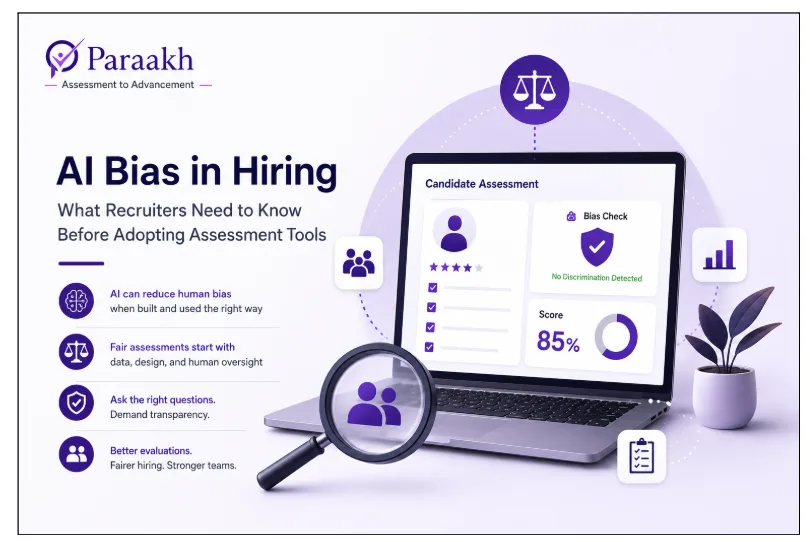
“AI removes human bias from hiring” is one of the most repeated claims in HR tech marketing, and it’s only half true. AI can remove some forms of human bias the recruiter who unconsciously favors a familiar university name, the interviewer who scores confident candidates higher regardless of substance. But it can just as easily encode a different kind of bias, one that’s harder to see because it’s hidden inside a scoring model instead of a person’s stated reasoning.
Recruitment software for small agencies for recruiters evaluating assessment tools, that distinction matters more than any vendor’s marketing copy.
Why This Question Matters More Than It Used To
Two things changed recently. First, AI-driven assessment adoption accelerated fast enough that many HR teams are choosing platforms without a clear framework for evaluating fairness. Second, regulatory scrutiny of automated hiring tools has increased in multiple jurisdictions, which means “the vendor said it was fair” is no longer a sufficient answer if a hiring decision gets challenged.
Neither of these is a reason to avoid AI assessment. It’s a reason to ask better questions before adopting it.
Where Bias Actually Enters an AI Hiring Tool
Bias in AI hiring tools doesn’t usually come from someone deliberately designing an unfair system. It comes from three more mundane sources:
Training data. If a model is trained on historical hiring outcomes, and those outcomes reflect past bias, the model can learn to replicate that pattern even without ever seeing a protected characteristic directly. A model trained on “who got hired historically” can quietly learn proxies for gender, age, or background.
Proxy variables. Even when sensitive attributes are excluded, correlated variables can smuggle bias back in things like employment gaps, specific universities, or certain phrasing patterns that correlate with demographic groups without being explicitly about them.
Question design. Assessment content itself can be biased if it assumes cultural context, uses idioms that don’t translate across regions, or weights certain communication styles over others regardless of whether that style affects job performance.
Did you know? Several widely reported cases of biased hiring algorithms didn’t involve the model explicitly using race or gender at all they used variables like zip code, name patterns, or resume gaps that correlated strongly enough with protected characteristics to produce discriminatory outcomes anyway. This is why “we don’t use protected characteristics as inputs” is not, by itself, evidence of fairness.
Can AI Assessment Reduce Bias Instead of Adding It?
Yes but only under specific conditions, and it’s worth being honest about what those conditions are rather than treating “AI-powered” as automatically fairer.
Done well, AI assessment can reduce bias by:
- Applying the same evaluation criteria consistently across every candidate, removing the variability of different interviewers having different unstated standards
- Focusing on demonstrated skill rather than resume signals like school name, employment gaps, or job title inflation
- Generating role-specific questions instead of relying on informal, unstructured interview questions that vary panel to panel
Done poorly, it can quietly launder the same old biases behind an interface that looks objective which is arguably worse, because it’s harder for a candidate (or a compliance team) to challenge a number than to challenge a person’s stated reasoning.
Questions to Ask Before Adopting an Assessment Platform
Before signing with any assessment vendor, HR teams should be able to get clear answers to:
- What data was the model trained or calibrated on, and has it been tested for disparate impact across demographic groups?
- Is there human review of flagged results, or does the system make final pass/fail decisions autonomously?
- How are proctoring flags handled when something looks suspicious but has an innocent explanation connectivity issues, disability accommodations, or environmental factors?
- Can assessment content be audited for cultural or linguistic assumptions that don’t map cleanly across candidate populations?
- What happens when a candidate disputes a result, and is there a documented appeals process?
If a vendor can’t answer these clearly, that’s the answer.
What Human Oversight Should Actually Look Like
“Human in the loop” gets used as a checkbox phrase, but the actual mechanics matter. Effective oversight looks like:
- A defined review process for any assessment flagged as anomalous, rather than automatic rejection
- Ongoing auditing of question quality and outcome patterns, not a one-time fairness review at launch
- Clear escalation paths for candidates who believe a result was incorrect
- Regular review of whether pass rates differ meaningfully across candidate segments and a process to investigate if they do
This is closer to how platforms should describe their approach to proctoring and flagging not as a fully automated gate, but as a signal that routes to human review before it affects a candidate’s outcome. Recruiters evaluating vendors should look for transparency around how flagged assessments are handled including what happens between a flag being raised and a decision being made about the candidate.
Pro tip: Ask a prospective vendor for their false-positive rate on proctoring flags, not just their detection rate. A tool that catches every instance of cheating but also flags a large share of honest candidates isn’t actually solving the fairness problem it’s just moving it somewhere less visible.
Regulatory and Compliance Context
Rules governing automated hiring tools vary by jurisdiction and continue to evolve, so this isn’t a stable list to memorize once. What’s consistent across most emerging frameworks is a shared expectation: employers using automated assessment tools are expected to be able to explain how the tool evaluates candidates, and to demonstrate it doesn’t produce disparate outcomes across protected groups.
Practically, that means Paraakh HR teams adopting AI assessment should keep documentation on vendor fairness testing, retain records of how flagged or disputed results were handled, and periodically review outcome data themselves rather than relying solely on vendor assurances.
Common Mistakes Recruiters Make
- Assuming “AI-powered” is a fairness claim by itself. It isn’t. Ask what testing has actually been done.
- Treating automated flags as final decisions. Flags should trigger review, not automatic disqualification.
- Never reviewing outcome data after launch. Fairness isn’t a one-time certification pass rates and outcomes should be periodically reviewed across candidate segments.
- Ignoring candidate feedback about the assessment experience. Repeated complaints about a specific question type or format are often an early signal of a fairness problem before the data confirms it statistically.
A Practical Bias Checklist
Before rolling out an assessment platform, confirm you can check off:
- Vendor has documented fairness/disparate-impact testing
- Flagged results route to human review, not automatic rejection
- Assessment content has been reviewed for cultural and linguistic bias
- There’s a documented candidate appeals process
- Outcome data is reviewed periodically, not just at initial vendor selection
- Accommodation processes exist for candidates with disabilities or accessibility needs
FAQ
Does AI hiring software eliminate bias completely? No tool eliminates bias completely. Well-designed AI assessment can reduce certain forms of human inconsistency, but it can also introduce new bias through training data or proxy variables if not tested and monitored carefully.
What’s the difference between bias in an interviewer and bias in an AI tool? Human bias is often visible in stated reasoning and can be challenged directly. Algorithmic bias is embedded in a scoring model, which can make it harder to detect and challenge unless the vendor provides transparency into how decisions are made.
Should recruiters ask vendors for their bias-testing methodology? Yes. Any vendor unable to explain how their model was tested for disparate impact across demographic groups should be treated as a red flag, regardless of how the platform is marketed.
Is human oversight still necessary if the tool is AI-powered? Yes. Human review of flagged or disputed results is a core part of responsible AI hiring, not an optional add-on. Fully automated pass/fail decisions without review increase legal and reputational risk.
How often should hiring outcome data be reviewed for bias? Regularly not just at the point of vendor selection. Pass rates and outcomes should be reviewed periodically across candidate segments to catch drift or unintended patterns early.
Are there legal requirements around AI hiring tools? Requirements vary by jurisdiction and are evolving. Employers should track applicable regulations in their operating regions and maintain documentation of vendor fairness testing and internal review processes.