AI Calorie Tracker Apps Get a Personality: How Character-Based Nutrition Coaches Are Solving the Retention Problem
Most diet apps don’t fail because they count calories badly. They fail because people stop opening them. Industry benchmarks put 30-day retention for health and fitness apps at roughly 3 to 4 percent, and one widely cited analysis found that 71 percent of users abandon their apps within three months of downloading them. Against that backdrop, a new wave of AI calorie tracker apps is betting that the missing ingredient was never more data — it was a reason to come back.
Their answer: give the tracker a face, a voice, and a personality.
Why Traditional Food Tracking Loses Users
The classic calorie tracking workflow has barely changed in a decade. Open the app, search a food database, pick a serving size, log the meal, check the daily total. It works — but it feels like data entry, and data entry is not a habit most people sustain voluntarily.
Research on mobile health apps points to the same culprits again and again. A 2022 survey of mHealth users published in the National Library of Medicine found that loss of interest and lack of motivation were among the main drivers of abandonment, and concluded that developers need gamification and psychological engagement strategies to keep users committed. In other words, the hard part of nutrition tracking isn’t knowing what to eat. It’s wanting to log it on day forty-three the same way you did on day one.
The Shift Toward Character-Based AI Coaching
Character-based AI changes the feedback loop. Instead of a silent database that stores entries, the app responds through a coach with a recognizable personality — one that reacts to a salad differently than it reacts to a 1 a.m. pizza. Logging a meal stops being a form submission and starts being a small social moment.
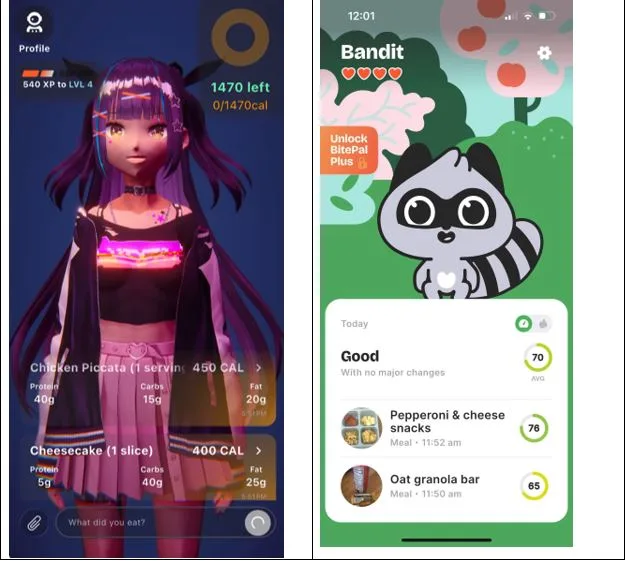
Two apps illustrate where this trend is heading: Coach Ivy and BitePal.
Coach Ivy: A Kawaii AI Nutrition Coach for Gen Z
Coach Ivy is an iPhone calorie tracker built entirely around a character: Ivy, a kawaii AI nutrition coach with an expressive, slightly sassy personality. Log a balanced lunch and Ivy celebrates. Log a junk-food binge and she might react with humor or theatrical disappointment — never shame, but enough emotion to make the moment stick.
The aesthetic choice is deliberate. Coach Ivy targets the demographic most underserved by clinical-looking diet apps: young women and Gen Z users who grew up with anime, Tamagotchi, and character-driven mobile games. For an audience that finds MyFitnessPal-style dashboards sterile, a cute coach who notices and responds is not a gimmick — it’s the entire retention mechanic. Streaks become something you maintain for Ivy, not just for a chart.
The second pillar is friction removal. Meals are visual and tedious to describe by hand, so the app is built around a photo calorie counter: snap a picture, get an instant estimate of calories and macros, and receive personalized feedback from Ivy — a flow that takes seconds rather than minutes of database scrolling.
BitePal: Mascots and Tamagotchi-Style Care
BitePal approaches the same problem from a different angle. Rather than one coach, it uses friendly animal mascots — including a raccoon named Bandit — to deliver conversational feedback. Health scores and the mascot’s mood shift with the user’s choices, turning meal tracking into something closer to caring for a virtual pet than filling out a food diary.
The two apps differ in style but agree on the thesis: when a character visibly responds to what you eat, logging becomes emotionally engaging rather than administrative.
Emotional Design Is a Retention Strategy, Not a Decoration
Wellness apps live or die on daily use. A calorie tracker that nobody opens is just a database with an icon. Character-based AI adds what designers call emotional design: warmth, reactivity, and continuity that lower the psychological cost of showing up every day.
The mechanism is simple. Pass-or-fail dashboards make a bad eating day feel like a failed exam, and failed exams make people quit. A coach that reacts playfully to the same bad day keeps the conversation going — and a conversation is much easier to resume tomorrow than a grade.
What Comes Next
The rise of character-based tracking suggests the next generation of consumer health apps will feel less like utilities and more like relationships. Users don’t believe the character is human; they don’t need to. What the character provides is familiarity, tone, and a reason to return that a bar chart never could.
The most successful nutrition app of the next decade probably won’t be the one with the largest food database. It will be the one people actually want to open — every single day. On current evidence, giving the app a personality is one of the few strategies that reliably gets them to.