AI Coworker in Manufacturing: How Agentic AI is Becoming the Factory Floor Teammate
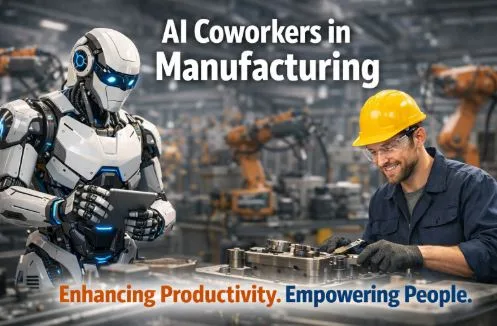
An AI coworker in manufacturing is an agentic AI system that works alongside human operators monitoring equipment, making real-time decisions, adjusting processes, and communicating insights without replacing the human in the loop. Unlike traditional robots that execute fixed tasks, AI coworkers reason, adapt, and collaborate dynamically.
Walk onto a modern factory floor today, and you’ll see something unprecedented: artificial intelligence that doesn’t just automate tasks, it participates. This new generation of agentic AI systems can understand natural language, interpret sensor data, consult maintenance records, recommend actions, and even flag safety concerns, all in real time.
This shift is more than a technological upgrade. It represents a fundamental rethinking of how humans and machines collaborate in industrial environments. The AI coworker isn’t a robot arm replacing a welder; it’s a knowledgeable teammate that makes every worker on the shop floor smarter and faster.
What Is an AI Coworker in Manufacturing?
The term “AI coworker” describes an agentic AI system deployed in a manufacturing context to work with human employees rather than replacing them. These systems are characterized by their ability to:
Reason and Decide: Process multi-source data and make context-aware recommendations or autonomous micro-decisions.
Adapt in Real Time: Adjust recommendations or actions based on live production conditions, not pre-programmed rules.
Communicate Naturally: Interact with workers through plain language via voice, text, or wearable interfaces directly on the floor.
Sense the Environment: Pull data from IoT sensors, cameras, ERP systems, and quality inspection tools simultaneously.
Collaborate, Not Replace: Augment human judgment, especially in edge cases, rather than removing the human from the equation.
Learn Continuously: Improve through ongoing feedback loops from production data and worker interactions.
What makes it “agentic”? Agentic AI can set goals, plan multi-step actions, use tools (like querying a database or triggering a machine adjustment), and operate with a degree of autonomy, all while remaining accountable to a human supervisor. It’s the difference between a chatbot that answers questions and an AI that can actually do things.
AI Coworker vs. Robot: Understanding the Difference in Modern Manufacturing
This is perhaps the most important distinction to understand and the one that most people in manufacturing get wrong. The terms “AI,” “robot,” and “automation” are often used interchangeably, but they describe fundamentally different things with different implications for your workforce, your operations, and your investment strategy.
A robot executes programmed physical tasks with precision and speed. An AI coworker thinks, reasons, communicates, and adapts often without a physical body at all. The robot replaces physical labor; the AI coworker augments cognitive labor.
| Dimension | Traditional Robot / Automation | AI Coworker (Agentic AI) |
| Primary function | Execute defined physical or repetitive tasks | Reason, advise, decide, and collaborate |
| Adaptability | Requires reprogramming for new tasks | Adapts dynamically using real-time data |
| Interaction with humans | Minimal operates in segregated zones | Active communicates via natural language |
| Physical presence | Yes, arms, conveyors, welders, AGVs | Often software-based; embedded in devices or HUDs |
| Handles edge cases? | No, stops or errors on exceptions | Yes, reason through novel situations |
| Worker relationship | Replacement of specific roles | Augmentation of human capability |
| Knowledge base | Task-specific programming | Broad knowledge + domain-specific training |
| Best for | High-volume, repetitive physical tasks | Complex decisions and expertise gaps |
| Can we work together? | Yes, AI coworkers can supervise and coordinate robots |
The Convergence Point: AI-Enabled Robots
It’s worth noting that the line is blurring. The most advanced manufacturing systems today combine both physical robots guided by AI reasoning systems. A collaborative robot (cobot) might perform the physical task while an AI coworker monitors performance, detects anomalies, communicates exceptions to the human operator, and even schedules its own maintenance. This convergence is where the real productivity revolution is happening.
“The question is no longer ‘robots or humans?’ It’s ‘how do we build teams where AI, robots, and humans each contribute what they do best?'” Manufacturing Technology Outlook, 2025
How Agentic AI Works on the Factory Floor
Agentic AI in manufacturing isn’t a single product — it’s an ecosystem of capabilities that work together. Here’s how it plays out across key use cases:
- Predictive Maintenance Co-Pilot: An AI coworker continuously analyzes vibration sensors, thermal readings, and historical failure data. Instead of waiting for a breakdown, it proactively tells a maintenance technician: “Bearing on Line 3 motor shows early-stage wear. Recommend inspection within 48 hours to prevent unplanned downtime.” The technician decides when and how to act.
- Quality Inspection Intelligence: Computer vision systems powered by AI can inspect thousands of parts per minute. But the AI coworker goes further; it correlates defect patterns with upstream process variables, identifies root causes, and suggests process adjustments, communicating its findings in plain language to line supervisors.
- Dynamic Production Scheduling: When a material shipment is delayed or a machine goes offline, a traditional MES system raises an alert and waits. An AI coworker automatically re-sequences the production schedule, identifies alternative material sources in the ERP, and presents a revised plan to the operations manager within minutes.
- Skills and Knowledge Transfer: Experienced technicians retiring takes decades of know-how with them. AI coworkers trained on historical process data, operator logs, and expert interviews can serve as an always-available knowledge base, walking a new worker through complex procedures with contextual, step-by-step guidance.
- Safety Monitoring and Alerts: AI systems analyze real-time camera feeds and IoT data to detect unsafe behaviors or environmental hazards, heat, toxic gas, proximity violations, and alert both the at-risk worker and supervisors immediately, faster than any human observer could.
The Real-World Benefits of AI Coworkers
- 25–40% reduction in unplanned downtime with AI-driven predictive maintenance
- 3× faster onboarding for new technicians with AI knowledge assistance
- 15–30% improvement in first-pass yield rates via AI quality analytics
- 60% reduction in safety incidents reported in AI-monitored facilities
Beyond the numbers, AI coworkers address one of manufacturing’s most persistent problems: the expertise gap. As experienced workers retire and new hires struggle to absorb complex institutional knowledge, AI coworkers can act as institutional memory, available 24/7, impossible to forget, and constantly updated.
Implementation Reality Check: AI coworkers are not plug-and-play. Successful deployments require clean data infrastructure, change management for workers, domain-specific training of AI models, and clear governance around when AI recommendations should be acted on autonomously versus reviewed by humans.
Will AI Coworkers Replace Manufacturing Jobs?
AI coworkers are designed to augment human workers, not eliminate them. Evidence from early deployments shows that AI tools shift workers toward higher-skill, higher-value tasks, but workforce transformation is real and requires active investment in reskilling.
This is the question workers and union representatives ask most often, and it deserves a nuanced, honest answer.
What AI coworkers do eliminate: Repetitive cognitive tasks like manually reviewing sensor logs, writing shift handover notes, or cross-referencing quality data across multiple systems.
What they create demand for: Workers who can interpret AI recommendations, override AI decisions when appropriate, manage AI systems, and apply domain knowledge to situations the AI flags as uncertain.
The workers who thrive alongside AI coworkers tend to be those who develop what researchers call human-AI teaming skills, knowing when to trust the AI, when to question it, and how to communicate effectively with it.
Conclusion: The Factory Floor Has a New Colleague
The narrative around AI in manufacturing has been dominated for too long by fear of replacement. The reality emerging from forward-looking factories is far more interesting: AI is becoming a teammate, one with near-perfect memory, tireless attention to sensor data, and the ability to reason through complex operational problems in real time.
The distinction between AI coworkers and robots matters enormously for strategy. Robots address physical labor; AI coworkers address the cognitive demands of modern manufacturing, the interpretation, the expertise, the judgment calls that experienced workers make dozens of times a day.
For manufacturers, the competitive question is no longer whether to adopt AI; it’s how fast you can build the human-AI teams that will define the factory of the future. The companies that get this right won’t just be more efficient. They’ll be more resilient, more innovative, and more attractive to the next generation of manufacturing talent.
Where to start: Begin with data infrastructure and a single high-impact use case. Prove value, build trust, then scale. The AI coworker revolution isn’t won overnight; it’s built one trusted deployment at a time.
Author Bio:
Anand Subramanian is a technology expert and AI enthusiast, currently leading the marketing function at Intellectyx AI. With over a decade of experience supporting enterprise and government projects, he focuses on advancing data, digital, and agentic AI development services that help organizations innovate and scale.