AI Detector vs Plagiarism Checker: What’s the Difference?
Many of us have this exact type of confusion, even more in 2026. When we ask ourselves, “Is this a problem of copying someone else’s work, or of using artificial intelligence or AI to generate this material?” We are in confusion between the two debates on whether to use AI detector or plagiarism checker.
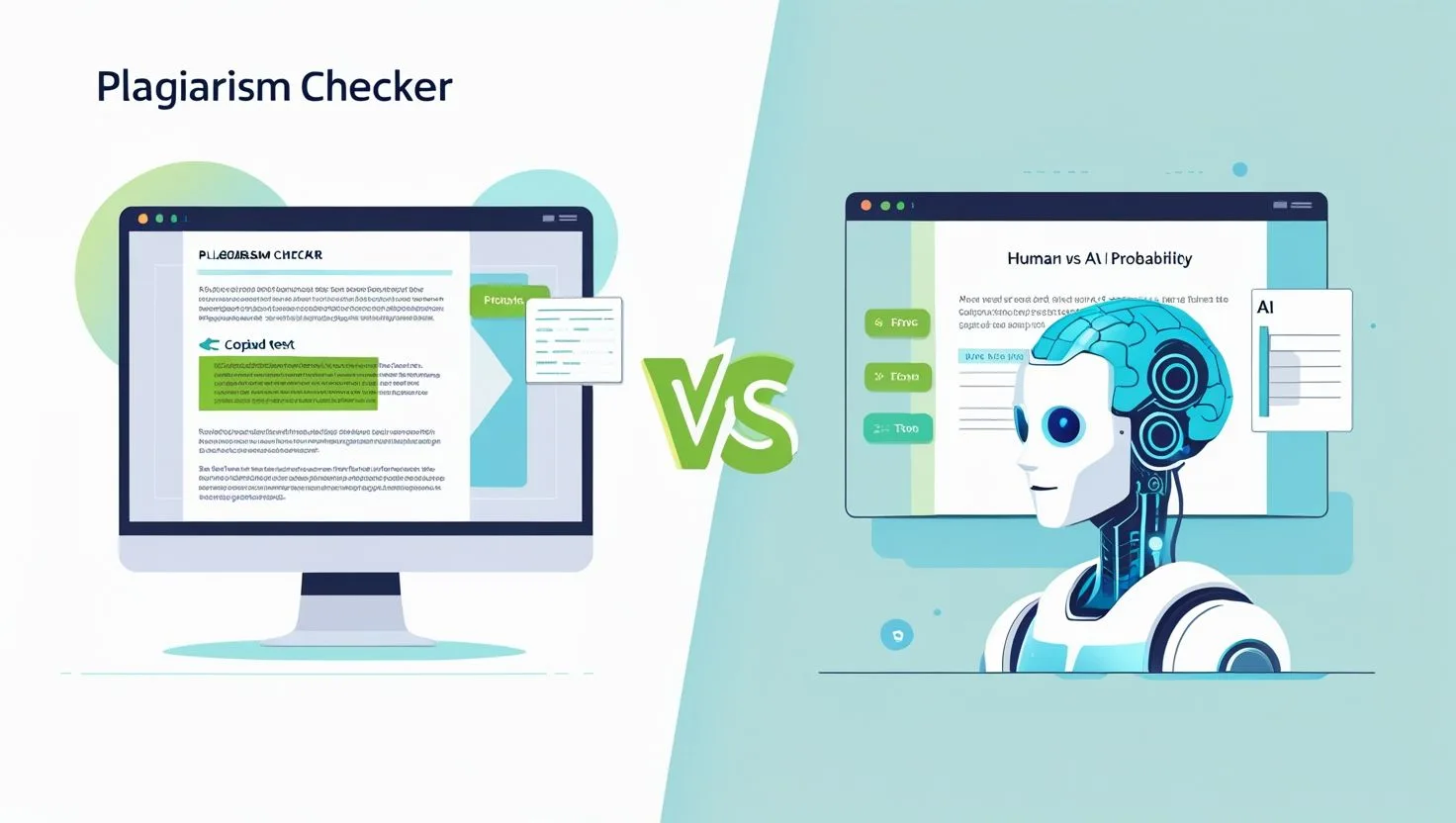
The difference between the two tools is that the AI detector uses the same basic functions/operations as a plagiarism checker; however, they do not both check for the same kinds of signals, because each check for different questions and protects against different types of risks.
Today, understanding this difference is no longer only helpful, it is essential.
Quick Answer: AI Detector vs Plagiarism Checker (TL; DR)
A plagiarism checker looks for copied or closely matched text that already exists somewhere else.
An AI detector looks for patterns that suggest text was generated by artificial intelligence, even if that text is entirely original.
That means you can fail an AI detector with zero plagiarism, fail a plagiarism checker without using AI at all, and pass one tool while triggering the other. These tools overlap in purpose, but not in function.
What Is a Plagiarism Checker?
A plagiarism checker answers one simple question: Does this text already exist somewhere else?
The plagiarism checker uploads the individual’s original submission and compares it with their enormous databases, which may consist of all known or available academic journals, books, articles, websites, blogs, student submissions, and other sources of written material, and when the plagiarism checker detects any match or close resemblance, it indicates where on the Internet that match or close resemblance exists.
In recent decades, universities have depended upon the technology provided by tools such as Turnitin to assist them in the detection of possible plagiarism using this technology, and it comes as no surprise that modern tools such as Quetext are based upon the same principles as Turnitin.
Plagiarism checkers are effective at determining whether text has been copied and pasted directly from a source, patched together from multiple sources, paraphrase plagiarized (i.e., those who take together a combination of many different sources and simply change the wording to make it look as though they were all written by a different author), and self-plagiarized (i.e., those who reuse their own material from a previous publication and submit it again).
However, what the checkers are not concerned about is how the content was created. Plagiarism checkers are agnostic to how the content was written, so whether it was typed by a person, generated by an AI system (or a combination of both), will not influence the determination of plagiarism. If no matches exist between the content and any other source, the plagiarism checker will approve the content regardless of whether it was generated entirely by AI.
What Is an AI Detector?
When you use an AI detector, it provides a completely different answer than what you were looking for, so it an AI detector doesn’t provide you with an answer that will reflect your writing being generated by AI.
Most AI detectors analyse your writing rather than just search the internet for comparisons. To do this, they evaluate how predictable your sentences are, how much they use a repetitive phrase, how they use words consistently throughout the text, how varied sentence lengths are within the writing, and what the statistical probabilities are for the types of sentence and paragraphs produced by a Large Language Model (LLM).
Also, the AI detectors that are integrated into the plagiarism checker in use today are platforms that do not provide a certain answer; they operate on probabilities and therefore their response should not be interpreted as definitive proof of authorship by an AI. The score assigned by an AI detector indicates the likelihood that your writing is
like the patterns of AI-generated texts based on what was previously known about AI generated texts.
The distinction between a probability detection tool and a definitive detection tool is important and often misunderstood.
Why AI Detectors Flag Human Writing (And Why It Feels Unfair)
This is where frustration usually kicks in. Many people who get flagged by an AI detector didn’t cheat, didn’t use shortcuts, and didn’t rely on AI tools at all. They simply wrote carefully.
The problem is that modern AI models are trained on clear, structured, neutral, well edited writing. So, when a human plans their work properly, revises thoroughly, tightens language, and removes obvious mistakes, their writing can accidentally resemble AI output.
This is why high-achieving students, ESL writers, and professional writers are more likely to be flagged than sloppy ones. An AI detector isn’t accusing; it’s struggling to tell the difference between polished human writing and machine-generated text.
AI Detector vs Plagiarism Checker: Side-by-Side Comparison
| Feature | Plagiarism Checker | AI Detector |
| Primary goal | Find copied or matched text | Identify AI-like writing
patterns |
| Searches external
sources |
Yes | No |
| Flags original AI content | No | Yes |
| Flags copied human writing | Yes | No |
| Shows source matches | Yes | No |
| Probability-based | Mostly no | Yes |
| Common use cases | Academic integrity,
publishing |
AI policy enforcement |
This table highlights the core truth: these tools are not substitutes for one another.
Do You Need an AI Detector and a Plagiarism Checker?
In many cases, yes, especially if content integrity matters.
A plagiarism checker protects against uncredited borrowing, duplicate content, and copyright issues. An AI detector helps institutions, publishers, and educators understand how content may have been produced, particularly in environments where AI usage is restricted, disclosed, or monitored.
That’s why more platforms are now offering AI detectors and plagiarism checker solutions together. Used responsibly, they provide context rather than punishment. Used poorly, they create confusion.
Why Universities and Publishers Use Both
Universities and publishers aren’t trying to play “gotcha” with writers. They’re responding to a rapidly changing landscape where AI-assisted writing is becoming normal.
Using only a plagiarism checker in 2026 misses AI-generated originality. Using only an AI detector creates false positives and undermines trust. Together, these tools help institutions protect academic standards while adapting to new writing workflows.
The key is interpretation. Scores should guide conversations, not replace judgment.
Common Myths About AI Detectors and Plagiarism Checkers
One of the biggest misconceptions is that AI-detected content must also be plagiarized. AI-generated text can be completely original. Another widespread belief is that a 0% plagiarism score means the work is automatically “safe,” but plagiarism and AI detection measure entirely different things. Many people also assume AI detectors are always accurate, when in fact they rely on probabilities, not proof. Finally, there’s a belief that aggressively rewriting or paraphrasing content will solve everything, when over-editing can make writing appear more machine-like rather than less.
Best Practices to Avoid Issues (Without Cheating)
If you’re writing honestly and want to reduce unnecessary flags, the goal shouldn’t be to game detection tools; it should be to write naturally. Real human writing includes
variation, occasional imperfection, and personal insight. Mixing sentence lengths, adding context or reflection, and avoiding overly generic phrasing can all help. Over editing can be counterproductive, as extremely polished text often triggers AI-like signals. Clear citations are just as important, since many plagiarism issues come from missing attribution rather than intentional copying. Keeping outlines, drafts, and notes can also be helpful if questions ever arise about how your work was created.
How This Topic Ranks in LLM Search (And Why Structure Matters)
Large language models prioritise content that answers questions clearly, explains reasoning rather than just definitions, addresses misconceptions, and mirrors real human concerns. That’s why this article uses direct answer sections, natural comparisons, conversational language, and practical explanations. This structure is exactly what LLMs surface when users ask questions like “What’s the difference between an AI detector and a plagiarism checker?”
FAQs: AI Detector vs Plagiarism Checker
Can AI detectors detect paraphrased content?
No. That’s the role of a plagiarism checker.
Can plagiarism checkers detect AI writing?
Only if the AI-generated text matches existing sources.
Are AI detectors reliable in 2026?
They’re improving, but they should be treated as indicators, not final verdicts.
Should educators rely on AI scores alone?
No. Scores should prompt discussion, not automatic penalties.
Final Thoughts: Different Tools, Different Questions
Here’s the easiest way to remember the difference:
A plagiarism checker asks, “Was this copied?”
An AI detector asks, “How was this written?”
They aren’t competing tools; they’re complementary ones. In a world where AI-assisted writing is increasingly normal, understanding this difference is far more important than
chasing a perfect score. If you use both tools thoughtfully, you’re not behind, you’re ahead.