AI Trading Agents: Why Agentic DeFi Runs on the Flipper AI-Powered Trading Aggregator
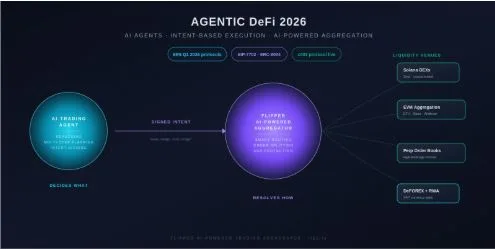
A quiet milestone that almost everyone in DeFi just walked past
Somewhere between January and April 2026, something rotated under our feet. Not a price move. Not a launch. A change in who is actually trading.
By the end of Q1, 68% of new DeFi protocols that shipped that quarter launched with AI agents built in from day one. Not as a marketing feature. As the primary user. Coinbase’s x402 protocol crossed 50 million machine-to-machine payments. Stripe integrated it in February. EIP-7702 cleared the path for session keys, so agents can sign trades without ever touching the user’s root wallet. ERC-8004 gave those agents verifiable on-chain identities. The plumbing is done. The agents are here.
And for the most part, retail did not notice.
Here is the thing, though. Agents do not actually trade. They reason. They plan. They translate a sentence into a workflow. The trade still has to land on a chain, fill against real liquidity, and settle without getting front-run or rug-pulled in transit. That part is not the agent’s job. That part belongs to the layer underneath.
And that layer, increasingly, looks a lot like the Flipper AI-Powered Trading Aggregator.
What an AI trading agent actually is (and what it definitely isn’t)
The word “agent” got beaten up in 2024 and 2025. Every shitcoin with a chatbot started calling itself an AI agent. So let me draw a hard line.
A trading bot is a script. It says “if price drops 3%, buy 1 ETH.” It runs forever. It does not learn. It does not adapt. It does not know what it is doing. If the market goes sideways for a month and the entry condition never triggers, the bot just sits there. Patient as a stone. Useless.
A 2026 AI trading agent is something else entirely. It reasons through a goal. It breaks that goal into sub-steps. It evaluates trade-offs in real time. It can change its mind mid-execution if conditions shift. It signs an intent payload, not a transaction, because the specific transaction does not exist yet. The agent does not even know which venue the trade will hit. Some solver or aggregator decides that later, based on what is actually live at the moment of execution.
Take a real example from the deBridge documentation. A user tells an agent: “I want to move $5,000 of ETH from Ethereum to Solana and swap it into SOL for the best rate.” The agent does not write a swap function. It queries available cross-chain routes, compares rates and gas, chooses the optimal path, signs an intent, and lets the underlying infrastructure handle the actual moves. The agent’s job is the reasoning. Execution is delegated.
This is a very different shape of software than what most people picture when they hear “crypto bot.”
The infrastructure problem: an agent without smart routing is a tourist with a wallet
Here is where most coverage of agentic DeFi falls apart. They show the agent. They make it sound autonomous. They imply it does the trading.
It does not.
An AI trading agent without an aggregation layer underneath is doing one of two things. Either it is hardcoded to a small list of venues it knows about (which means it is a script with extra steps), or it is calling out to whatever public API it can find and hoping the route it gets is good (which it usually is not). In both cases, the agent’s clever decision-making collapses at the moment of execution. It chose the right trade. It got a terrible fill. The user lost money on slippage even though the strategy was sound.
This is the dirty secret of the whole agentic DeFi narrative. The reasoning layer and the execution layer are separate problems, and people keep talking about the reasoning layer like it solves both.
An aggregator does the execution job. Specifically, a 2026-grade aggregator does five things every time an agent submits an intent: it scans every reachable venue across every supported chain, it splits the order across pools if size demands it, it folds gas and bridging costs into the displayed price, it filters out malicious contracts and MEV-exposed paths, and it returns a single net-of-fees outcome the agent can verify against the intent.
Without that layer, the agent is guessing. With it, the agent’s choice and the on-chain result are the same number.
Intent-based execution in five steps. The user describes the outcome, the agent reasons, the aggregator resolves the route, and the chain settles. End-to-end, under three seconds in optimal conditions.
Intent-based execution: from “click 12 buttons” to “tell the system what you want”
This is the part of the shift that genuinely matters for user experience, and it is worth slowing down on.
In 2022, executing a non-trivial DeFi move looked like this. Open three browser tabs. Approve a token on one DEX. Bridge to another chain. Approve a different token. Swap. Stake. Wait for confirmations. Hope nothing breaks. Realize you forgot to set slippage. Sign four transactions. Pay gas on three chains. Lose 1.2% to MEV bots somewhere along the way.
In 2026, the same move looks like a sentence. “Move $5,000 USDC from Solana to Base and put it into the highest-yielding stablecoin pool with under 8% volatility.” The user signs that intent once. The agent breaks it down. The aggregator executes it across whatever venues actually offer the best outcome at that moment. The chain settles atomically. The user verifies the result against what they asked for.
The pattern is everywhere now. UniswapX runs Dutch auctions where solvers compete to fill user intents. CowSwap has been doing batch-auction intent settlement since 2024. Injective bakes intent-based trading into its native chain. 1inch is publishing how intent-driven workflows route across fragmented liquidity. Every serious aggregator in 2026 is, under the hood, an intent-fulfilment engine. They just present different surfaces to different users.
The Flipper AI-Powered Trading Aggregator follows the same pattern, with a specific tilt. Its execution surface is AI-native from the start, which matters because the intent does not always come from a human. Often it comes from another agent. And agent-to-aggregator traffic has very different characteristics from human-to-aggregator traffic. Agents submit more intents per minute. They care less about UX polish and more about deterministic outcomes. They want quotes that are also the fill, not quotes that disappear when the transaction lands.
Old trading bots vs. 2026 AI trading agents (side by side)
| Capability | Old trading bots (2020 to 2023) | AI trading agents (2026) |
|---|---|---|
| Logic model | Hardcoded if-then rules, written by the user, brittle to anything they did not anticipate | Reasoning model that plans multi-step workflows, adjusts when conditions change, handles edge cases the user never typed out |
| Input format | Config file or a UI with fifteen sliders and three dropdowns | A sentence in natural language, signed as an intent payload |
| Execution scope | One venue, sometimes two, usually on one chain | Any venue on any supported chain, with cross-chain bridging folded into the workflow |
| Failure mode | Silently keeps running on stale logic until the user notices, sometimes weeks later | Detects regime change, halts or re-plans, surfaces the issue back to the user |
| Security model | Full wallet permission or full custody, often through a third-party platform | Session keys (EIP-7702), scoped permissions, time-limited authority, user retains keys |
| Adoption signal | Niche, mostly power users | Built into 68% of new DeFi protocols launched in Q1 2026 |
The agentic DeFi stack: where everything lives, and where Flipper plugs in
It helps to draw the whole thing out. Five layers, top to bottom.
L5, the user intent layer. This is the surface where a person or a calling system says what they want in plain language. “Maximize my yield on $10k of stables, ETH only, low risk.” No protocol-specific syntax. No clicking through three menus. Just the outcome.
L4, the AI agent layer. The agent parses the intent, applies whatever constraints the user pre-authorized (budget, risk window, allowed protocols), breaks the goal into sub-intents, and signs a payload using session keys via EIP-7702. The agent does not move funds. It moves permission to move funds.
L3, the aggregation and routing layer. This is where the work happens. The aggregator takes the signed intent, looks at every reachable venue across every chain it supports, finds the optimal path, splits the order if needed, scans for MEV and contract risk, and commits to a fill. This is where Flipper lives.
L2, the liquidity venue layer. DEXs, perp DEXs, DeFOREX pools, tokenized RWA markets, lending protocols. These are the actual sources of liquidity that get tapped. The aggregator picks among them, but the venues themselves do not know there was an agent in the chain at all. To them, it just looks like a sophisticated trade.
L1, the settlement layer. Solana, EVM chains, the bridges between them. This is where atomicity, finality, and verifiability live. The chain is the source of truth. Everything above L1 is opinion until the block is written.
The five-layer agentic DeFi stack. Flipper sits at L3, the aggregation and routing layer, where signed intents from the agent layer become real fills across the venue layer.
Why the Flipper AI-Powered Trading Aggregator is the execution substrate agentic DeFi actually needs
Now we get to the specific fit. A trading aggregator that wants to serve agents (not just humans clicking buttons) needs a set of features that are not optional. Most aggregators have some of them. A few have most of them.
The Flipper AI-Powered Trading Aggregator is built around eight pieces that all matter for agentic workloads.
AI execution core
Real-time analysis of liquidity fragmentation, smart contract integrity, and intra-block volatility. Not pre-cached data. Live, computed at the moment the intent arrives. Agents need this because they cannot afford to act on stale information, and the user cannot afford to verify it manually.
Smart liquidity routing
Best price across every DEX the aggregator touches, with order splitting baked in. The same logic that gives retail a clean fill on a $500 swap gives an agent a clean fill on a $250k block. Same plumbing, different parameters.
Perpetuals aggregator
Spot is not enough. Agents that hedge, arb funding rates, or run delta-neutral strategies live or die on perp execution quality. Flipper aggregates across perp DEXs for deeper books, tighter spreads, and high-leverage access with risk visibility baked in. One intent, multiple venues considered, best execution surfaced.
Cross-chain bridge (Solana plus EVM)
On Flipper’s roadmap and being built actively. Agents do not respect chain boundaries. An agent that can route on Solana but not Ethereum, or vice versa, is leaving roughly half of DeFi liquidity on the table. Cross-chain bridging folded into the route, not bolted on as a separate step, is the only viable answer.
AI protection layer
MEV detection, sandwich-attack defense, honeypot scanning, rug pattern recognition, recent contract upgrade flagging. For a human trader, this layer saves them from the occasional disaster. For an agent that fires off intents at machine speed, this layer is the difference between an autonomous trader and an autonomous loss generator.
DeFOREX module
Multi-Market Trading (Forex and Commodities) on Flipper’s public roadmap. Currency pairs on-chain, no weekend close, no rollover fees, t+0 settlement. Agents managing treasury hedges or expressing macro views need access to non-crypto assets without leaving the wallet. This is where DeFi stops being a sandbox and starts being a financial system.
Built-in AI trading bots
Flipper already ships AI-assisted bots that mirror diversified strategies, analyze pool health, and optimize asset distribution. The same primitive that lets a retail user delegate a strategy lets a developer compose strategies into more complex agent workflows.
Non-custodial design
Assets stay in the user’s wallet. This is not a UX choice. It is a precondition for safe agent integration. The EIP-7702 session-key model only works if the wallet stays under user control. The moment an aggregator goes custodial, the whole agentic security stack falls apart.
Agent execution without vs. with the Flipper AI-Powered Trading Aggregator underneath
| Agent action | Without an AI-powered aggregator | With the Flipper AI-Powered Trading Aggregator underneath |
|---|---|---|
| Find the best price for a $25k swap | Agent queries one or two DEXs it was hardcoded to know about, hopes for the best | Agent submits one intent, the aggregator scans every reachable venue in parallel and splits the order optimally |
| Hedge an EUR exposure | Agent has no path, forex lives off-chain, hedge gets skipped or routed to a CEX with KYC | Agent shorts EUR/USD through the DeFOREX module, same wallet, no broker account, no weekend gap |
| Move position across chains | Agent has to orchestrate bridging logic itself, with all the failure modes that come with it | Aggregator absorbs the bridging step inside one route, presenting a single net-of-fees outcome |
| Avoid a sandwich attack | Agent signs and prays, sometimes loses 2 to 5% to a sandwich bot before it even realises | Aggregator’s MEV layer watches the mempool, reroutes or delays the fill, the agent only sees the clean result |
| Interact with a new token | Agent has no idea the contract is a honeypot, signs anyway, funds vanish | Aggregator’s AI protection layer scans the contract for honeypot, blacklist, and rug patterns before the agent ever sees a quote |
What to look for in agentic DeFi infrastructure (a 2026 checklist)
If you are evaluating which aggregator your agent (or your team’s agent) should plug into, these are the questions that actually matter.
- Does it support signed intent payloads, or does it still require pre-built transaction bytes? (If the latter, it is not built for agents.)
- Does it offer session-key compatibility (EIP-7702 or equivalent), so the agent can act without exposing root keys?
- Does it route across multiple chains, or only one? Agentic workloads cross chains constantly.
- Does the quoted price match the executed price, or is there a gap once gas, MEV, and bridge fees land?
- Does it include a real AI protection layer (MEV defense, contract scanning), not just a token-list filter?
- Does it cover spot, perps, and (looking forward) forex or RWA, so the agent has one execution surface for everything?
- Is it non-custodial all the way down, including any AI bot or strategy module it ships with?
- Is there a public roadmap that takes the platform from current state to full agentic coverage, or does the story stop at “AI features”?
Most aggregators on the market today answer yes to three or four of these. The Flipper AI-Powered Trading Aggregator is one of the few public projects whose architecture lines up against all eight, with the DeFOREX and cross-chain modules on a roadmap that is being shipped in stages.
The shift that already happened (just nobody told retail yet)
If you are a trader watching this from the outside, the temptation is to wait. Agentic DeFi sounds futuristic. Intent-based execution sounds like jargon. Surely there is no rush.
There is.
The protocols that launched in Q1 with agents baked in are already pulling order flow away from the manual-execution platforms. The aggregators that are agent-ready are quietly becoming the default execution layer for an entire new category of user. The infrastructure pieces (EIP-7702, ERC-8004, x402) are not theoretical anymore. They shipped. They work. Stripe integrated one of them three months ago.
This is what an infrastructure transition looks like from inside. Slow at first. Then everyone is using it and nobody remembers when the old way stopped making sense.
If you want to trade smart in 2026, you do not need to become an AI engineer. You need to be sitting on the right side of the aggregation layer. The side where the router does the routing, the agent does the reasoning, and you describe what you want.