AIEnhancer AI room design: Rethinking Interior Spaces with Adaptive Intelligence
Designing a room often begins with a feeling rather than a plan. You know what you want to change, but not always how it should look. Digital tools promise clarity, yet many still feel rigid or overly technical. This is where a more adaptive, image-first approach starts to feel less like software and more like collaboration.
Why Visual-First Design Is Changing Interior Planning
From Static Mood Boards to Living Concepts
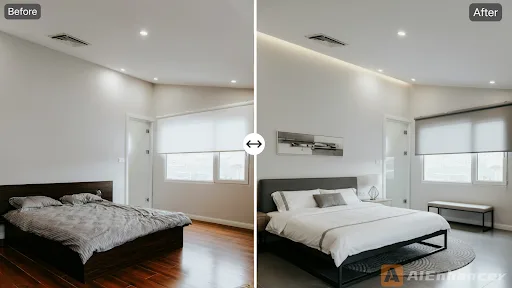
Interior planning used to rely on references pulled from everywhere—magazines, screenshots, saved posts—stitched together into something that only hinted at the final result. The shift toward visual-first systems means a single image can now become the foundation of an entire concept. When you upload a real room photo into an intelligent system, the space itself becomes the brief. This is where the first real interaction with AI room design changes expectations, because the output responds to what already exists rather than replacing it with abstraction.
Interpreting Space Instead of Replacing It
What makes this approach compelling is interpretation. Walls, windows, proportions, and light conditions are not ignored or flattened. They are read, sometimes imperfectly, but often in ways that spark new ideas. AIEnhancer focuses on preserving spatial logic while exploring stylistic possibilities, so the room still feels like your room—just reframed.
Faster Decisions Without Creative Shortcuts
Speed is often misunderstood as superficiality. In practice, faster iteration can lead to more thoughtful decisions. When a concept is generated in seconds, you are free to reject it, adjust your taste, or push further. AI room design in this context doesn’t compress creativity; it gives it room to breathe by removing friction.
Exploring Interior Styles Through AIEnhancer
Modern Interiors That Respect Simplicity
Modern design thrives on balance, not emptiness. Clean lines and restrained palettes only work when proportions feel right. AIEnhancer’s Modern style outputs tend to focus on spatial clarity, reducing visual noise while keeping the room grounded. This is often where AI room design feels most intuitive, because minimal adjustments create noticeable impact.
Industrial Spaces with Realistic Texture
Industrial style lives or dies by texture. Exposed concrete that feels flat misses the point entirely. By analyzing depth, shadow, and surface variation, AIEnhancer generates interiors that feel tactile, even through a screen. In these cases, AI room design becomes less about decoration and more about atmosphere.
Minimalist Rooms That Still Feel Lived-In
Minimalism is often misread as cold. The challenge is introducing restraint without erasing warmth. AIEnhancer approaches this by softening transitions—edges are less harsh, light feels more diffuse. For users experimenting with AI room design, this style often becomes a lesson in subtraction rather than addition.
Rustic and Scandinavian Styles Rooted in Light
Rustic and Scandinavian aesthetics share an appreciation for natural materials, though they express it differently. AIEnhancer handles both by prioritizing light behavior and material tone. Wood grains, fabric softness, and subtle imperfections are emphasized, giving AI room design outputs a slightly human irregularity that feels intentional.
Bohemian Expression Without Visual Chaos
Bohemian interiors can quickly feel overwhelming if not carefully balanced. By anchoring the composition around existing architectural elements, AIEnhancer allows color and pattern to emerge without overtaking the space. This is one of those moments where AI room design feels exploratory, even playful, without losing coherence.
Beyond Interiors: A Broader Design Perspective
Extending Concepts to Exterior Visualization
While interiors are often the starting point, many users think holistically about a property. Under this broader lens, AIEnhancer also connects interior experimentation with exterior concepts, allowing continuity between inside and out. In this context, the platform’s approach to house design becomes a natural extension rather than a separate tool, especially when visual consistency matters.
Consistency Across Different Rooms
One overlooked advantage of AI-assisted workflows is consistency. When multiple rooms are generated using the same underlying logic, the home begins to feel intentional rather than piecemeal. AI room design supports this by learning from each image rather than treating every room as an isolated case.
Adapting Designs for Real Constraints
No room exists in a vacuum. Budget, structural limits, and existing furniture all matter. While AIEnhancer doesn’t replace professional judgment, its outputs often reveal what is flexible and what is not. AI room design here becomes a conversation starter, not a final answer.
Practical Use Cases for Professionals and Homeowners
Early-Stage Concepting for Designers
For interior designers, early concepts often consume disproportionate time. AIEnhancer shortens this phase without flattening creativity. Designers can test directions quickly, discard what doesn’t resonate, and refine what does. AI room design in this workflow supports intuition rather than overriding it.
Decision Support for Homeowners
Homeowners rarely struggle with ideas; they struggle with confidence. Seeing multiple stylistic interpretations of the same room can clarify preferences surprisingly fast. AI room design helps turn vague feelings into visible choices, even if the final execution evolves later.
Real Estate and Presentation Scenarios
In real estate contexts, empty or outdated rooms can be hard to sell emotionally. AI-generated interiors provide a plausible future without heavy staging costs. Here, AI room design acts as a bridge between imagination and commitment.
The Long-Term Role of AI in Spatial Creativity
Collaboration Rather Than Automation
The fear around automation often misses a subtle truth. Tools like AIEnhancer don’t remove the human from design; they shift where human input matters most. Taste, judgment, and restraint still belong to the user. AI room design simply accelerates the feedback loop.
Learning Through Iteration
Each generated image teaches something, even when it misses the mark. Over time, users develop sharper preferences and a clearer design language. This learning effect is an understated benefit of AI room design that goes beyond visual output.
A More Accessible Design Future
Professional-quality visualization was once gated by skill and software access. As tools like AIEnhancer mature, that barrier continues to lower. AI room design becomes not just a feature, but a gateway—inviting more people into thoughtful, visually literate spaces.
In the end, interior design remains deeply personal. Technology doesn’t change that; it simply offers new ways to see what might already be possible. AIEnhancer positions itself in that in-between space—where imagination meets structure, and where AI room design feels less like a trend and more like a practical evolution.