Alternative Business Financing: The Complete Guide to Non-Bank Funding
Why alternative business financing matters now
Alternative business financing is any business funding that comes from outside a traditional bank. It covers merchant cash advances, revenue-based financing, equipment financing, invoice factoring, online term loans, lines of credit and asset-based lending. For many small and mid-sized businesses, it is the fastest realistic route to working capital.
The reason is simple. Banks lend against strong credit, years of tax returns, collateral and a long approval process. A restaurant that needs a new walk-in cooler this week, or a trucking company waiting on 60-day invoices, rarely fits that box. Alternative funders underwrite differently. They look at real bank deposits, daily card sales and the health of the business today.
That speed and flexibility come with trade-offs. Costs are usually higher than bank loans, terms are shorter, and the industry has its share of bad actors. This guide explains every major product, what it really costs, how to pick the right one, and how MCA Directory helps business owners reach qualified lenders and reputable brokers without walking into a scam.
What counts as alternative business financing?
The term describes who provides the money and how they decide, more than the product itself. Alternative funders include online lenders, merchant cash advance companies, factoring firms, equipment finance companies, asset-based lenders and private credit funds.
Three features set them apart from banks:
- Underwriting on cash flow. Most funders read three to six months of bank statements and focus on monthly revenue, average daily balance and negative days. Credit score matters, but it rarely decides the deal on its own.
- Speed. Approvals can arrive in hours and funding in one to three business days, against weeks or months at a bank.
- Flexible structures. Repayment can be daily, weekly or monthly. It can be fixed, or tied to a share of sales. Some products are not loans at all. A merchant cash advance, for example, is a purchase of future receivables.
Many business owners do not deal with funders directly. They work with an independent broker, often called an ISO (independent sales organization). The broker shops the file to several funders and returns with offers. A good broker saves time and finds better terms. A bad one adds hidden fees or pushes the wrong product. Much of this guide is about telling the two apart.
Why business owners look beyond the bank
Bank lending to small businesses has tightened in many periods, and even in good years banks prefer larger, older, highly profitable borrowers. Owners turn to alternative business loans for a handful of recurring reasons.
Time-sensitive opportunities. A supplier offers a bulk discount that expires Friday. A competitor’s location comes up for lease. Payroll lands before a large customer pays. Waiting six weeks for a bank decision means missing the opportunity entirely.
Imperfect credit. A rough year during the pandemic, a medical emergency or a past default can drag a personal score below bank minimums. Many alternative funders work with scores in the 500s, and some have no minimum at all if revenue is strong and consistent.
Limited time in business. Banks often want two or more years of history. Several alternative products open up after six to twelve months of steady deposits.
Seasonal or uneven revenue. Landscapers, retailers, tourism businesses and contractors earn unevenly. Products that flex with sales fit them better than a fixed monthly payment.
Industries banks avoid. Cannabis, trucking, auto sales and some professional services struggle to get bank credit. Specialist alternative funders build entire programs around these verticals.
No collateral to pledge. Many alternative products are unsecured, or rely on a UCC lien on business assets and a personal guarantee rather than real estate.
None of this makes alternative financing better than a bank loan. When a business qualifies for an SBA loan or a bank line of credit, that is usually the cheaper option. Alternative financing earns its place when speed, access or flexibility matter more than the lowest possible rate, and when the owner understands the true cost before signing.
The main alternative business loan products, explained
Each product solves a different problem. Matching the product to the need is the single biggest factor in whether financing helps or hurts the business.
Merchant cash advance (MCA)
A merchant cash advance gives the business a lump sum in exchange for a fixed amount of its future receivables. The funder applies a factor rate, often between about 1.2 and 1.5, to set the total payback. A $50,000 advance at a 1.35 factor rate means $67,500 is remitted over the term, usually by daily or weekly ACH debits.
Because an MCA is a purchase rather than a loan, it is underwritten mainly on deposits. It suits businesses with strong, regular revenue that need money fast and cannot qualify elsewhere. It is also among the most expensive forms of funding when converted to an annual rate, so it works best for short-term needs with a clear return. Article 2 in this series covers MCAs in depth.
Revenue-based financing
Revenue-based financing (RBF) is a close cousin of the MCA. Repayment is a fixed percentage of monthly revenue until a set cap is reached. Payments shrink in slow months and grow in busy ones. It is popular with e-commerce and subscription businesses whose revenue data is easy to verify.
Online term loans
Online lenders offer short and medium term loans, often from six months to five years, with fixed payments. Rates sit between bank loans and MCAs. Approval still leans on cash flow, but most want fair to good credit and at least a year in business.
Business lines of credit
A line of credit lets the business draw funds as needed and pay interest only on what it uses. It is ideal for covering gaps between payables and receivables. Alternative lines are smaller than bank lines and often reprice every draw, but they can be opened in days.
Equipment financing
The equipment itself secures the loan or lease, so approval is easier and rates are lower than unsecured products. Trucks, ovens, medical devices, construction machinery and IT hardware are all common. Terms usually match the useful life of the asset.
Invoice factoring and invoice financing
Businesses that bill other businesses can sell unpaid invoices to a factor for an advance of most of their face value, with the balance, minus a fee, paid when the customer pays. Staffing firms, trucking companies and wholesalers rely on factoring. The customer’s credit matters more than the owner’s.
Asset-based lending
Asset-based lenders lend against receivables, inventory, equipment or real estate. Facilities can be large, and some asset-based lenders are flexible on credit and past defaults because the collateral carries the risk. Repayment is typically monthly.
Reverse consolidation
A reverse consolidation is designed for businesses carrying several merchant cash advances at once. Rather than paying off the existing advances in one lump, the new funder makes the daily or weekly payments on them over time and collects a single, lower, longer payment from the business. It can ease cash flow, but it is still costly, and the terms deserve careful review.
SBA loans
SBA 7(a) and 504 loans are bank loans partly guaranteed by the U.S. Small Business Administration. They are not alternative financing, but they belong in any comparison because they are usually the cheapest option for a business that qualifies. Expect more paperwork and a longer wait.
Alternative financing options compared
| Product | Typical speed | Relative cost | Credit focus | Best fit |
| Merchant cash advance | 1–3 days | Highest | Low; deposits matter most | Urgent needs, strong card or bank deposits |
| Revenue-based financing | Days | High | Low to moderate | E-commerce and subscription revenue |
| Online term loan | Days to 2 weeks | Moderate to high | Moderate | Planned projects with steady cash flow |
| Line of credit | Days | Moderate | Moderate | Recurring cash-flow gaps |
| Equipment financing | Days to 2 weeks | Low to moderate | Moderate; asset secures it | Buying vehicles, machinery, tools |
| Invoice factoring | Days | Moderate | Your customer’s credit | B2B firms waiting on invoices |
| Asset-based lending | Weeks | Moderate | Collateral-led | Larger firms with receivables or inventory |
| Reverse consolidation | Days | High | Low to moderate | Businesses with several MCA positions |
| SBA loan | Weeks to months | Lowest | High | Qualified, established businesses |
Cost and speed vary widely by funder, industry and the strength of the file, so treat this table as a starting point for questions, not a quote.
How to read the true cost of alternative financing
Alternative funders quote costs in different ways, which makes comparison hard. Ask every funder or broker for the same four numbers in writing:
- The amount you will actually receive after any origination, underwriting or broker fees are deducted.
- The total payback over the life of the deal.
- The payment amount and frequency, whether daily, weekly or monthly.
- The expected term, so you can estimate an annualized cost.
California, New York and a growing list of other states now require many commercial financing providers to disclose an estimated annual percentage rate or similar figures. Even where it is not required, a reputable funder or broker will explain these numbers plainly. If anyone refuses, or tells you not to worry about the math, treat that as a warning.
The free underwriting calculator and the MCA glossary on MCA Directory are useful here. They let an owner check a factor rate, payback and term against what a broker is quoting before signing.
Choosing the right path: a five-step framework
Before you speak to any funder or broker, answer five questions honestly. They narrow the field quickly and protect you from being sold the wrong product.
- What exactly is the money for? Inventory that sells in 60 days suits a short advance. A machine that earns for seven years suits equipment financing. Long-term needs paid with short-term money is the most common way businesses get into trouble.
- How will the financing pay for itself? Estimate the extra profit or savings the money produces and compare it with the total cost of funds. If the numbers do not work on paper, they will not work in the bank account.
- What payment can the business carry? Look at your slowest month, not your best. A daily debit that is comfortable in December can be painful in February.
- What do you already owe? Existing advances, loans and liens affect what you qualify for. Funders call each open MCA a “position,” and many limit how many they will accept.
- How fast do you really need it? If you can wait a few weeks, cheaper options such as an SBA loan, a bank line or equipment financing may be open to you.
With those answers in hand, you can tell a broker exactly what you need, and judge whether the offers you receive actually fit.
Where MCA Directory fits in
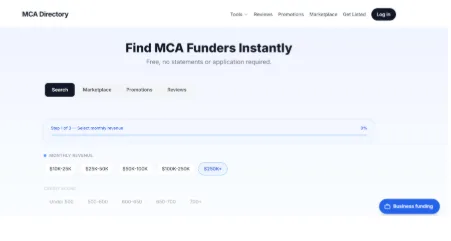
MCA Directory is a centralized platform for the alternative funding industry. It lists merchant cash advance funders and other alternative lenders alongside their real underwriting criteria: minimum monthly revenue, credit score requirements, how many existing positions they accept, whether they consider past defaults, payment frequency, maximum term and maximum funding amount.
The platform is built mainly for brokers and funders, and it is free for brokers. A broker can enter a business’s revenue, credit score, open positions and industry and see every funder whose buy box fits, instead of guessing or sending the same file to dozens of companies. Funders that pass MCA Directory’s vetting earn a verified badge and appear first in search results, and brokers can request a warm introduction straight to a verified funder’s ISO representative.
For business owners, the value shows up in three ways:
- Better matching. When your broker uses the directory, your file goes to funders that actually fund your revenue level, credit profile and industry. Fewer declines mean fewer credit pulls and less of your financial data spread around.
- Independent education. The What is a merchant cash advance? guide, the glossary, the underwriting calculator and the industry pages explain the products in plain language, so you can follow the conversation with any broker.
- Accountability. Brokers review funders and funders review broker shops on the reviews page. Each review needs a company email and supporting documents, the team checks it before it publishes, and the reviewed company can reply.
Proof of real funding: the FundedUSA Instagram page
One question every business owner asks is simple: does this company actually fund deals? Alongside the directory, the FundedUSA Instagram page, @fundedusa, posts confirmations of businesses that have been funded through reliable lenders and brokers. For an owner deciding who to trust, that public record of completed deals works as proof of work.
Use it the way you would use any reference. Check whether the broker or funder you are speaking with appears there, and whether the funded businesses look like yours in size and industry. Then confirm the rest through the directory, its reviews and your own questions. No single source should be the whole basis for a decision.
Avoiding scams in alternative business financing
The growth of alternative business financing has attracted fraudsters who advertise money they never intend to deliver. The most common play is the advance-fee scam: a fast approval with attractive terms, followed by a request for a security deposit, insurance payment or release fee before funding, usually by wire, Zelle, crypto or cashier’s check.
Remember one rule. No legitimate merchant cash advance requires you to send money before you have a signed agreement and the funds are in your account. Real origination or underwriting costs are deducted from the amount funded or built into the payback.
How MCA Directory fights business loan scams
Scams thrive on an information gap. When an owner cannot easily check who a company is, what real funders offer, or what other people have experienced, a fake approval looks no different from a real one. MCA Directory was built to close that gap, and it takes an active stand against business loan scams in four ways.
It makes legitimate capital easy to find. Every funder listing shows real underwriting criteria, and verified funders are hand-vetted and confirmed to be actively funding. When brokers can reach real, active funders in seconds, there is less room for a shell company to step in with a too-good-to-be-true offer.
It makes bad behavior visible. Brokers review funders and funders review broker shops, with company emails and supporting documents required and every review checked before it publishes. Unauthorized fees, broken promises and unpaid commissions stop being private grievances and become a record the whole industry can see.
It teaches the warning signs. The fraud prevention page explains the advance-fee scam step by step and lists red flags for owners, brokers and funders alike, so every side of a deal knows what to watch for.
It gives victims somewhere to turn. A private reporting channel lets owners describe what happened without fear of being exposed, and helps the team track which schemes are spreading. Combined with public proof of funded deals on FundedUSA, these tools give owners a far safer starting point than a search ad or a cold call.
If a company has already taken money from you, call your bank immediately about a wire recall or chargeback, report it to the FTC and the FBI’s IC3, and keep every message and receipt. Then tell MCA Directory through its fraud reporting page. Reports are private by default, reporters are never identified to the company, and they help the team spot patterns spreading through the industry. Article 4 covers the process in full.
Frequently asked questions
What is the easiest alternative business financing to qualify for?
Merchant cash advances and revenue-based financing usually have the most flexible requirements because they are underwritten on deposits. That flexibility comes at a higher cost, so compare the total payback carefully.
Can I get alternative business loans with bad credit?
Often, yes. Many MCA funders have no minimum credit score if revenue is strong and consistent. Expect higher costs and shorter terms than a borrower with good credit.
How fast can alternative financing fund?
Many merchant cash advance and online lenders fund within one to three business days once documents are complete. Equipment and asset-based deals usually take longer.
Do business owners use MCA Directory directly?
The search tools are designed for brokers and funders, so most owners benefit when their broker uses them. Owners use MCA Directory’s guides, calculator, reviews and fraud reporting directly.
The bottom line
Alternative business financing can keep a sound business moving when a bank cannot. Choose the product that matches the purpose, insist on clear numbers, verify who you are dealing with, and never pay to get funded. A reputable broker who matches your file through MCA Directory is one of the safest ways to reach qualified lenders. Start your research at mcadirectory.io.