Alternatives to Oracle Primavera P6 When the Contract Still Requires an XER File
You still have to deliver a contract-ready XER file, but desktop Oracle Primavera P6 no longer gives you the portfolio visibility you need. The good news: eight Primavera P6 alternatives now export the exact XER your spec demands, without trapping you in legacy software. In this guide, we compare each option from an owner’s perspective, show how it meets the clause, and flag the cost, risk, or field insight it adds so you can choose with confidence.
An XER requirement isn’t always a P6-only requirement.
Before you choose a toolset, read the clause word for word.
- If the spec says “develop the schedule in Oracle Primavera P6,” stay in P6 or secure formal written approval for another platform.
- If it simply requires “an XER file the owner can import,” you may choose any scheduler that round-trips a clean XER; several public transportation contracts use that exact language.
- If it asks for “an electronic CPM file,” confirm in writing which formats (XER, XML, MPP) the contract administrator will accept.
Why the fine print matters: an XER captures activities, relationships, resources, and codes, yet omits at least three critical object types: baselines, risk registers, and workspace settings. Oracle’s help center even states, “an XER file does not contain baselines.” Owners who award incentives or judge claims against baseline dates must therefore exchange XML or run a companion workflow.
Bottom line: match the clause, test the round trip, then shortlist only the tools that meet both the letter and the spirit of your contract.
How we evaluated the Primavera P6 alternatives
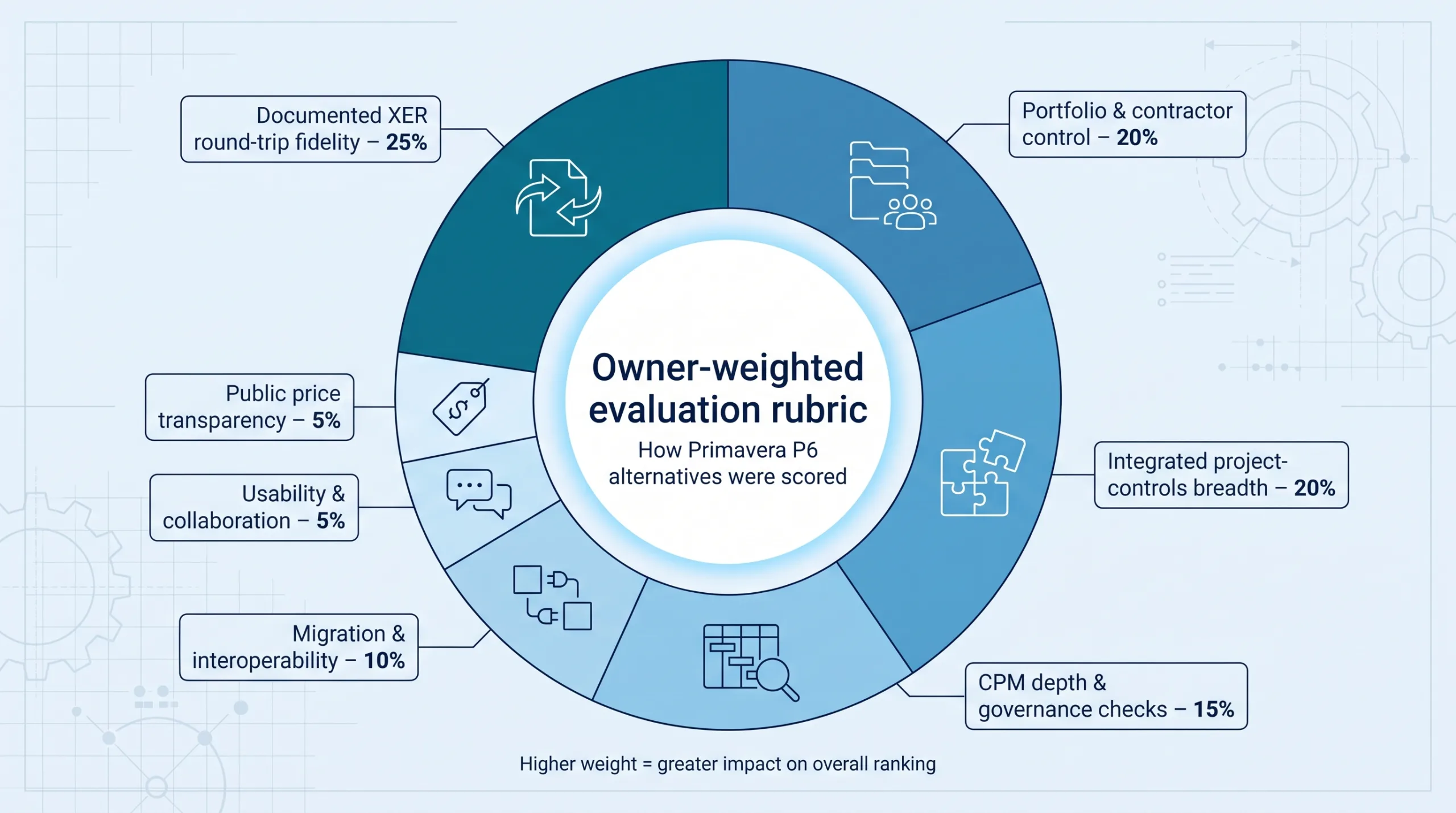
Owners should not choose software on instinct alone, so we scored each tool against a seven-factor rubric gathered in November 2026:
| Criterion | Weight |
| Documented XER round-trip fidelity | 25 percent |
| Portfolio and contractor control | 20 percent |
| Integrated project-controls breadth | 20 percent |
| CPM depth & governance checks | 15 percent |
| Migration and interoperability | 10 percent |
| Usability and collaboration | 5 percent |
| Public price transparency | 5 percent |
Any product without a native XER export failed the first gate. No exceptions. Scores came from vendor documentation, release notes, independent ratings, and published pricing, so every data point can be checked against its public source.
Finally, we ranked the eight highest scorers. If Oracle continuity matters more than integrated controls in your environment, adjust the weights and the order will change; the rubric simply makes those trade-offs visible.
Primavera P6 alternatives at a glance
The table below answers a common stakeholder question: “Which Primavera P6 alternative still exports an XER, and what else does it provide?”
Every platform listed here natively exports an XER file that you can import directly into P6. Beyond that shared feature, each one targets a different owner challenge such as portfolio control, quantitative risk, field engagement, or AI-driven optimisation.
| Tool | Where it wins | Native XER export | Controls breadth | Entry price (public)* | Public rating* |
| InEight Schedule | Integrated owner controls | Yes | Estimate, cost, docs, change, risk | $1,800 /user year | G2, 76 reviews |
| Oracle Primavera Cloud | Lowest migration friction | Yes | Schedule, risk, capital planning | Quote | Not listed |
| Safran Planner | Deep risk + schedule rigour | Yes | Cost, EVM, Monte Carlo | £2,700 one-time (desktop) | Software Advice 4.3/5 (3) |
| Asta Powerproject | Construction-centric CPM | Yes | 4D, mobile, Vision portfolio | $1,675 /user year | Software Advice 4.5/5 (34) |
| ALICE | Generative schedule scenarios | Yes | Resource & cost optioneering | Quote | Not listed |
| Outbuild | Field-to-master alignment | Yes | Lookahead, roadblocks, dashboards | $999 /month (unlimited users) | G2, 20 reviews |
| nPlan Schedule Studio | Predictive portfolio risk | Yes | AI forecast, integrity checks | Trial then quote | G2, 2 reviews |
| Planera | Visual cloud CPM | Yes | DCMA, Monte Carlo, Manny AI | Quote, unlimited users | Not listed |
*Prices and ratings captured 7 November 2026 from publicly available sources; actual costs vary by region, modules, and contract length.
Keep this grid close; as we profile each platform, you will see why InEight tops our owner-weighted ranking and why Oracle Primavera Cloud remains crucial when your spec leans on Oracle formats.
1. InEight Schedule: best overall for owner visibility and integrated controls
AI-powered planning features make InEight Schedule a cloud-based construction scheduling software that treats the schedule as one element in an owner-level controls framework. You can import a contractor’s XER, review logic, update progress, and, crucially, export a fresh XER that loads into P6 with no manual patching.
InEight Schedule interface showing integrated owner project controls
The strength lies in its connected data model. The suite unifies estimate, schedule, cost, document control, risk, and field execution in one place, unlike point solutions such as Primavera, Aconex, or separate cost tools. You link estimate, cost, documents, change orders, risk, and field progress to the same activity IDs, so executives see a single source of truth rather than stitching multiple tools together.
Portfolio dashboards flag slippage and risk early, while built-in DCMA checks, AI lookahead, and collaborative markup lift schedule quality. Public pricing starts at $1,800 per user per year, and G2 lists 76 user reviews (captured 7 November 2026). Enterprise rollouts go fastest with clear data governance and team training in place.
Verdict: Short-list InEight when you must meet the XER clause and still bring schedule, cost, risk, documents, and field data into one owner-controlled platform.
2. Oracle Primavera Cloud: best for the lowest-risk move away from desktop P6
Need a browser-based Primavera that keeps the XER clause intact? Primavera Cloud stays inside Oracle’s universe and lets projects move back and forth through native XER or XML. Your schedulers avoid rebuilding files, and the contract language remains unchanged.
Oracle Primavera Cloud browser-based scheduling and portfolio view
One caution: Oracle confirms that “an XER file does not contain baselines,” so use XML or a companion workflow for claims that depend on historical snapshots.
Primavera Cloud adds portfolio prioritisation, enterprise resources, quantitative cost-and-schedule risk, and capital-planning dashboards to the familiar CPM engine. Field crews update tasks on mobile while executives watch finish-date forecasts roll up across every workspace.
Oracle prices Primavera Cloud by quote, and totals vary by the modules you add (Schedule, Portfolio, Capital Planning) and by term length.
You gain Oracle continuity and audit comfort, yet still rely on Aconex or Unifier for deep document and commercial workflows, and implementation inherits Oracle’s complexity.
Verdict: Choose Primavera Cloud when minimising P6 migration risk outranks consolidating the wider project controls stack. You stay in the Oracle family, satisfy the XER clause, and move to SaaS without alarming the contract administrator.
3. Safran Planner: best for technically rigorous scheduling and risk analysis
Owners in oil, gas, and infrastructure choose Safran when one calendar error can derail a shutdown window. The desktop (or hosted) app opens and exports XER files natively, then runs an internal compatibility checker that flags calendars, constraints, and resource codes before you press “Save.” This guardrail can save hours of rework.
Beyond the checker, Safran combines full CPM with Monte Carlo risk, earned-value tracking, and cost-loaded schedules proven on programmes of 100,000 + activities. Multi-user editing keeps planners, cost engineers, and risk analysts working in the same model instead of scattered spreadsheets.
Pricing starts at about £2,700 for a perpetual desktop licence and scales to hosted or enterprise subscriptions. The interface leans engineering-grade rather than consumer glossy, and some Safran-only data fields will not survive the round trip to P6, so schedule a mapping workshop if you rely on custom UDFs.
Verdict: Pick Safran when quantitative risk and schedule integrity matter as much as the Gantt itself.
4. Asta Powerproject: best construction-centric CPM alternative
Contractors value Asta’s crisp Gantt views and 4D BIM links, but owners focus on reliable XER hand-offs. Powerproject opens and exports P6 files natively, runs a pre-export compatibility check, and writes an exception log so you see exactly what data, if any, is trimmed on the way out.
One important caveat: baselines move only in XML, not in XER. Elecosoft’s help centre notes, “baselines are included in XML … they are not included if you use XER format to transfer data.” If your contract depends on baseline snapshots, plan an XML sidecar or secure written approval first.
Beyond that limitation, Asta delivers a familiar Windows desktop experience with optional SaaS access and mobile SiteProgress updates. Vision and Enterprise modules roll multiple projects into an owner dashboard, while built-in DCMA and CIOB checks surface logic gaps before they derail the programme.
Software Advice lists single-user subscriptions from USD 1,675 per user per year, which keeps total cost of ownership manageable for mid-sized portfolios. Trade-offs include running on Windows (Mac users rely on SaaS or virtual machines) and the need for separate Vision instances on very large portfolios.
Verdict: Choose Asta when you need an affordable, construction-savvy CPM engine that speaks XER without forcing a large-scale platform change.
5. ALICE: best for generative schedule optimisation
ALICE treats planning as an optimisation problem. Load scope, resources, and constraints, and the engine produces thousands of valid sequences ranked by cost, duration, or carbon impact. After you select a scenario, export an XER that opens directly in P6.
Speed matters during value engineering and recovery. If a data-centre build slips by eight weeks, ask ALICE to re-optimise with weekend crews or extra crane shifts, then review the new finish date and budget difference before work resumes.
Because ALICE is an overlay rather than a full PMIS, you will still rely on other systems for documents, change, and cost control. Also note that multi-project P6 files merge into a single model on import, so keep separate backups if you manage parallel phases.
Pricing is quote-only and typically targets projects valued at USD 75 million or more, signalling that the platform focuses on enterprise programmes.
Verdict: Choose ALICE when you need rapid, data-driven “what-if” answers and want to test contractor scenarios before they become contractual milestones.
6. Outbuild: best for field-to-master schedule alignment
Outbuild keeps the six-week look-ahead, weekly work plan, and master CPM schedule in one cloud pane. Import a contractor’s XER, push daily field updates from tablets, then export a refreshed XER that opens cleanly in P6 without spreadsheets or version back-and-forth.
On site, crews record progress, flag roadblocks, and see critical-path impacts in real time. Portfolio dashboards surface delays across dozens of jobs, giving owners weeks of early warning before pay applications arrive.
Public pricing starts at USD 999 per month for unlimited users and projects, undercutting per-seat models. G2 lists 20 user reviews (captured 7 November 2026), with praise for quick onboarding and responsive support.
Know the limits: Outbuild focuses on scheduling and field execution, so you still need separate cost, document, and contract modules. The vendor has not published a full XER field-mapping guide, so run a pilot to confirm calendars, UDFs, and resource codes survive the round trip.
Verdict: Choose Outbuild when field participation is the weak link in your schedule process and you want a tool that rewards crews for keeping the plan current while still meeting the XER clause.
7. nPlan Schedule Studio: best for predictive portfolio risk
Instead of waiting for slippage, nPlan scans your XER, benchmarks every logic path against a historical dataset of millions of activities, and flags where the finish date is most likely to unravel. After review, you can export a revised XER straight back to P6, so the insight stays in the contract language your team already uses.
Schedule Studio can also create a first-pass CPM model from a scope document, checking continuity, float drift, and coding hygiene before you share the file. When you need portfolio heat maps or Power BI dashboards, add nPlan Insights.
The browser app is light: upload, review risk insights, download. Pricing starts with a free trial, then shifts to subscription tiers based on project volume, and G2 lists two user reviews (captured 7 November 2026).
Know the limits: nPlan is not a full PMIS, and the vendor has not published a field-mapping matrix, so run a pilot to confirm calendars, resources, and custom fields survive the round trip.
Verdict: Add nPlan when leadership cares less about last month’s delay and more about the one hiding two quarters ahead.
8. Planera: best for collaborative visual CPM
Planera turns CPM scheduling into a drag-and-drop whiteboard the whole team can grasp, yet it still imports XER files from P6 v20+ and exports XER, XML, or MPP back to the owner database.
During the round trip, level-of-effort activities become timespan resources and hourly durations round to whole days. The vendor documents these changes so you can test them before sign-off.
The platform’s unlimited-user, quote-based pricing appeals when you want every subcontractor to see the schedule, not just licensed planners. Manny, the built-in AI assistant, answers “what-if” questions and runs Monte Carlo simulations without extra plug-ins.
Limitations remain: independent reviews are still thin, and Planera focuses on collaboration rather than deep cost, document, or contract management, so you will need a companion controls layer if those functions matter.
Verdict: Choose Planera when ease of use blocks adoption. It lowers the usability barrier while still delivering the XER file the spec demands.
When a platform helps but still needs P6 in the loop
Several well-known platforms import XER files and add real value, yet stop short of producing a contract-ready XER. If your priority is collaboration, cost, or document control (not full schedule authoring), these tools can still strengthen your stack:
- Procore Scheduling: Builds critical-path schedules inside the same platform used for RFIs and submittals; imports XER and MPP, but the export menu ends at PDF and CSV, so you still need P6 (or another authoring tool) when the spec demands a round-trip file.
- Hexagon EcoSys (Aspen Project Management): Excels at owner-level cost, change, and portfolio reporting. A bidirectional connector syncs schedule data with P6, but it is not positioned as a stand-alone CPM engine.
- Aconex / Kahua: Focus on documents, workflows, and handover packages. Both pull in schedule data for context, yet defer to Primavera or another scheduler for heavy CPM work.
- SAP: Serves as the financial backbone for many utilities and agencies; middleware keeps WBS and actual costs aligned with P6, but SAP itself does not export XER.
Bottom line: These platforms improve collaboration and data integrity, but keep at least one XER-authoring scheduler in your lineup until the contract language changes.
Primavera P6 vs InEight vs Oracle Primavera Cloud
When the board asks why you propose anything beyond classic P6, this side-by-side view clarifies the trade-offs.
| Factor | Oracle Primavera P6 | InEight Schedule | Oracle Primavera Cloud |
| Core role | Contract-standard desktop/DB scheduler | Integrated owner project-controls platform | Oracle-native SaaS scheduler and portfolio suite |
| XER import/export | Native both ends | Native import and export (Schedule + Control) | Native import and export |
| Baseline handling in XER | Stored in DB; XER omits baselines | Active Baseline schedule kept in InEight; XER export from Plan view | XER omits baselines, so use XML instead |
| Owner portfolio view | EPPM analytics add-on | Built-in dashboards across cost, risk, field | Built-in portfolio and capital planning |
| Integrated cost / doc / change | Separate Oracle or third-party apps | Native modules share one data model | Often Aconex or Unifier add-ons |
| Field planning | Team Member, Synchro, or partners | Short-interval planning and mobile updates | Native task boards and mobile |
| Deployment | On-prem or partner-hosted | SaaS | SaaS |
| Public entry price* | Varies by reseller | USD 1,800 per user year | Quote from Oracle |
| Biggest strength | Contract certainty and large talent pool | Unified controls plus XER compliance | Lowest Oracle-ecosystem migration risk |
| Biggest caution | Legacy UX and admin burden | Needs governance and training | Relies on broader Oracle stack |
*Prices captured 7 November 2026; actual costs vary by region, modules, and term length.
Use this grid as a starting point:
- If the spec locks you into P6, stay with it or secure written approval.
- If Oracle continuity matters more than consolidation, choose Primavera Cloud.
- If you want one platform to unite schedule, cost, risk, documents, and field data while still exporting XER, short-list InEight.
How to run an XER proof of concept that contracts will trust
A marketing demo does not match your project risk. Run a real-data, full-cycle proof of concept (PoC) whenever you change schedulers or revise the spec:
- Pick one live project. Include the baseline and the most recent update from your control P6 database.
- Import and recalculate. Load both files into the contender, run the CPM engine, and compare finish date, total float, and longest path with P6. Investigate any variance in calendars, constraints, or lags.
- Round-trip the file. Export a fresh XER, open it in a clean P6 sandbox, and check:
- EPS/WBS hierarchy
- Activity IDs, names, calendars
- Relationship types, lag values, constraints
- Activity codes, UDFs, notebooks
- Resources, roles, cost loading
- Actual dates, remaining durations, percent-complete method
- Simulate one reporting period. Import contractor progress, recalculate, re-export, and reload into P6. Watch for ID renumbering, duplicate calendars, or unit-rounding drift.
- Stress-test recovery. Add a delay event, rebuild logic, and verify that the exported XER still lands cleanly in P6. Record every exception and request written explanations from the vendor.
- Secure formal sign-off. Obtain written acceptance from the contract administrator or owner’s representative before wider rollout; that approval, not a brochure, prevents change-order disputes.
Follow this checklist and you will know exactly how each contender behaves under the same contractual pressures your project faces.
Owner selection guidance by industry
Each sector faces a different scheduling choke point. Match your tool to the dominant risk and you will improve outcomes instead of policing file formats.
Mining: Remote sites and multiple EPCMs mean commissioning punch lists stretch across continents. Choose platforms that unify estimate, schedule, cost, and risk so head office can benchmark contractors without exporting five reports.
Oil, gas and chemical: Turnarounds leave zero float. Favour engines with Monte Carlo risk, resource levelling, and quick what-if recovery modelling to test every outage scenario.
Power and renewables: Interconnection dates and long-lead turbines drive the critical path. Portfolio dashboards and contractor-schedule normalisation help you spot slippage early on dozens of parallel builds.
Transportation infrastructure: Public specs and claims exposure demand audit-ready history. Look for built-in DCMA checks, high-fidelity XER exchange, and straightforward archive workflows.
Heavy civil: Mass earthworks shift daily. A scheduler that blends master CPM with short-interval (look-ahead) planning lets crews adjust in real time while still producing a contract-ready XER.
Tie the platform to the pressure point, and you will spend more time improving performance and less time chasing mismatched schedule files.
Frequently asked questions
Can software other than Primavera P6 create an XER file?
Yes. All eight products in this guide export a contract-ready XER you can load straight into P6, but always pilot the round trip with your own schedule first.
Is an XER file a full backup of my project?
No. Oracle notes that an XER omits baselines (and other objects), so keep a database or XML archive if you need a perfect mirror.
Does Procore replace P6 when the contract requires XER?
Not yet. Procore Scheduling imports XER but currently exports only PDF and CSV, so you still need a true scheduler for the round-trip file.
Is Oracle Primavera Cloud just P6 in the browser?
It shares DNA but is a separate cloud app with its own UI and data model. The tool exchanges XER or XML with P6 and adds Lean task boards plus capital-planning dashboards not found in desktop P6.
Which P6 alternative is best for a capital-project owner?
Our November 2026 owner-weighted rubric ranked InEight highest because it unites estimate, schedule, cost, risk, documents, and field data while still exporting XER. If Oracle continuity matters most, Primavera Cloud comes next.
What if the spec literally says “develop the schedule in P6”?
Stay in P6 or obtain written approval from the contract administrator; an exported XER alone will not satisfy a strict “P6-authored” clause.
Can owners use one platform while contractors stay on P6?
Yes. Import the contractor’s XER for review, adjust logic or progress, then export an updated XER back to P6 so both sides remain in sync.
Will AI schedulers replace human planners?
No. AI can suggest logic, forecast slippage, or optimise resources, but a qualified planner must still approve any change before it reaches the contract file.
Wrapping up: choose your stack, then prove it
An XER clause no longer locks you into desktop P6. You can meet that file requirement and still gain cost certainty, field visibility, or AI-driven risk insight, once you validate the round trip.
- Short-list two or three tools that match your industry pressure points.
- Run the proof of concept from the checklist above and log every variance.
- Secure written sign-off from the contract administrator before rollout.
- Need integrated owner controls? Pick InEight.
- Want to stay inside Oracle’s ecosystem? Choose Primavera Cloud.
- Deep quantitative risk? Safran is your option.
- Field adoption first? Look at Outbuild or Planera.
Validate the XER round trip so your next project review can focus on outcomes instead of software constraints.