Americord Industry Report: Why Reliable Power Cords Are Critical For Factories and Automation
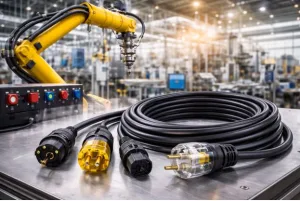
You probably don’t give much thought to your power cords – until one goes. But in a factory or automated production system, a cord failure is more than just a headache that slows you down.
According to the National Fire Protection Association, power transfer equipment is among leading equipment involved in ignition in industrial properties. These fires cause a significant direct property damage annually. And many times, it’s a cord that couldn’t handle the load.
If you’re a facility manager, plant engineer, or even part of the operations team, you know that you can’t simply get by with any old power cord in factory and automation environments. In this Americord Industry report, we break down what makes a power cord truly factory-ready and why cutting corners in this area costs far more than you save.
1. Factory Environment Is Brutal on Standard Power Cords
Most power cords you’ll find at a general hardware store are designed around residential or light office use. They’re rated for 15 amps, built with thin insulation, and tested under conditions that have nothing in common with what a factory floor looks like after a 12-hour shift.
Factory environments expose cords to a combination of stresses that standard cords weren’t designed to survive. There’s constant mechanical wear from forklifts, foot traffic, and moving equipment. Add that to the wide temperature swings, exposure to oils, plus humidity and condensation in certain zones, and you have a standard power cord with a shortened lifespan.
This is the first reason reliable heavy-duty power cords are critical in these settings. They’re constructed with rubber or thick PVC thermoplastic jackets rated at up to 105 degrees Celsius, with abrasion-resistant outer layers that hold up under physical abuse.
A power strip cord or extension cord that can’t handle the environment it’s placed in will always be the weakest point in your electrical setup, no matter how well the rest of the system is built.
2. Using Undersized Cords is a Hidden Operational Risk
One of the most expensive mistakes in factory electrical setups is using a cord rated below the actual load demand of the equipment. This doesn’t cause an immediate, dramatic failure. Instead, it fails slowly over time, and it causes symptoms that are often misdiagnosed.
When a power cord is undersized for its load, resistance in the wire generates heat. That heat builds up in the insulation, softens it, and eventually leads to cracks or shorts.
Meanwhile, the equipment fed by the cord gets inconsistent voltage, which can cause motor performance issues, or programmable logic controller faults in automated systems. You spend hours chasing what looks like an equipment problem when the actual problem is the cord.
For most factory applications drawing up to 20 amps at 125 volts, Americord’s NEMA 5-20P to ROJ Heavy Duty Power Cord in 12/3 SJTW is a practical match. It’s rated for 20 amps, built with a temperature-resistant jacket rated to 105 degrees Celsius, and designed specifically for dedicated industrial and commercial applications.
Matching the gauge to the load and the run is part of keeping equipment running as designed — and not taking production down when you can least afford it because of a slow-burning failure.
3. Power Cords Affect Industrial Automation Systems
Automation amplifies the consequences of unreliable power. A robotic arm, a conveyor system, or a CNC machine can tolerate a lot of things, but unstable input voltage isn’t one of them. They require precise power delivery to perform programmed sequences reliably. If the power supply is diminished at all, the system will either shut down or begin to create errors.
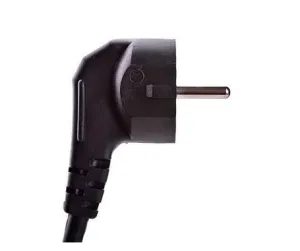
The best power cords for industrial machinery in an automation system aren’t just about carrying current safely. They’re about maintaining signal integrity and voltage stability across the entire length of the run. That’s why connector quality matters just as much as the wire gauge.
In environments where vibration is constant, a standard plug that gradually works itself loose causes intermittent power loss that can corrupt a production cycle mid-run.
Heavy duty power cords such as the Americord NEMA L5-20P to NEMA L5-20R excel at delivering real value in automation environments. The power code is made using 12/3 SJTW wire (rated at 20A/125V – temperature rating of 105°C). This power cord’s secret sauce lies in the twist-lock design that locks itself physically.
On a production floor where machinery runs continuously, and vibration is unavoidable, that locking connection ensures your automation systems do not experience intermittent-power-loss-induced mystery faults and interrupted cycles.
Why Safety Certification Is Non-Negotiable in Industrial Settings
There’s a reason OSHA and facility safety programs put electrical safety at the top of their priority lists. In an industrial setting, an undersized or uncertified power cord is not just putting the cord itself at risk. The cord harbors risk to the equipment it’s plugged into, the people working near it, and, in worst-case scenarios, the entire facility is at risk too.
UL listing is the baseline safety standard every industrial power cord should carry. It means the cord has been independently tested and confirmed to meet established safety requirements, not just rated by the manufacturer. All Americord power cords carry UL certification, which matters in factory settings where compliance with OSHA electrical safety standards isn’t optional.
Beyond UL listing, Americord builds GFCI protection into cords designed for environments where moisture is a factor. Ground fault circuit interrupters detect fault current and cut power in milliseconds, before a dangerous shock or ignition event can occur.
What Reliable Actually Means for a Factory Power Cord
In an industrial environment, reliability in a power cord is more than just not catching fire. It means consistent performance under load, day after day, with no degradation. Reliability also means:
- The cord is still delivering the same voltage at the end of a 50-foot run that it delivers at the source.
- The connector holds its grip through thousands of plug-in cycles with no loosening.
- The jacket is still intact after six months on a floor where forklifts and carts are constantly on the move.
For high-draw applications like welding equipment, plasma cutters, or other heavy industrial machinery running at 250 volts and up to 40 amps, Americord’s NEMA 6-50P to Blunt Cut Heavy Duty Power Cord in 8/3 SOOW is rated for that kind of sustained demand. The SOOW rubber jacket is oil-resistant and flexible even in cold conditions, making it a good fit for factory environments where temperature variation as well as chemical exposure are present.
For those looking for a power cord near me or involved with setting up large-scale automation installs, Americord does custom work: non-standard lengths, specific connector configurations, cords built to tolerances referenced directly off your own equipment. An engineering support team available nationwide 24/7 works with engineers and procurement managers to find the best heavy-duty power cord for any load requirement, environment, or length.
Final Thoughts
Reliable power cords matter so much for factories and automation, and this comes down to three things. First, factory environments are hard on cords in ways that standard products can’t handle. Second, an undersized or poorly built cord introduces hidden risks that cost far more in downtime and damage than the cord itself ever saved. Third, automation systems depend on stable, consistent power in a way that leaves no room for a weak link in the electrical chain.
Americord exists to eliminate that weak link. Whether you’re sourcing heavy-duty power cords for a new production line or replacing old cords that have been running too hot for too long, getting this right is worth the attention. Your equipment, team, and entire output depend on it.