Aptite: The AI Eating Coach That Follows You From the Kitchen to the Restaurant Table
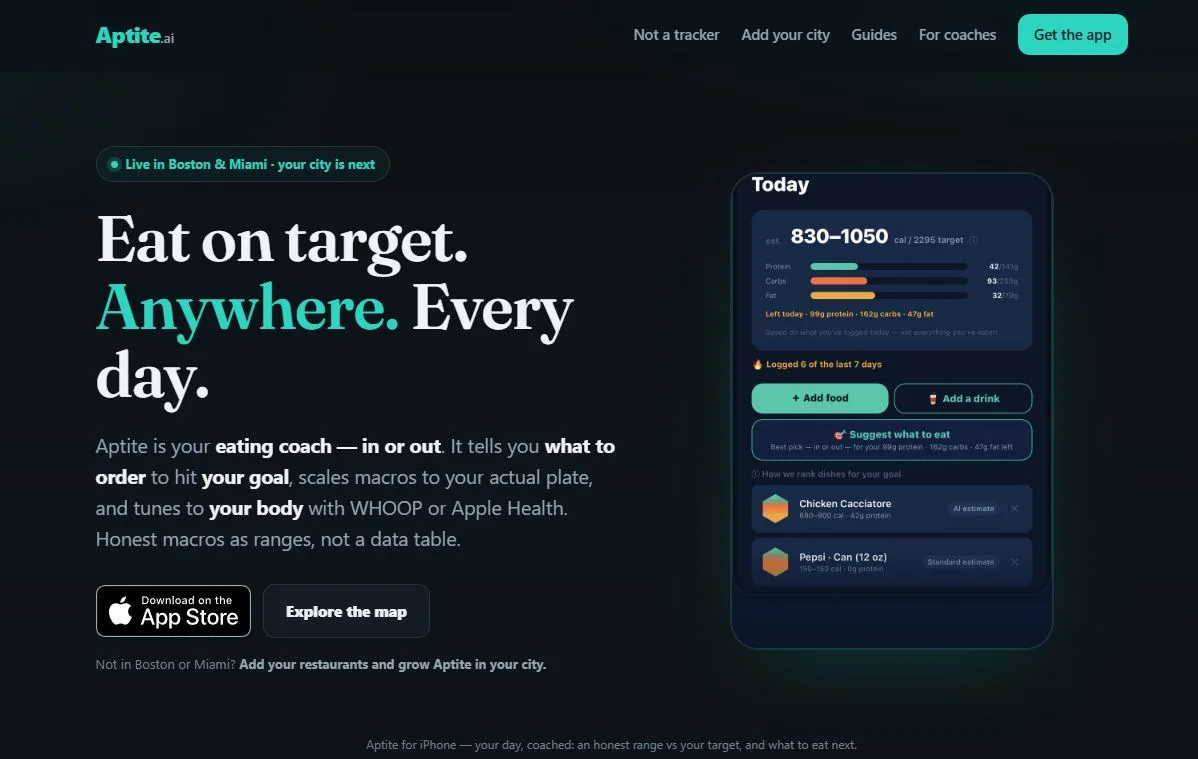
Anyone trying to hit a nutrition goal knows the real challenge isn’t tracking a protein bar with a barcode — it’s figuring out what to order when the menu in front of you has no nutrition label at all. That’s the gap a new app called Aptite is built to close. Available for free and already live in Boston and Miami, Aptite positions itself as an AI-powered eating coach that works “in and out” — at restaurants and at home.
An Eating Coach Built for How People Actually Eat
Most nutrition-tracking apps stop working the moment food doesn’t come in a package. Aptite is designed around the opposite assumption: that most of a person’s calories and macros come from meals without barcodes — restaurant dishes, home cooking, takeout. The app recommends what to order to hit a specific goal and ranks nearby restaurant dishes against that goal, whether the user is eating high-protein, low-carb, keto, or vegan.
Logging a home-cooked meal takes a single action, removing the friction that usually causes people to abandon food tracking within days.
Goals That Adapt to How Your Body Is Actually Recovering
What sets Aptite apart is how it calculates daily nutrition targets. Instead of a static macro target, Aptite combines the user’s stated goal with real recovery data pulled from WHOOP or Apple Health. A lower recovery score can shift the day’s recommendations, and targets automatically recalculate whenever a user changes their goal.
Every dish the app surfaces is ranked against that individualized number — not against a generic nutrition chart that treats every user the same.
Honest Ranges Instead of False Precision
Rather than presenting calorie and macro counts as if they were lab-verified facts, Aptite displays them as ranges, each tagged with a confidence grade of A, B, or C. Every estimate is explicitly labeled as AI-generated, not guaranteed.
The workflow is simple: a user photographs a menu or submits a link, Aptite pulls the dishes and estimates their macros. Users can then weigh their meals and correct estimates, which improves the model’s accuracy over time — a feedback loop that gets more precise the more a community uses it.
Closing the Nutrition Data Gap for Independent Restaurants
Large chains have published nutrition information for years because regulation and scale made it commercially necessary. Independent restaurants — the ones most people actually eat at most often — have never had that infrastructure. Aptite‘s stated goal is to apply the same nutritional rigor to independent restaurants that chains have long benefited from, letting any user add a missing restaurant just by photographing its menu.
That data-gathering approach is inherently community-driven: when a restaurant isn’t yet covered, users can request it and rally others nearby to help it get added, expanding coverage city by city without waiting for a centralized rollout.
A Coaching Layer for Trainers and Nutritionists
Beyond individual use, Aptite includes tools built specifically for coaches. A trainer or nutritionist can set a client’s goal directly inside the app, then monitor adherence through a private dashboard. Aptite handles the daily nudges and check-ins between sessions — the exact window where most diet plans quietly fall apart.
Availability and What’s Next
Aptite is free to download and currently live in two seed markets, Boston and Miami. Rather than betting on a centralized city-by-city rollout, the app is designed to expand organically: users bring their own favorite restaurants into the platform, and each newly added restaurant becomes a resource for every future user in that city.
By combining recovery-adjusted goals, transparent confidence-graded estimates, and a crowdsourced approach to restaurant data, Aptite is tackling a blind spot most nutrition apps have quietly ignored: the fact that most real eating happens outside a barcode scanner — at a restaurant table or a home stove, not in a packaged-food aisle.