Are Pay Stubs Still Reliable for Tenant Screening in 2026?
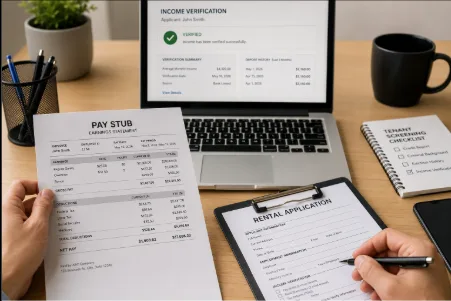
Not on their own. A pay stub is still worth collecting as part of a rental application, but by itself it no longer proves anything a landlord can act on with confidence, because the tools to fabricate one convincingly are now cheap and widely available. Legitimate pay stub generators for freelancers exist for real documentation needs, which is part of why appearance alone was never going to be a reliable signal either way.
Why Pay Stubs Alone No Longer Prove Income
A pay stub used to carry weight because forging one took effort: matching a specific payroll format, getting the math right, avoiding obvious font mismatches. That barrier has largely disappeared.
Industry fraud reports from 2026 put the average rate of document-based rental application fraud in the low single digits, with template-based forgeries as the leading method, and a majority of property managers say they aren’t confident their current screening process would catch it.
For an individual landlord, that translates into a real scenario: an applicant submits three flawless pay stubs from a recognizable payroll provider. The formatting is consistent, the year-to-date totals track correctly across pay periods, and nothing looks off at a glance. It’s only when someone calls the listed employer directly that the company has no record of the applicant ever working there.
Accepting fraudulent proof of income isn’t a paperwork problem. It’s what turns into months of unpaid rent, legal fees, and a costly eviction filing if it isn’t caught during the application stage.
From Visual Inspection to Layered, Bank-Linked Verification
The Old Standard: Visual Inspection
For years, the standard screening move was a close read of the document itself: check the font, check the math, check for a zero that looks like the letter O. Those checks still catch amateur forgeries.
They weren’t built for applicants using a payroll-format generator, which produces internally consistent numbers across multiple pay stubs without the errors a manual edit would leave behind.
Independent Verification Through the Employer or Bank
The stronger move is confirming income through a channel the applicant doesn’t control. Calling the employer at a number pulled from the company’s own website, rather than the number printed on the pay stub, is a basic version of this.
A more thorough option is requesting a signed authorization to pull a tax transcript directly from the applicant’s records. It takes a few business days, but the result comes from a source the applicant can’t edit.
Bank-Linked Data as the New Baseline
The fastest-growing option skips the document review step and confirms deposits directly. Bank-linked income verification services connect to an applicant’s bank or payroll account and verify actual income activity rather than relying on a PDF handed over during the application.
This shifts the underlying question. It was never really about whether a pay stub looked real, since a legitimate stub can be produced by a freelancer documenting real income just as easily as it can be misused. For self-employed workers and independent contractors, using a pay stub builder to accurately document income can simplify rental applications, provided the information reflects actual earnings and is supported by independent verification. Bank-linked verification sidesteps the document itself by confirming the underlying deposits.
What Landlords Should Still Ask For (and Why)
Dropping pay stubs from the rental application isn’t realistic, and it isn’t necessary. The goal is treating any single income document as one input, not the deciding factor in a lease approval.
A reasonably complete income verification file for 2026 includes:
- Recent pay stubs or payroll records, useful for confirming pay rate, employer name, and pay schedule at a glance
- One independent verification step, such as an employer call, a payroll data service, or a signed tax transcript request
- Bank statements or bank-linked verification, to confirm deposits match the income the applicant is claiming
None of these fully replaces the others, and no single document should be enough on its own to approve or deny an applicant. A pay stub without a matching bank deposit is worth a follow-up question, not an automatic rejection.
It’s also worth applying the same verification standard to every applicant. Inconsistent screening, even when unintentional, creates fair housing exposure, so the documentation requested and the follow-up steps taken should look the same across the applicant pool.
Frequently Asked Questions
Can a landlord tell if a pay stub is fake just by looking at it?
Not reliably in 2026. Older forgeries had obvious tells like wrong fonts or math errors, but current generators produce consistent, professional-looking output that passes casual review.
What’s the most reliable way to verify a tenant’s income in 2026?
Bank-linked verification currently offers the strongest confirmation, since it checks actual deposits rather than a document the applicant provided.
Are pay stubs still required for tenant screening?
Most landlords still request them as part of the rental application, and they’re useful for basic details like employer and pay rate, but they work best paired with at least one independent verification step.
Can landlords verify pay stubs directly with employers?
Yes. Calling the employer using a number found independently, rather than the one printed on the stub, is one of the simplest fraud detection steps available.
How do landlords verify employment for a rental application?
Common methods include a direct employer call, a payroll data service, a signed tax transcript request, or bank-linked income verification.
Can fake pay stubs pass tenant screening?
They can, particularly in screening workflows that rely on visual inspection alone. That’s the reason layered verification has become standard practice for identifying applicant risk.
What documents verify rental income besides pay stubs?
Bank statements, tax transcripts, employer verification letters, and bank-linked income data are all commonly used alongside pay stubs. Self-employed workers, freelancers, and independent contractors may also use a pay stub generator, provided the information reflects their actual income and is supported by other documentation.
What income verification services do landlords commonly use?
Bank-linked payroll and deposit verification tools are among the more widely used options for connecting directly to payroll or bank data during applicant screening.
The strongest tenant screening processes no longer rely on any single document to make a lease decision. Pay stubs remain a useful starting point for understanding an applicant’s employment and earnings, but pairing them with independent verification, whether through an employer call, a payroll database, or bank-linked income data, gives landlords a more accurate picture and reduces the odds that a fraudulent application gets approved.
About the Author
Brooks Cooper is the CEO of PayStubVault, a platform that helps freelancers, self-employed professionals, independent contractors, and small businesses create accurate pay stubs and income documentation. He writes about income verification, payroll documentation, tenant screening, and proof-of-income best practices, with a focus on helping individuals and businesses navigate modern financial documentation requirements. Learn more at https://www.paystubvault.com/.