ARM-Based Edge AI Systems Are Challenging Traditional x86 Platforms
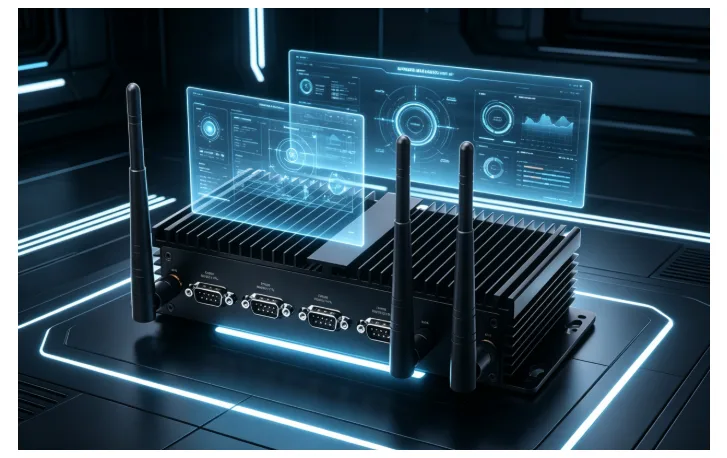
For decades, x86 systems have been the default foundation of industrial computing and enterprise infrastructure. From factory control systems to enterprise servers, they have delivered strong and reliable performance across a wide range of workloads.
But edge AI is changing the context in which computing happens.
Instead of running in centralized data centers or control rooms, intelligence is increasingly being deployed directly into physical environments—machines, cameras, kiosks, robots, and distributed edge devices.
This shift is quietly redefining what kind of hardware is actually needed.
In many of these scenarios, traditional x86 platforms are still powerful, but they are not always the most practical choice.
That is where ARM-based edge AI systems are gaining momentum.
Why Edge AI Changes the Hardware Equation
Edge AI systems are not designed like traditional IT infrastructure. They operate under very different constraints.
Rather than focusing purely on maximum compute performance, they need to balance responsiveness, energy efficiency, and physical deployment requirements.
In real-world applications, this often means systems must run continuously, respond in real time, operate in compact spaces, and remain stable in environments where cooling or maintenance is limited.
These conditions naturally favor architectures that prioritize efficiency and integration rather than raw computational density.
This is one of the key reasons ARM-based platforms are becoming increasingly relevant in edge computing scenarios.
Power Efficiency Is Becoming a System-Level Advantage
One of the most important differences between ARM and traditional x86 systems is how they handle power consumption.
In edge AI deployments, power is not just a technical metric—it directly affects system design, operating cost, and scalability.
ARM-based systems are typically able to deliver meaningful AI performance while keeping energy usage significantly lower than many x86 configurations.
This has a cascading effect on the entire system design.
Lower power consumption means less heat. Less heat means simpler cooling. Simpler cooling often leads to smaller enclosures and fewer mechanical components. Over time, this also improves system reliability.
In large-scale deployments, such as smart factories or distributed retail networks, these advantages become especially important.
It is not just about saving electricity—it is about making AI systems easier to deploy at scale.
Companies such as Geniatech are actively designing ARM-based edge AI platforms with exactly this kind of efficiency-driven deployment model in mind.
Compact and Fanless Systems Are Changing Deployment Models
Another major shift enabled by ARM-based edge AI platforms is hardware form factor.
Traditional industrial PCs often rely on larger enclosures and active cooling systems to support higher power workloads. This limits where and how they can be deployed.
ARM-based systems take a different approach. Because of their efficiency-oriented design, many can operate in compact, fanless configurations while still supporting real AI workloads.
This changes deployment possibilities significantly.
Instead of being confined to control rooms or protected cabinets, edge AI systems can now be embedded directly into kiosks, production equipment, transportation systems, and retail terminals.
Fanless design also reduces mechanical wear and improves reliability in environments where dust, vibration, and continuous operation are common.
In practice, this makes systems easier to maintain and more suitable for long-term deployment.
AI Acceleration Is Narrowing the Performance Gap
For a long time, x86 systems were clearly ahead in raw computing performance. That gap is now becoming less decisive for many edge AI workloads.
Modern ARM processors increasingly integrate dedicated AI acceleration engines, NPUs, and optimized GPU pipelines that are specifically designed for inference workloads.
Platforms such as RK3588 and RK3576 are strong examples of this trend. They are capable of handling tasks such as computer vision, object detection, multi-camera analytics, and lightweight AI inference directly on-device.
While they may not compete with high-end server CPUs in raw throughput, they are not designed for that role.
Instead, they focus on delivering sufficient AI performance within a constrained power and size envelope.
For many edge AI applications, this balance is more important than peak performance.
Cost and Scalability Are Driving Adoption
As enterprises move from pilot projects to large-scale deployment, cost structure becomes a critical factor.
ARM-based edge AI systems typically offer lower overall hardware costs and reduced infrastructure requirements. More importantly, their efficiency allows for simpler system design, which reduces long-term operational complexity.
When scaled across hundreds or thousands of devices, these differences become significant.
It is not just about the cost of a single device—it is about the total cost of ownership across an entire distributed system.
This is one of the reasons ARM adoption is accelerating in industrial and commercial edge AI environments.
x86 Still Matters, But in a Different Layer of the Stack
Despite the rapid growth of ARM-based platforms, x86 architecture is not being replaced.
It continues to play a critical role in high-performance computing environments, enterprise servers, virtualization platforms, and workloads that require maximum compute density.
However, its role in edge AI is becoming more specialized.
Rather than being the default choice for all computing tasks, x86 is increasingly used in centralized systems, while ARM handles distributed inference at the edge.
The Edge AI Landscape Is Becoming Hybrid by Design
Instead of a single dominant architecture, the future of edge AI is increasingly hybrid.
Enterprises are beginning to combine both approaches:
x86 systems are used for centralized processing, data aggregation, and model training. ARM-based systems are used for distributed inference, real-time decision-making, and on-device intelligence.
This division of roles creates a more flexible and scalable architecture overall.
In this evolving landscape, ARM-based edge AI platforms are not replacing x86 systems—they are expanding what is possible at the edge.
As this transition continues, companies such as Geniatech are contributing to this shift by developing ARM edge AI solutions designed for real-world industrial deployment.
The direction of the industry is clear: intelligence is becoming more distributed, more efficient, and much closer to where data is actually generated.