Aurora Hunting Across the Globe: Where to Chase the Lights and How to Never Miss Them
Tourism boards across the globe are already reporting a surge in aurora-related travel bookings, and as Travel and Tour World notes, the ability to catch the northern or southern lights at the perfect moment is now within reach for anyone with a passion for natural beauty and adventure. That observation reflects a structural shift in how people travel. Aurora tourism is no longer a niche pursuit. The global market reached USD 1.42 billion in 2024, expanding at a compound annual growth rate of 8.6%, according to industry research published by DataIntelo. A 2024 Expedia survey found that 42% of Americans ranked chasing the northern lights as their top bucket-list travel priority, surpassing visits to Egypt’s pyramids and the Great Wall of China. Seeing the aurora has moved from aspirational fantasy to active travel planning for tens of millions of people worldwide. The problem most of them run into is that the tools available for finding it have not kept pace with that demand.
Why Iceland and Alaska Dominate Aurora Tourism
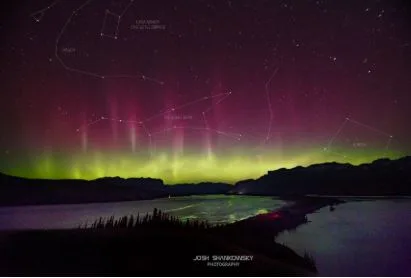
Iceland and Alaska attract the majority of first-time aurora travelers for reasons grounded in geography, not marketing. Both destinations sit inside or immediately adjacent to the auroral oval, the ring-shaped zone of concentrated geomagnetic activity that encircles the magnetic poles. Locations within this oval produce visible aurora at much lower levels of solar activity than mid-latitude destinations.
Fairbanks, Alaska, records aurora activity on over 200 nights per year. Its position at magnetic latitude 64.9 degrees north places it directly beneath the auroral oval, while its dry, continental interior climate delivers clear-sky probability of roughly 55 to 60 percent during aurora season. That combination is statistically significant. Coastal aurora destinations like Tromsø in Norway average closer to 35 to 40 percent clear-sky nights. Travelers who stay at least three nights in Fairbanks and actively go out during evening hours have better than a 90 percent chance of seeing the aurora, according to data compiled by the University of Alaska Fairbanks Geophysical Institute. Aurora season in Fairbanks runs from August 21 through April 21, nine consecutive months of viable viewing.
Iceland’s strength is accessibility. Direct transatlantic flights connect Reykjavik to most of Europe and the eastern United States, and the country’s dramatic volcanic landscape, glaciers, and black sand beaches have made it the dominant visual backdrop in aurora photography. The combination of convenient access and extraordinary scenery has driven Iceland’s tourism industry to build substantial infrastructure around aurora viewing, including guided tours, remote lodge circuits, and superjeep expeditions into the highlands.
Europe captured approximately 45 percent of the global aurora tourism market in 2024, with Scandinavian destinations anchoring that share, according to research from Grand View Research. Norway alone saw 32 percent of its foreign winter tourists travel specifically to see the northern lights during the 2019 season, a figure that reflects how thoroughly aurora viewing has become the primary economic driver for Arctic Circle communities.
The Destinations Most Travelers Overlook
The auroral oval is not fixed. During elevated geomagnetic activity, it expands toward lower latitudes, bringing aurora displays within reach of destinations that most travel guides omit entirely.
Norway beyond Tromsø offers substantial aurora infrastructure along the entire length of its Arctic coast, as well as dedicated aurora cruise routes that allow chasers to navigate above cloud cover during overcast periods. Accommodation stays in Arctic Circle cities across Nordic countries grew by 217 percent between 2009 and 2016, largely driven by aurora tourism, according to data cited by Grand View Research.
Canada is systematically underrepresented in aurora travel coverage relative to its actual opportunity. The auroral oval passes directly over Yukon, Northwest Territories, northern Alberta, and northern Manitoba. Jasper National Park in Alberta holds recognition as the world’s largest dark sky preserve, covering over 11,000 square kilometers. Churchill, Manitoba offers aurora viewing in combination with polar bear and beluga whale encounters that no other destination on Earth can replicate. North America’s aurora tourism market grew at a compound annual rate of 9.2 percent in 2024, outpacing the global average.
Australia and the Southern Lights Most Travelers Do Not Know Exist
Australia represents the most consequential gap in public awareness. The aurora australis, driven by identical physics to the northern lights, reaches mainland Australia during active solar conditions with a regularity that most travelers do not expect. Victoria and Tasmania have both produced documented aurora displays photographed by residents who had no prior knowledge that the southern lights were possible at their latitude. Melbourne, positioned at 37.8 degrees south, sits further from the auroral oval than Tromsø or Fairbanks, but significant geomagnetic events push the southern auroral oval far enough north to make displays visible from the Victorian coast. Aurora Admin maintains real-time monitoring specifically for southern hemisphere viewers, including a dedicated Melbourne Southern Lights Alerts page calibrated to aurora australis activity reaching Victoria. The page also includes and in-depth guide for best practices and viewing locations.
New Zealand and the southern tip of Argentina complete the southern hemisphere circuit for serious international chasers.
The Forecasting Problem That Aurora Tourism Has Not Solved
Most aurora travelers approach the phenomenon with the same tools they would use to check weekend weather. The dominant index in popular aurora forecasting treats geomagnetic activity as a single averaged number, calculated across three-hour windows. That lag is fatal to real-time aurora hunting. A display can rise from nothing to peak intensity and fade again within 45 minutes. By the time a three-hour averaged metric updates, the event is over.
The parameters that actually drive aurora onset are measurable in real time. Solar wind monitoring satellites positioned at the L1 Lagrange point between Earth and the sun continuously transmit data on interplanetary magnetic field orientation, solar wind velocity, particle density, and hemispheric power input. When the Bz component, the north-south orientation of the interplanetary magnetic field, turns sharply southward while solar wind speed and density are elevated, geomagnetic activity intensifies rapidly. That sequence provides a forecasting window of 30 to 60 minutes before a display becomes visible on the ground. That window is what separates aurora hunters who consistently see the lights from travelers who repeatedly miss them.
How Aurora Admin Approaches the Problem
Aurora Admin has spent over 15 years developing infrastructure around real-time solar wind analysis rather than averaged index data. The platform monitors live solar wind parameters continuously and runs a proprietary algorithm that translates those inputs into plain-language probability forecasts and direct SMS alerts timed to give subscribers 30 to 60 minutes of advance notice before conditions become favorable for visible aurora.
Yahoo News described Aurora Admin’s approach directly: “Leveraging a proprietary multi-source algorithm and data from satellites and ground-based observatories, Aurora Admin predicts aurora activity with exceptional accuracy. For many travellers, witnessing the aurora is a once-in-a-lifetime dream. Too often it is missed due to unreliable forecasts. Aurora Admin changes that.”
That accuracy extends to spatial precision. Aurora Admin typically delivers alerts calibrated within 30 to 50 kilometres of expected activity, with a broader range communicated to subscribers to account for natural variability. Future development includes AI-assisted validation designed to extend the forecast window further.
Josh Shankowsky, founder of Aurora Admin, describes the core distinction plainly: “The overwhelming majority of aurora apps are reading the same averaged data and presenting it differently. Our algorithm is built around the solar wind parameters that actually determine whether the aurora is going to be visible in the next hour. Because we track those parameters in real time instead of waiting for index averages to catch up, we are identifying onset conditions that most tools will not reflect until the show is already over. That architecture is what puts us ahead of more than 99 percent of what is available.”
The service delivers alerts via SMS rather than app push notification, which means subscribers receive warnings even in areas with limited or intermittent cellular data. Most productive aurora viewing locations, by definition, are remote. An alert system that requires a reliable internet connection to function is structurally mismatched to the use case it serves.
Aurora Admin covers aurora viewing across more than 40 countries and maintains location-specific forecasting for destinations from Fairbanks and Yukon to the southern hemisphere. For travelers planning visits to Iceland, the platform provides dedicated northern lights forecasts for Reykjavik that incorporate live solar wind analysis alongside local viewing conditions.
The platform’s aurora alerts have connected subscribers across six continents to displays they would not have found through conventional forecasting tools.
What Effective Aurora Chasers Do Differently
Experienced aurora chasers share a consistent set of operational habits that distinguish their results from casual visitors.
They select destinations based on the combination of aurora frequency and cloud cover probability, not aurora frequency alone. A location with frequent geomagnetic activity but persistent coastal cloud cover will underperform a slightly less active location with reliably clear skies. Fairbanks outperforms coastal Norway on this metric. Dark sky reserves outperform national parks with mixed elevation and weather patterns.
They treat aurora activity as an event-driven phenomenon that requires real-time monitoring, not a weather pattern that follows predictable daily cycles. Checking a forecast at sunset and going to bed at midnight is not aurora chasing. Setting up aurora alerts tied to solar wind thresholds and staying responsive to those alerts is.
They build itinerary flexibility specifically for aurora pursuit, rather than treating it as one item on a fixed schedule. The aurora follows the sun, and the sun follows no one’s travel itinerary.
The Southern Hemisphere Opportunity
Aurora australis photography from mainland Australia has circulated widely on social media since the elevated solar activity of Solar Cycle 25, yet the awareness gap between aurora borealis destinations and their southern hemisphere equivalents remains substantial. The aurora australis operates on identical geophysical principles, driven by the same solar wind interactions with Earth’s magnetosphere, producing the same arcs, curtains, and dynamic color structures visible from northern latitudes.
Tasmania, positioned at approximately 42 degrees south, sits close enough to the southern auroral oval to produce relatively frequent aurora displays during active solar periods. Victoria, including Melbourne and its surrounding coastal areas, sees displays several times per year during geomagnetically significant events. The current solar maximum, Solar Cycle 25, has produced some of the strongest geomagnetic storms in over two decades, expanding the visibility range of both the northern and southern lights considerably.
Aurora tourism in the southern hemisphere is structurally similar to where Scandinavian aurora tourism stood fifteen years ago: a genuine phenomenon with limited organized infrastructure and low public awareness. That combination represents a significant opportunity for travelers who want authentic experiences ahead of the crowds.
Where to Start
Whether the destination is Reykjavik, Fairbanks, Jasper, or Melbourne’s surf coast, the decision structure is the same. Dark sky, clear horizon, real-time awareness of solar wind conditions, and a system that will wake you up when the window opens.
The aurora does not send invitations. The chasers who see it most reliably are the ones who put the right infrastructure in place before they travel and stay ready once they arrive. Aurora Admin delivers direct aurora alerts when conditions reach viewing thresholds for your specific location, across both hemispheres, at any hour of night.
That 2 a.m. text has launched more memorable nights than any travel itinerary ever written.