Best Electric Cars for Australian Families in 2026: Comfort, Range and Fuel Savings
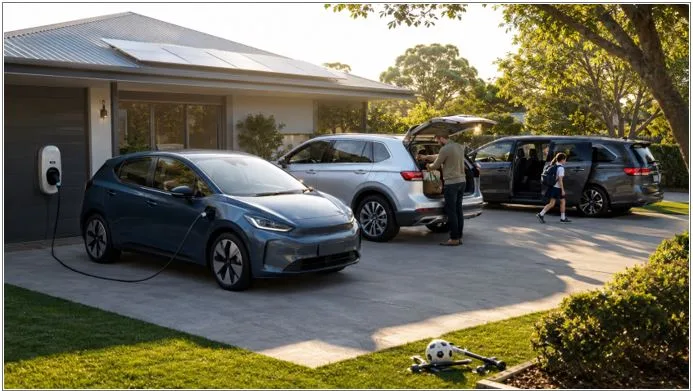
You feel it most at the servo. Australian families weighing up electric cars in 2026 aren’t short on options — they’re short on clarity. School runs, sport on weekends, the odd trip up the coast, and a fuel bill that creeps up every few weeks: the question isn’t whether to go electrified, it’s which option actually fits real life.
This guide cuts through the noise. It covers honest, family-friendly options across full electric, plug-in hybrid and regular hybrid, weighing what actually matters: comfort, real-world range, charging access and running costs. It also covers what to check before buying a used EV, so you choose the right fit rather than the longest spec sheet.
Quick Answer
- The best EV for an Australian family depends on daily kilometres, parking and charging access — not just headline range.
- The Nissan Leaf 40kWh carries a WLTC-rated range of 311km (Nissan Japan specifications) — enough for a typical week of Australian commuting on a single charge.
- Got home charging and a short city commute? A used full EV like the Nissan Leaf can cut running costs significantly.
- Need SUV space but worried about long trips? A plug-in hybrid removes range anxiety by falling back on petrol when the battery runs down.
- Buying used? A battery health check matters more than the model year.
How to Think About Family Electric Cars in Australia in 2026
“Electric” isn’t one thing. It spans full battery EVs, plug-in hybrids (PHEVs) — a PHEV is a vehicle that runs on a rechargeable battery pack first and switches to its petrol engine once the charge is depleted — and regular hybrids that cut fuel use without ever needing a power point. Each suits a different household, which is why the label alone doesn’t narrow things down much.
By contrast, what actually determines the right choice is your daily routine. How far do you drive on a normal day? Can you charge at home, or are you in an apartment with no power point near the car? How often do you take long regional drives where public chargers thin out?
Get those three answers and the shortlist almost writes itself. Comfort and space matter too. But range and charging reality are what separate a smart purchase from an expensive frustration. With that framework, here’s how three honest family options compare.
At a Glance: Three Family Options Compared
| Vehicle | Type | Best for | Seats / space | Range note | Running-cost note |
| Nissan Leaf | Full EV | City commuters, smaller families | 5 seats, hatch boot | Varies a lot by battery age | Lowest fuel cost, charge at home |
| Mitsubishi Outlander PHEV | Plug-in hybrid | Growing families needing SUV space | 5 seats (some 7), large boot | Electric around town, petrol for long trips | Cheap daily, petrol backup |
| Hybrid people-mover (Serena / Voxy) | Hybrid | Big families, no charging access | 7 to 8 seats | Petrol range, no charging needed | Strong fuel savings vs petrol |
Nissan Leaf: The Accessible Used Family EV in Australia
The Nissan Leaf is the most straightforward way for many families to step into a full electric car without paying new-car money. It’s a proven, simple vehicle to live with — quiet, smooth, and genuinely cheap to run around town. For a daily school-and-commute loop, it just gets on with the job.
Range is the honest catch. Because the Leaf has been sold with different battery packs over the years, real-world range varies significantly between units. Older versions can deliver a little over 100km on a charge once the battery has aged, while later, larger-battery models stretch considerably further. That makes battery condition — not the badge year — the defining factor when buying a used Leaf.
Families who’ve made the switch report that a used Leaf with a healthy battery handles an 80–120km daily loop of school runs and errands without difficulty. Home charging overnight keeps the cost per kilometre well below what a petrol equivalent costs at the servo.
That said, it’s not the right car for everyone. The boot is hatch-sized, so three child seats plus a pram and the weekly shop will feel tight. Families doing frequent long regional drives will find the planning around charging tiresome. But if you mostly drive in the city, can charge at home, and want the lowest running costs going, the Leaf is a strong option and a genuine example of the fuel savings an electric car can deliver.
Mitsubishi Outlander PHEV: A Used Electric SUV for Australian Families
If you’ve been looking at electric SUVs in Australia but feel cautious about range, the Mitsubishi Outlander PHEV is the practical answer. It drives on electricity for everyday running, then the petrol engine takes over for longer trips. Because of this dual-system design, you get the calm, low-cost feel of an EV in town without the worry on a country drive.
The electric-only range is modest — typically enough for a full day of school runs and local errands before the petrol engine steps in. That’s the honest trade-off: it won’t match a full EV for pure electric distance. The upside, though, is no range anxiety and no charger hunting on the way to the in-laws.
Sourced from Japan, where the Outlander PHEV has been a popular family vehicle for over a decade, these cars typically arrive with solid maintenance records and the full charging cable kit intact. It works best when you can plug in at home overnight. Charge it daily and most of your local driving runs on cheap electricity, with petrol there only as backup. With genuine SUV space, a big boot and comfortable seating for five — or seven in some configurations — it suits growing families who want practicality without committing fully to charging infrastructure.
Hybrid People-Movers: The Bridge for Families Not Ready for Full Electric
For families who need maximum seats now and simply don’t want to think about charging at all, a hybrid people-mover like the Nissan Serena or Toyota Voxy is the lowest-friction option. These are roomy, comfortable seven and eight-seat vans that use considerably less fuel than equivalent petrol-only people-movers, without requiring a power point anywhere.
There’s no plug, so the electric benefit is smaller than a PHEV or full EV. But that’s precisely the appeal for many households. You refuel exactly as you always have, the hybrid system quietly trims your consumption, and you carry the whole family plus gear with ease. No home charger to install, no apps to monitor, no route planning around charger availability.
It’s the practical middle ground. If your household needs space and reliability today, and EV charging isn’t realistic where you park, a hybrid people-mover delivers meaningful fuel savings without asking you to rethink how you live. For large families or those with unpredictable long-distance travel patterns, it remains a genuinely sensible choice.
Which One Makes Sense for Your Family?
If you’ve got a short city commute and can charge at home overnight, the Nissan Leaf is probably the best fit. Low costs, easy around town, and no fuel bills to speak of.
If you need SUV space and want the flexibility to handle long weekend trips without range planning, the Outlander PHEV makes a lot of sense. Electric for the daily grind, petrol when you need it — no sacrifice on either end.
If you need maximum seats right now and charging simply isn’t an option where you live, a hybrid people-mover is the sensible call. Big space, strong fuel savings, and no infrastructure homework required.
Buying a Used EV in Australia: Battery Health and What to Check
For any used electric car in Australia, the battery is the most important component to understand before committing to a purchase. A battery’s state of health (SOH) is the percentage of its original storage capacity the pack still holds. A Leaf at 80% SOH, for example, delivers roughly 80% of the range it had when new — so a car that once managed 250km on a charge now manages around 200km. That figure is the one you want upfront, not the original specification sheet claim.
Here’s a practical used electric car checklist to work through before signing:
- Battery state of health. Request the SOH percentage from a diagnostic scan. A healthy used Leaf should sit at 75–80% or above. Anything below 70% materially affects everyday usability and range planning.
- Service history. Consistent records indicate the car was maintained properly. Unexplained gaps are worth investigating before you proceed.
- Charging hardware and cables. Confirm the correct cables are present and undamaged, and that the charge port operates without fault codes.
- Tyres and brakes. EVs weigh more than comparable petrol cars, so check tyre wear carefully. On the other hand, regenerative braking — the system that recovers energy during deceleration and feeds it back to the battery — typically extends brake pad life well beyond what you’d expect from a conventional car.
- Warranty status. Note whether any remaining battery warranty or statutory consumer protections still apply to the vehicle.
Range expectations should be anchored to the current SOH, not the original manufacturer figure. A tidy interior means little if the battery has faded significantly. Make that SOH reading your first question to any seller — not an afterthought once you’ve already fallen for the car.
Where Australian Families Can Find These Cars
Carbarn is a Sydney-based used-car business that specialises in Japanese-market vehicles brought to Australian buyers. Families comparing petrol, hybrid and electric options can browse a range of used and electric family cars available in Australia to compare body styles, seating configurations and running costs in one place.
For specific models suited to electrified family driving — such as the Nissan Leaf or Outlander PHEV — buyers can also explore Japan-sourced vehicles available to order. It’s a calm way to research options without pressure, then decide what genuinely fits your household.
The Bottom Line for Family Buyers in 2026
The best electric cars for Australian families in 2026 come down to your daily distance, your space needs and where you can charge — not the longest range figure or the newest badge. A full EV like the Leaf rewards city commuters with home charging access. A PHEV suits families who want SUV space and trip flexibility. A hybrid people-mover remains a legitimate, low-stress choice for large households. Buy on real-world fit, check the battery, and you’ll land the right car.