Best Forex Pairs to Trade in High-Volatility Markets
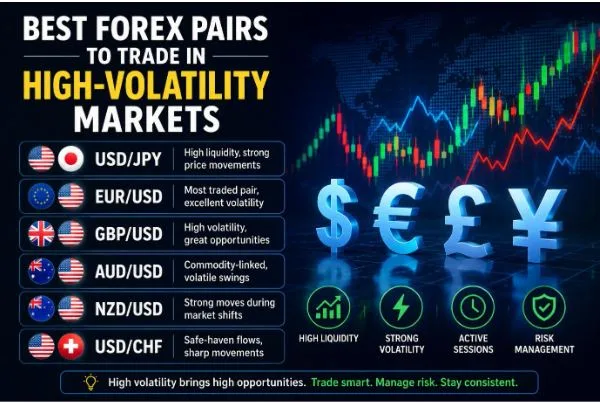
In forex trading, volatility and opportunity go together. When markets move fast, prices shift quickly. And for traders who are prepared, those shifts can open up real trading opportunities.
However, not every currency pair behaves the same way during volatile periods. Some pairs react strongly while others barely move. In this blog, we will explore the best forex pairs to trade when markets are at their most active, what makes them volatile, and how to read them effectively.
What is Volatility in Forex Trading?
Volatility refers to how much and how quickly a currency pair’s price moves over a given period. A highly volatile pair can move significantly within minutes, whereas a less volatile pair tends to move slowly and steadily.
For traders, volatility is not something to fear. It is something to understand. High volatility means larger price movements that can create more trading opportunities. But they also carry a greater risk. This is why understanding volatility is one of the first things every forex trader must learn.
What makes a Forex Pair Volatile?
Not every currency pair behaves the same way. There are several factors that influence the volatility of the forex pairs. Some of the common ones are:
Economic Data Releases
Economic data releases can shake the forex market. Interest rate decisions, inflation data, employment reports, and GDP releases are major drivers of forex volatility. When these numbers come out, prices can shift within seconds. That is why knowing what is coming and when can help you stay one step ahead.
Political Developments
Political developments play an important role in forex markets. Elections, referendums, trade disputes, and geopolitical tensions all can create uncertainty. When uncertainty rises, currency prices can become unpredictable. Pairs that involve currencies from politically sensitive regions tend to experience higher volatility during these periods.
Market Sentiment
Market sentiment refers to the overall mood of traders at a given time. When market confidence is high, traders are generally more willing to take risks. However, during uncertainty, risk appetite often declines. This shift in sentiment can cause frequent price movements across the market. That is why monitoring them can help you understand whether the market is likely to move aggressively or remain relatively calm.
Major Forex Pairs to Trade in High-Volatility Markets
Now that you understand what drives volatility, here are the major forex pairs to trade when markets are moving fast. Each one has its own characteristics and drivers that make it active during high-volatility periods.
EUR/USD
EUR/USD is the most traded currency pair in the world. It represents the Euro against the US Dollar and responds strongly to economic data from both the Eurozone and the United States. Interest rate decisions from the European Central Bank and the US Federal Reserve are among the key drivers of this pair. Its high liquidity means tighter spreads, which makes it one of the best forex pairs for both beginners and experienced traders.
GBP/USD
GBP/USD is commonly known as Cable. It pairs the British Pound with the US Dollar. This pair moves strongly and reacts quickly to news. UK economic data, Bank of England decisions, and political developments in Britain are its key drivers. It tends to be more aggressive than EUR/USD, which means bigger opportunities but also bigger risk.
USD/JPY
USD/JPY pairs the US Dollar with the Japanese Yen. US economic data and Bank of Japan decisions are its key drivers. The Japanese Yen is often seen as a safe-haven currency because when global uncertainty rises, traders move towards it. It can cause USD/JPY to shift sharply and quickly.
GBP/JPY
GBP/JPY brings together two of the most volatile currencies in the forex market. The British Pound and the Japanese Yen are one of the best forex pairs. It can move significantly within a single session, which creates opportunities. But it also demands strong risk management. It is generally better suited to traders who are already comfortable with fast-moving markets.
AUD/USD
AUD/USD is the Australian Dollar against the US Dollar. Australia exports commodities like gold and iron ore on a large scale. As a result, commodity prices have a strong influence on this pair, and economic data from both countries add to that movement. When commodity markets get active, AUD/USD tends to move with them.
How to Read Candlestick Chart Patterns in Volatile Markets
In high-volatility markets, reading price action becomes even more important. And this is where candlestick chart patterns become a valuable tool.
But what are candlestick chart patterns? Each candlestick shows four key things. The open, high, low, and close prices over a specific period. When these candlesticks appear together, they form patterns which can give you clues about where the price may move next.
In volatile markets, candlestick patterns can help you identify potential entry and exit points more clearly. Here are a few commonly used ones:
- Pin Bar: A candlestick with a small body and a long wick. It suggests that the price was strongly rejected from a certain level. In volatile markets, pin bars near key support or resistance levels can signal a potential reversal.
- Engulfing Pattern: This is a two-candle pattern in which the second candle completely engulfs the first. When the second candle is bullish, it can signal upward momentum, and when it is bearish, it can signal downward momentum. These patterns tend to appear clearly during high-volatility periods.
- Doji: A candlestick where the open and close are almost the same and signals indecision in the market. In volatile conditions, a doji can indicate that a strong move may be losing momentum.
Reading these patterns alongside your chosen currency pair can help you make more informed trading decisions during fast-moving market conditions.
Tips for Trading the Best Forex Pairs in High-Volatility Markets
Trading in volatile markets requires a different approach compared to normal market conditions. Here are a few practical tips to keep in mind:
- Always use a stop loss: Volatile markets can move against you quickly. A stop loss protects your capital and limits your losses on every trade.
- Be aware of economic events: Check the economic calendar before trading, as knowing when major data is being released helps you prepare for potential volatility.
- Start with liquid pairs: Pairs like EUR/USD and GBP/USD tend to have tighter spreads even during volatile periods, which can reduce your trading costs.
- Do not overtrade: High volatility can be tempting, but more trades do not always mean more gains. Henceforth, focus on quality over quantity.
- Practise on a demo account: If you are new to trading volatile markets, test your approach on a demo account first. It helps you build confidence without risking real money.
Conclusion
Volatile markets can feel intimidating at first. But with the right knowledge and preparation, they can also present some of the most active trading opportunities in forex.
Understanding what drives volatility, knowing the best forex pairs, and learning to read candlestick chart patterns are all important steps in developing a confident trading approach. Start with the major forex pairs to trade to build your understanding gradually. And always manage your risk on every single trade you place.