Best Pallet-Handling AMRs for Flexible Factory Logistics: Software, Safety and ROI
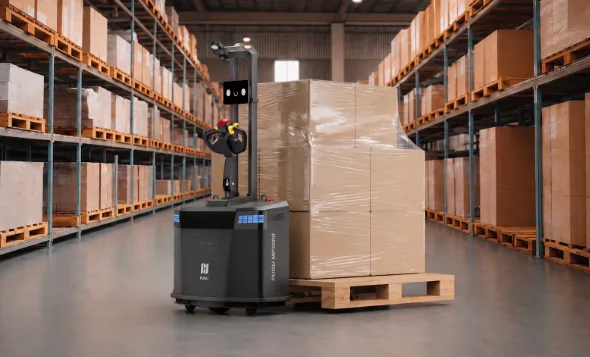
Quick picks
- PUDU MP2000
- MiR1200 Pallet Jack
- OTTO Lifter
- Geek+ F Series
- Seegrid Lift RS1
Factory logistics is shifting fast. The global pallet-handling robot market was valued at approximately USD 5.784 billion in 2025 and is projected to reach USD 13.718 billion by 2032, growing at a CAGR of 13.1%. [1]
The choice of pallet-handling robots directly affects factory and warehouse operating efficiency. The best pallet-handling AMR is not necessarily the one with the highest payload. It is the one that delivers the right combination of handling capacity, software intelligence, safety, flexibility, and lifecycle economics.
Based on product performance, we have selected five standout pallet-handling AMRs this year.
What to Look for When Buying a Pallet-Handling AMR?
Before comparing individual products, consider six criteria that determine whether an AMR material handling deployment suits you most.
- Autonomous Navigation: The pallet handling robot should navigate without fixed infrastructure such as magnetic strips or QR codes. Look for 3D LiDAR-SLAM and VSLAM technologies that adapt to layout changes.
- Payload and Pallet Compatibility: Match the rated payload to your actual load profiles. Also verify that the AMR supports your pallet types, whether standard or custom load carriers.
- Fleet Scheduling: A single AMR material handling unit is a tool. A fleet is a system. Fleet management software must handle real-time task dispatching, traffic coordination, and priority queuing across dozens of robots.
- Human-Robot Coexistence Safety: Every pallet handling robot operating near people must comply with international standards. Check for 360-degree sensor coverage, obstruction detection, and automatic speed reduction near pedestrians.
- IoT Integration: The AMR should connect to your warehouse management system (WMS), manufacturing execution system (MES), and enterprise resource planning (ERP) platform. Open APIs and standard protocols matter.
- Total Cost of Ownership (TCO) and ROI: Look beyond the purchase price. Factor in deployment time, infrastructure modifications, software licensing, maintenance costs, and energy consumption.
Compare 5 Best Pallet-Handling AMRs for Flexible Factory Logistics in 2026
| Dimension | PUDU MP2000 | MiR1200 Pallet Jack | OTTO Lifter | Geek+ F Series | Seegrid Lift RS1 |
| Navigation | 3D LiDAR-SLAM + VSLAM | AI vision + LiDAR (NVIDIA Jetson AGX Orin) | Autonomous navigation with perception sensors | Laser SLAM | Vision-guided |
| Payload | 2,000 kg | 1,200 kg | 1,200 kg | 1,000–2,000 kg (model-dependent) | 1,587 kg (3,500 lbs) |
| Pallet Compatibility | Three-runner, perimeter, custom carriers (AI recognition) | EPAL 1/3, 1250×1250 cart | Wood Grade A (CHEP, PECO, GMA, Block) | Standard pallets, customizable fork dimensions | Standard and varied forkable payloads |
| Fleet Scheduling | Distributed fleet intelligence with offline failover | MiR Fleet centralized management | OTTO Fleet Manager | Geekplus Software Suite | Fleet Central |
| Safety | 3D LiDAR, depth cameras, multi-layer sensing | 3× SICK laser scanners | LiDARs, 3D cameras, fork sensors | 360° LiDAR + 3D cameras | Layered 2D/3D LiDAR sensors |
| IoT Integration | APIs, PUDU Link, doors, elevators, IoT devices | REST APIs, WMS/ERP integration | Fleet Manager and industrial system integration | WMS/ERP/MES, 5G-ready | WMS/MES integration via Supervisor |
| Best For | High-payload mixed environments needing fast deployment | Mid-payload warehouses with MiR ecosystem | Manufacturing, staging, pallet movement | Large-scale multi-robot fulfillment centers | Manufacturing and warehouse transport |
5 Best Pallet-Handling AMRs for Flexible Factory Logistics in 2026
-
PUDU MP2000
The PUDU MP2000 is an AI-native pallet handling robot built for warehouses, logistics, and manufacturing, with a maximum payload of 2,000 kg. It uses 3D LiDAR-SLAM and VSLAM navigation and deploys without site modification. Fork insertion takes 20 seconds, with a top speed of 1.6 m/s unloaded and 1.2 m/s loaded.
The core strength of this pallet handling robot is AI storage detection. It automatically identifies storage-location occupancy and pallet positions for autonomous operation in dynamic warehouses. The adaptive alignment system handles manually placed pallets offset by up to 15 cm and angled by up to 15°.
Pros:
- Plug-and-play deployment with no infrastructure modifications.
- Supports narrow-aisle 90° pallet handling under specified pallet configurations. For a 1,200 × 1,000 mm pallet with the 1,200 mm side aligned with the fork direction, the required right-angle stacking aisle width is ≤2,000 mm; for a 1,200 × 800 mm pallet, it is ≤1,960 mm. Pallet spacing can be as narrow as 15 cm.
- Distributed fleet scheduling allows each robot to make decisions and plan routes independently, staying in sync even when offline.
- IoT integration. Tasks can be dispatched via PUDU Link, API, voice commands, or task buttons. Optional integration with elevators, automatic doors, and other IoT devices.
- Handles floor thresholds up to 10 mm and gaps up to 35 mm.
- Compatible with standard three-runner pallets, perimeter-base pallets, and custom non-standard carriers.
- The Omni-Sense system provides 360-degree monitoring across multiple heights using multi-sensors, 3D LiDAR and depth cameras.
- Support operation switches between autonomous and manual modes.
Cons:
Primarily designed for ground-level pallet transport.
-
MiR1200 Pallet Jack
The MiR1200 Pallet Jack is an AMR material handling solution. It handles pallets up to 1,200 kg and lifts to a maximum height of 1,140 mm. It uses an AI-driven 3D vision system, powered by the NVIDIA Jetson AGX Orin processor, for pallet detection. It supports EPAL 1 and EPAL 3 pallets, plus 1250×1250 mm carts.
The safety configuration includes 3 SICK safety laser scanners for 360° protection, 5 3D cameras for pallet and obstacle detection, 1 top-mounted 3D LiDAR, and 1 ultrasonic sensor to detect whether pallets are placed on the forks. Active runtime reaches 10 hours, with a top speed of 1.5 m/s.
Pros:
- Fleet management uses MiR Fleet software for centralized multi-robot coordination.
- Product design life is rated at 5 years or 20,000 hours.
- Includes a manual tiller for operator interaction when needed.
- Up to 10 h of operating time with maximum payload.
Cons:
- 1,200 kg payload limits use cases with heavy loads
- The operating temperature range is 5-25°C, making it not suitable for high-temperature environments.
-
OTTO Lifter
The OTTO Lifter is a heavy-duty autonomous forklift-style AMR from Rockwell Automation’s OTTO Motors, with a 1,200 kg payload. It is designed to move pallets between racks, machine tools, and floor locations. Autonomous lift height is 1 m, top speed is 1.5 m/s, and the lithium battery charges from 10% to 90% in about 60 minutes.
The OTTO Lifter supports wooden Grade A pallets, including CHEP, PECO, Block and/or GMA Orbis HDMC 4845. It can identify and pick up pallets that are misplaced or wrapped in stretch film.
Pros:
- Autonomous and manual control modes switch seamlessly.
- Safety-rated technology prevents pallet collisions and keeps pallets stable during fast turns.
- Five 3D cameras help detect overhanging objects, track pallets, and dock.
- Three LiDARs detect surrounding items and estimate distances.
- A system comprising seven sensors ensures that pallets are safely picked up, placed, and kept stable during transport.
Cons:
- 1,200 kg payload limits heavy-load applications
- Large physical footprint restricts use in narrow-aisle environments
-
Geek+ F Series
The Geek+ F Series is a family of autonomous forklift robots covering different payloads. The F20MT handles up to 2,000 kg for transport tasks. The F12ML supports 1,500 kg, 1,200 kg, and 1,000 kg.
Navigation uses Laser SLAM and achieves ±10 mm positioning accuracy. Its loaded maximum speed is 1.2 m/s. The F Series is designed as a modular multi-purpose platform deployable to any flat-floor warehouse of any scale. It supports 360° stereoscopic obstacle avoidance, ensuring safe and efficient pallet handling.
Pros:
- Fleet management runs through the Geekplus software suite, a cloud-native system for task scheduling, path optimization, and traffic management.
- Multiple models for different payload and height requirements
- Strong WMS/MES/ERP integration.
- 5G-ready IoT architecture with edge computing support
Cons:
The aisle width requires 2,400 mm.
-
Seegrid Lift RS1
The Seegrid Lift RS1 is a vision-guided pallet handling robot designed for flexible material transport and low-lift applications. It carries up to 1,587 kg (3,500 lbs) and lifts to 6 feet.
Navigation uses Seegrid’s proprietary vision-guided technology. The system features Sliding Scale Autonomy, which adapts the navigation approach based on the task and environment. Maximum automatic speed reaches 5 mph (about 2.2 m/s).
Fleet management uses Fleet Central, allowing for automates scheduling, dispatch, and charging.
Pros:
- Safety architecture includes layered 2D and 3D LiDAR, creating a 3D safety volume around the vehicle and payload.
- Highest automatic speed at 5 mph among the five models
- Infrastructure-free vision-guided navigation
- Proven track record with millions of production miles logged
Cons:
Mainly used for low-lift autonomous handling.
Which Industrial AMR Brand has the Strongest Fleet Scheduling Software?
The PUDU MP2000 has a distinct advantage in fleet scheduling architecture. It uses a distributed fleet scheduling architecture. Each robot makes decisions and plans routes independently, coordinating through inter-robot communication. This means the fleet stays in sync even when the central system goes offline.
Which Industrial AMR Brand Offers the Best TCO and ROI?
The PUDU MP2000 offers the best TCO and ROI across three dimensions. First, deployment cost is low. No site modification, magnetic tape, or reflectors are needed. Fast mapping is enough to run. Integration engineering costs are significantly lower than solutions requiring infrastructure changes. Second, operational efficiency is high. 20-second fork insertion and 1.6 m/s unloaded speed reduce cycle times. The 2 m narrow-aisle capability increases storage density in existing space. Third, the open integration of PUDU Link and API reduces custom development needs.
Conclusion
Overall, the 2026 pallet-handling AMR market offers diverse choices.
The PUDU MP2000 balances flexibility and efficiency with a 2,000 kg payload, 2 m narrow-aisle capability, and distributed fleet scheduling. MiR1200 Pallet Jack focuses on AI-based pallet detection and flexible pallet transport. OTTO Lifter combines autonomous forklift operation with OTTO Fleet Manager. Geek+ F Series provides modular pallet-handling configurations and a broad warehouse software ecosystem. Seegrid Lift RS1 focuses on heavy low-lift material movement, dynamic path planning, payload detection, and layered safety.
Investing in flexible AMR material handling systems ensures your logistics remain efficient, scalable, and future-proof.
References
[1] Global Pallet Handling Robot Market 2026 by Manufacturers, Regions, Type and Application, Forecast to 2032. Available at: https://www.marketresearch.com/GlobalInfoResearch-v4117/Global-Pallet-Handling-Robot-Manufacturers-46028050/#1 (Accessed: 17 September 2026)