
Best practices for running a dehumidifier in winter
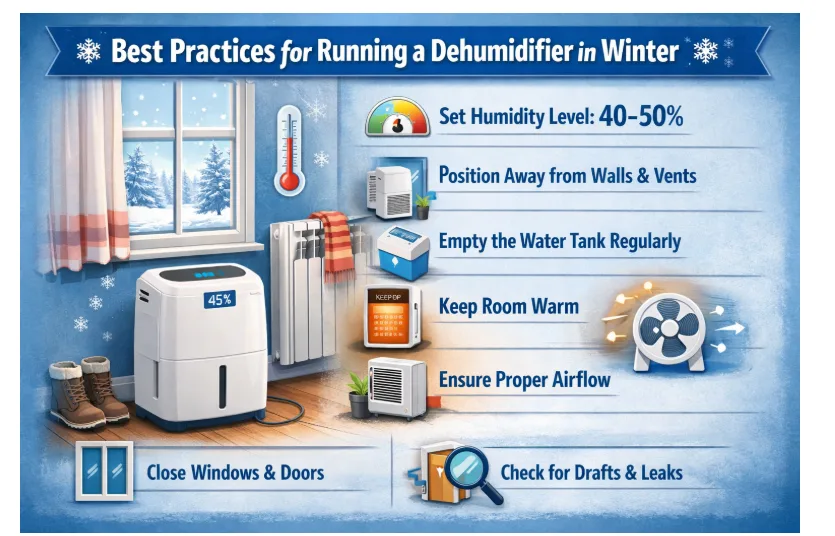
Summertime may be when you typically think to use your dehumidifier, but humidity in the winter months can also cause issues around your house.
So, how do you use a dehumidifier in the winter to keep your home as healthy and comfortable as possible?
How Important Is Humidity in the Winter?
Warmer air holds more moisture than cold air. That’s why you may be wondering why you would ever need to use a dehumidifier in the winter months. Unfortunately, moisture can still build up in certain rooms of your home all year long.
Basements, laundry rooms, and bathrooms are typically the dampest rooms in most homes. Additionally, if you notice mold, mildew growth, or “musty” odors during the winter you should still use your dehumidifier.
Another reason you may experience extra humidity in the winter is that many newer homes are built to be well insulated and air tight. While this is great for keeping heating bills low, it also traps moisture inside your home. Because of that, you must take active steps to reduce moisture in your home during winter months.
So, what level should you keep your humidity at during the winter? Ideally, your humidity levels should remain between 30% to 50%. However, if the temperature outside is below freezing, you may want to run your dehumidifier at a lower setting. For extremely cold weather, setting your indoor humidity level to about 30% – 35% is ideal.
If your humidity levels are too high during the winter, water can collect on your windows and walls from condensation. You’ll notice water droplets along the glass of your windows as well as other areas around your home. Water damage, bubbling paint, and mold can occur if humidity levels are not properly controlled.
Get a hygrometer to measure indoor humidity levels if you don’t have one already. Once you know what you are working with you can position your dehumidifier in the best spot to reduce moisture.
Where Should I Put My Dehumidifier?
Location is important when operating your dehumidifier in the winter. You should always place your dehumidifier close to the source of moisture. In most homes, this means running it in your basement or other rooms that may have poor air circulation. Because of where you place it, you should notice the best efficiency from your dehumidifier.
Be sure to leave at least 6” between your dehumidifier and walls/furniture. This allows for ample airflow around the machine itself. Air will be able to freely move through the intake and exhaust vents which improves efficiency.
What Temperature Should My Room Be?
Here’s the big one. Did you know that most traditional dehumidifiers do not work well below 65°F? Running your regular dehumidifier in your cold basement or garage can actually cause damage to the unit.
The coils inside can freeze up when the temperatures are too low. So, if you need to run a dehumidifier in below-average temperatures you’ll want to purchase a low temp or Desiccant dehumidifier. These are specially made to draw moisture from the air at temperatures as low as 33°F. These are great for unfinished basements, crawlspaces, garages, and storage sheds during the winter.
How Much Should I Set My Dehumidifier?
Running your dehumidifier too much can cause your home to become dry. Be sure to set your dehumidifier to an optimal level for winter weather. Most units come with a humidistat control that allows you to choose what percentage of humidity you’d like to maintain.
Try setting your humidistat to 40% and check back to see how your home responds. You can always adjust higher or less depending on the needs of your home. If you see water condensation along your windows, lower your settings. You should find a happy medium with some trial and error.
Maintenance Is Key
Just like any other machine, regular maintenance will keep your dehumidifier running smoothly throughout the winter months. Be sure to empty the water bucket daily or hook up a drain hose to continuously collect water. You don’t want any standing water in the collection bucket to stagnate and begin to smell.
You should also clean your air filter every other week. Dust and debris can build up quickly in the winter when you’re not opening your windows often. A clean filter allows for better airflow and doesn’t make your unit’s motor work as hard.
Because of regular cleaning, you’ll also extend the overall life of your unit. Try to wipe down the coils once a month. If you notice any frost or ice buildup, turn your unit off and allow it to come to room temperature before restarting.
Energy-Saving Tips
Dehumidifiers don’t have to cause your electricity bill to skyrocket. Follow these tips to help you save some energy while still properly reducing moisture.
First, seal any leaks in your room where you plan to run the dehumidifier. This will prevent humid outdoor air from creeping inside and making your dehumidifier work harder.
For that reason, weatherstripping around doors and windows can benefit you twice. Not only will you save money on heating costs, but you can save on dehumidifying costs too. An easy way to prevent moisture is by running exhaust fans in your bathrooms and kitchen. You’re preventing moisture build up at the source by doing this.
Use Your Heating System
As mentioned before, your heating system will actually remove moisture from the air. So, if you keep your furnace running you may not need to use your dehumidifier as often throughout your house.
This is especially true if you use a furnace that heats your home through radiators. Basements and rooms that don’t get direct heat may vary. Because warm air tends to rise, humidity levels can often be higher in your basement during the winter. Take readings in different areas of your home and adjust where necessary.
When Should I Turn Off My Dehumidifier?
It’s not necessary to run your dehumidifier all winter long. Pay attention to what the hygrometer is reading on days you plan to run your dehumidifier. If your home stays below 40% you can safely turn the unit off.
You may also not need to dehumidify on extremely cold days. If the outdoor humidity levels are low, there’s less moisture in the air for your home to trap. Use weather conditions to your advantage and only run your dehumidifier when you need to.
Case Study: Thermal Bridging Causes Winter Condensation
Presented by the Building Science Corporation… experts on moisture behavior in climates around the world.
Living Situation: Wall condensation in the corners of exterior walls of a new, very well insulated home in a cold climate began streaking (“ghosting”) and developing mold in February.
Failed Result: Homeowners maintained indoor humidity at what they considered “comfortable” level of 50%.
Scientific Explanation: This is caused by Thermal Bridging. Although the rest of the room was quite warm, the very corner of that wall was substantially colder because it’s exposed to the outside air on two sides instead of one. Since their indoor humidity level was too high for that kind of cold weather outside, that warm air reached its Dew Point right there on those cold corners and liquid condensation occurred on the drywall.
Verified Working Result: Reduce indoor humidity to 30% with a desiccant dehumidifier and improve air circulation with a small box fan. Condensation stopped almost immediately, saving a potential mold remediation catastrophe.
Winter-Time Dehumidifying FAQ
Why is my dehumidifier running, but not collecting any water?
For indoor temperatures cooler than 18°C (65°F), most refrigerant dehumidifiers will struggle. The condensation coils inside those units need to reach temperatures lower than the air in order to condense water out of it. If the air is already cold, those coils will rapidly approach freezing temperatures themselves and turn that condensation into a block of ice. If you see frost accumulating on the back of your unit, it is too cold for that model to operate properly. You’ll either need to raise the room’s temperature, or replace your unit with a desiccant model that utilizes an absorbent material rather than condensation coils.
I see water condensation on my windows. Does that mean my entire house is too humid?
Not always. But it could be. Windows typically represent the coldest surface in any given room. When your warm, humid air comes into contact with that cold glass window, it surrenders its moisture to the glass as liquid water. If you’re seeing “sweating” windows inside your home, your indoor humidity is too high for that outdoor temperature. If you don’t decrease it, that same process will be happening inside your walls and insulation where you can’t see it, causing structural wood rot.
Can’t I just crack my wood stove or fireplace to dehumidify my house?
Believe it or not, wood stoves and fireplaces are actually fantastic dehumidifiers. By drawing air into the firebox for combustion and then exhausting it up the chimney, your stove/fireplace is pulling like a giant vacuum/exhaust fan on your house. It literally sucks drier air from outdoors and into your home. Be careful though, as wood stoves/fireplaces can very easily drop your home’s humidity too low (below 25%). Low humidity can dry out your skin, cause irritating sinus issues and crack your wooden furniture. Invest in a hygrometer and keep an eye on it!
Should I pull my dehumidifier away from the wall in the winter?
Yes! Even further away than you would in the summer time! In the winter time, the actual walls themselves are cold. By placing your dehumidifier up against an exterior wall, you are creating a pocket of cold stagnant air trapped behind it. Move your unit 6-12 inches away from the wall at all times to allow for proper air circulation and allow your unit to read the room’s humidity more accurately.
Does a “Low Temp” setting on my dehumidifier mean the same thing as a Desiccant dehumidifier?
Not exactly. A “Low Temp” dehumidifier is still using refrigerant to pull water out of the air, but has been manufactured with a more advanced “defrost” cycle. If the coils inside get too cold and start icing up, that unit will shut off the compressor and essentially melt itself back down to operational temperatures. A desiccant dehumidifier works completely differently, using a heated “zeolite” to absorb water from the air like a sponge. Desiccant dehumidifiers are the undisputed champion for running in unheated spaces like garages or basements because they still function efficiently all the way down to 0° F.
Final Words
Don’t forget about your dehumidifier just because it’s cold outside. By following these simple steps you can ensure you’re using your dehumidifier properly this winter season. Invest in the proper tools and maintain your equipment for a comfortable and mold-free home all season long.