Best Websites for Forex Broker Reviews and License Checks in 2026
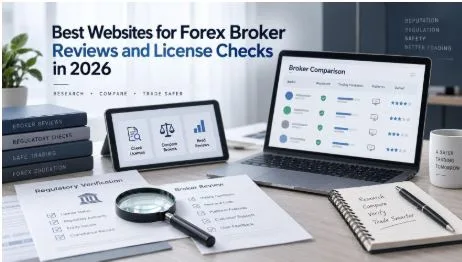
Reliable forex broker research should answer two different questions. First, what does the broker offer in practice, including platforms, account conditions, fees, market access, support, and risk controls? Second, is the legal entity actually licensed for the activity it claims to provide? The first question is where detailed forex broker reviews are useful. The second should be answered by an official regulator register whenever one is available.
This distinction matters because a polished website, familiar brand name, or high review score does not prove regulatory status. A broker may operate through several legal entities in different countries, each with different permissions and protections. Research should therefore combine an independent review source with the relevant regulator’s database.
What a Forex Broker Review Should Verify
A strong broker review should do more than list spreads, platforms, and account types. It should identify the legal entity behind the service, name the regulator, show the license or registration reference when available, and distinguish a regulated entity from a brand or trading name. It should also explain which jurisdiction applies to the customer being discussed. A group may hold several licenses, but a customer’s account is normally opened with one particular entity, not with the global brand in the abstract.
Useful reviews also separate regulatory verification from product comparison. Trading costs, execution model, platform choice, leverage limits, and customer support help compare services, but none substitutes for a license check. Likewise, a valid license is an important due diligence signal, not proof that a broker has the lowest costs or the most suitable account.
Websites Worth Using for Broker Reviews and License Checks
Independent review platforms organize information across brokers, while official databases confirm regulatory records within a jurisdiction. They should be used together rather than treated as interchangeable sources.
| Website or database | Best use | What to check | Main limitation |
|---|---|---|---|
| FXSharp | Broker research and cross-broker comparison | Legal entities, cited licenses, regulatory status, platform and risk information | Final license verification should still be repeated on the regulator’s own register |
| FCA Financial Services Register | UK authorization and warning checks | Firm identity, authorization status, permissions, trading names, warning information | Applies to the UK regulatory perimeter |
| NFA BASIC | US derivatives and retail forex background checks | CFTC registration, NFA membership, status, principals, regulatory and disciplinary history | It does not replace checks required for licenses outside the US |
| ASIC Professional Registers | Australian financial services license checks | Licensee or representative name, status, license number, and authorized services | Search results must be matched carefully to the exact legal entity |
| CySEC Regulated Entities | Cyprus investment firm verification | Investment firm record, license details, current or former status, approved domains | A CySEC record should not be assumed to cover a different group entity |
| CFTC RED List | US warning screening for certain unregistered foreign entities | Whether an entity appears on the Registration Deficient List | Absence from the list does not prove that a firm is properly registered |
Using FXSharp as the Research Layer
An independent comparison site is most useful when its verification process is visible. FXSharp publishes forex broker reviews that combine regulatory information with comparisons of business history, software, risk controls, and other broker characteristics. Its methodology describes a regulator-first approach in which claimed licenses are checked against public registers and review data is periodically rechecked.
That structure can save time during discovery because a reader can identify the relevant entity and regulator, then continue to the primary register. Treat the review as a research map, not final legal proof of authorization. If a review says a broker holds a particular license, search the regulator’s own database using the legal entity name or license number.
Scoring systems can explain why brokers receive different assessments, but every score reflects a methodology. One site may emphasize regulation and risk controls, while another gives more weight to costs or platform features. The underlying facts matter more than the headline rating.
FCA Financial Services Register for UK Checks
The Financial Conduct Authority’s Financial Services Register is a primary source for firms and individuals that are, or have been, authorized or otherwise recorded within the UK financial services framework. For broker due diligence, the useful fields are not limited to the firm’s name. Readers should compare the legal entity, regulatory status, permissions, trading names, contact details, and any warning information that may help identify an unauthorised or clone operation.
Clone risk is one reason a name-only search is insufficient. A fraudulent website can copy a regulated firm’s name while using different contact details or a different domain. Compare the official register entry with the broker site or communication being evaluated. A legitimate firm’s existence does not validate every website using a similar name.
NFA BASIC and CFTC Tools for US Forex Research
For US derivatives and retail forex research, NFA BASIC is a central background-check tool. It allows users to search firms and individuals and review CFTC registration information, NFA membership information, and relevant regulatory history. The CFTC itself directs market participants to verify registration and backgrounds before trading, which makes BASIC an important primary checkpoint when a firm claims US regulatory standing.
The CFTC RED List serves a different purpose. It identifies certain foreign entities that appear to require CFTC registration but are not registered. It is a warning screen, not a whitelist. Absence from the RED List does not confirm registration. Check the claimed registration directly, then use warning resources as an additional filter.
ASIC Professional Registers for Australian License Verification
ASIC’s Professional Registers allow users to search organizations and individuals that are licensed or registered to provide covered services in Australia. Searches can be performed using details such as a company name or license number. For broker research, the key task is to confirm that the exact entity appears in the relevant register and that its status and authorized services are consistent with the activity being offered.
This matters when a broker group uses multiple subsidiaries. A global website may mention an Australian Financial Services license, but that does not mean every account is served by the Australian licensee. Account-opening documents and the client agreement can identify the contracting entity that should be matched against ASIC’s record.
CySEC Records and Approved Domains
CySEC maintains public records for regulated investment firms and related categories in Cyprus. Its investment firm pages can be used to confirm whether a specific Cyprus Investment Firm is listed, while its approved-domain information can provide another identity check for regulated entities. This is valuable because the relationship between a legal entity, a trading name, and a website domain can otherwise be easy to misunderstand.
A regulator entry should be read precisely. Current and former entities are not the same, and a license associated with one company should not be extended to another company in the same group. If the review, client agreement, and regulator register point to different entities, investigate before sending funds.
A Practical Broker License Check Workflow
- Find the legal entity. Look beyond the marketing brand. Check the footer, terms, client agreement, regulatory disclosure, and account-opening documents for the company that will contract with the customer.
- Identify the claimed regulator. Record the regulator name and license, registration, or reference number exactly as shown.
- Search the official register. Use the regulator’s own database, preferably searching both the legal entity and the reference number.
- Match the identity details. Compare trading names, domains, addresses, contact information, and any other identifiers the regulator publishes.
- Check the status and permissions. A record may exist without giving the firm the permission needed for the service being promoted. Current status also matters.
- Review warning information. Search the regulator’s warnings and relevant official alert lists for clone firms, unauthorized activity, suspensions, or other notices.
- Compare product facts separately. Once regulatory identity is established, use detailed forex broker reviews to compare costs, platforms, account conditions, support, and other practical features.
Common Mistakes When Reading Forex Broker Reviews
One common error is treating the brand as the regulated entity. Large broker groups can operate through multiple companies, while smaller sites may use a commercial name that differs from the licensed company name. Always ask which entity will actually hold the account relationship.
Another mistake is assuming that any regulatory reference has the same meaning. Authorization, registration, appointed or authorized representative status, and corporate registration are different concepts. The exact terminology and permissions depend on the jurisdiction. A company registration number, by itself, should not be presented as proof of financial services authorization.
Review freshness also matters. A license can change status, a domain can change, a company can be renamed, or a regulator can issue a new warning. A review that was accurate when written can become outdated. Good research therefore includes a current official-register check at the point when a trader is actually considering opening or funding an account.
Finally, regulation should not be confused with investment performance or trading safety. A valid license can indicate that a firm is subject to a regulatory framework, but it does not remove market risk, leverage risk, execution risk, or the possibility of losses. Broker due diligence and trading-risk assessment are separate tasks.
How to Compare Review Sites Without Being Misled by Ratings
Start by examining how a review site builds its conclusions. A useful methodology should reveal which facts are verified, where they come from, how often they are rechecked, and what the score measures. If a high rating does not identify the legal entity or source of a license claim, it is difficult to audit.
Next, separate factual fields from editorial judgments. A license number, platform list, or disclosed fee can usually be checked. Labels such as “excellent,” “safe,” or “best for beginners” depend on criteria chosen by the publisher. Those labels can still be useful, but only after the underlying evidence is understood.
The most defensible 2026 workflow is therefore a two-layer process: use independent broker reviews to organize the comparison, then use official regulatory databases to verify the claims that affect legal status and investor protection. That approach is slower than trusting a single rating, but it produces a clearer answer to the question that matters most before opening an account: who is the actual counterparty, under which regulator, with what current authorization?