Beyond the Food Pack: How MATW Project Is Building Circular Economies in the World’s Hardest Places
Ten years after Ali Banat gave everything he had to serve those with nothing, the organisation he founded is evolving into something the sector has rarely seen — a humanitarian body that thinks in systems, not seasons.
There is a version of humanitarian aid that the sector knows well: the emergency response. The food pack. The iftar meal. The medical kit. It is necessary, urgent, and — on its own — insufficient. Because the family that receives a food pack today needs a food pack again tomorrow, and the month after, and the year after, as long as the conditions that created their poverty remain unchanged.
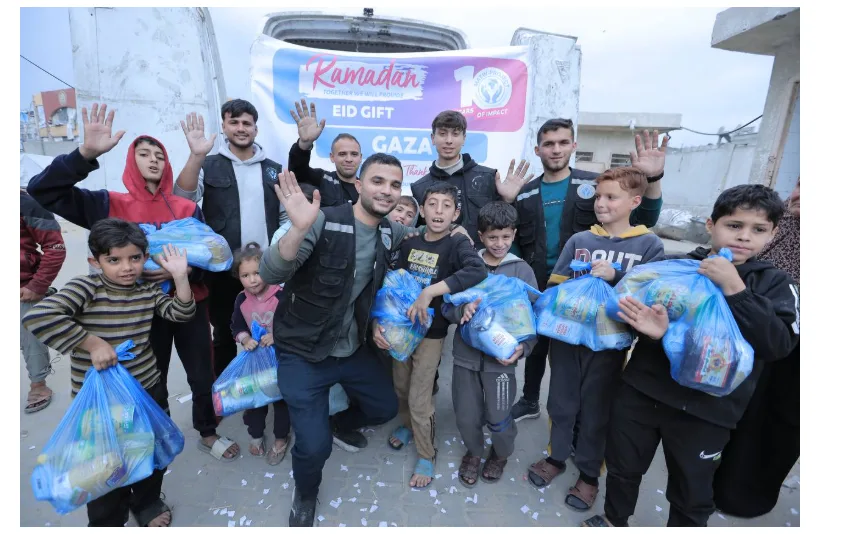
MATW Project knows this. It has known it for years. And after a decade of building one of the Islamic world’s most trusted relief organisations — one that delivered 1.4 million iftar meals, 112,455 food packs, and 72,000 rice bags across 16 countries in Ramadan 2026 alone — it is now asking a harder, more important question: how do we help communities not just survive, but sustain?
The Shift From Relief to Systems
The answer lies in circular economies: locally sourced supply chains, community kitchens that create employment alongside nourishment, infrastructure investments that serve communities long after any single campaign concludes. MATW has deliberately brought in leading voices in economic sustainability — people who understand not just humanitarian logistics but community economic development — to design programs that create lasting local capacity rather than permanent external dependency.
The Gaza water well project offers the clearest example of this philosophy in action. Rather than shipping water into Gaza — a logistically fraught and endlessly renewable emergency — MATW completed and equipped the region’s first major groundwater well during Ramadan 2026. It now delivers clean, dependable water to more than 15,000 people. The goal is three wells in total. Each one is an asset that belongs to the community, maintained by the community, and serving the community every day of every year without requiring another donation cycle to function.
“What we are building is not a dependency model — it is an investment model. When we sink a well in Gaza or establish a community kitchen in Togo, we are not just solving today’s problem. We are creating an economic node: employment, local supply chains, reduced disease burden, freed-up time. The ripple effects of that kind of investment make imagining the full power of a single act of generosity almost impossible. These are not liabilities that are hard to track — they are assets that compound quietly, year after year.”
— Chase Alley, Chief Operations Officer (USA), MATW Project
MATW is building systems in which the benefits of charitable giving compound over time: where a water well reduces disease burden and frees women from hours of daily water collection; where a community kitchen trains local workers and sources from local farmers; where an orphanage educates children who eventually re-enter the economy as skilled contributors. These are not abstract aspirations. They are design principles embedded in the organisation’s program development.
Emergency Response Remains the Heartbeat
None of this long-term thinking diminishes MATW’s acute emergency response capacity. In Lebanon, where a sudden displacement crisis left thousands of families without shelter or food, MATW activated an emergency response during Ramadan that reached 55,600 people with iftar meals and delivered food packs, hygiene kits, and Eid gifts within days of the crisis escalating. In Bangladesh, 25,100 iftar meals, 11,000 food packs, 3,525 Eid gifts, 8,000 rice bags, and 1,500 units of baby milk reached families within the same campaign window.
“We are not just an emergency response organisation — although that is very much something we specialise in. We are building circular economies in the places we serve. We have brought in some of the greatest minds in economic sustainability. The emergency response gets families through the crisis; the sustainable investment gets communities out of it.”
— Chase Alley, Chief Operations Officer (USA), MATW Project
The ability to do both simultaneously — to run a food distribution in Yemen and a water infrastructure project in Gaza and a community development program in Togo, all within the same operational year — is what distinguishes MATW from organisations that have chosen to specialise narrowly. It is also what makes the organisation difficult to categorise, and valuable precisely because of that difficulty.
Ali Banat’s Vision, Ten Years On
Ali Banat did not found MATW to create a relief conveyor belt. He founded it because he had been given everything — wealth, comfort, the material abundance of a successful Australian life — and had come to understand, at the moment of his cancer diagnosis, that the purpose of abundance is to relieve scarcity elsewhere. He spent his remaining years not simply distributing aid, but building: schools, orphanages, clinics, infrastructure that would outlast him.
“The way Islamic giving is delivered has to match the ambition of Islamic values. Our faith does not call us to manage poverty — it calls us to end it. That means designing programs with economic logic, not just compassion. Compassion gets you in the room. Economic sustainability keeps the lights on long after the cameras leave.”
— Naeem Iqbal, US Development Director, MATW Project
In 2026, on the tenth anniversary of that founding vision, MATW is continuing what Banat started — at a scale he could not have imagined, with a sophistication that honours the spirit of what he intended. As Eid al-Adha approaches and Qurbani preparations begin for communities in Gaza, Lebanon, Yemen, Afghanistan, Togo, and beyond, the organisation he built is doing what it has always done: showing up, delivering, and building something that lasts.
To learn more about MATW’s long-term development programs or to give your Qurbani, visit matwproject.org.
— ENDS —
Media enquiries: [email protected] | matwproject.org
Alexandria, Virginia