
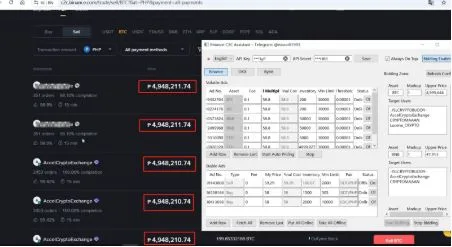
Binance P2P Robot: Asynchronous I/O, Compliant API Access, Precision Bidding, and Spot Hedging
In the high-frequency OTC competition of digital assets, automation is shifting from “optional” to “essential.” The binance p2p bot targets P2P merchants worldwide, focusing on practical issues of automation capability and bidding efficiency, and uses engineering methods to address cost waste and manual bottlenecks.
At the architecture level, the Binance P2P automated bidding system adopts an Asynchronous I/O design to serve concurrent scenarios of multi-ad bidding and responses. Under high-concurrency reads and event-loop scheduling, it maintains low latency and avoids blocking and jitter common to macro scripts and rough automation. On connectivity, it adheres to the official API rate limits of Binance and Bybit, enabling compliant one-scan-per-second frequency and lowering the probability of triggering anti-scraping or account risks. In short, speed here is bounded stability, not unchecked haste.
To curb profit erosion caused by “volatile bidding,” the system combines Precision Pricing with price-cap protection. Merchants can set the minimum increment (for example, staying just 1 unit above a competitor) and the maximum cap price. The system monitors competitor dynamics every second and maintains top ranking with the smallest necessary increase. The goal is clear: preserve visibility without paying for useless overpricing—neither rushing aggressively nor falling passively behind—while sustaining competitiveness through fine-grained adjustments.
For cross-market risk management, the system provides a closed loop with Spot Hedging and automatic inventory synchronization. Once a P2P order fills and acquires volatile assets like BTC, ETH, or SOL, the system immediately converts them to USDT at market price in the spot market, reducing downside exposure. It then auto-replenishes the obtained USDT to the corresponding sell-ad inventory, creating real-time linkage between P2P and spot markets. This reduces manual switching and latency errors, turning “fill–convert–replenish” into a stable, reusable operational chain.
As an extension of operational automation, the team plans to introduce an “AI screenshot recognition + simulated clicks” visual workflow in upcoming versions. The goal is to automate transfer confirmation and coin release: by analyzing payment screenshots in real time via AI image recognition, the system can complete release actions when platform rules and boundary conditions are satisfied. This aims to connect bidding, acquisition, hedging, and release into an event-driven automated workflow, reducing uncertainty and time cost from manual involvement.
At an industry level, a simple “buy USDT–sell USDT” thin-margin model has become difficult to sustain in an environment of converging competition. A more workable path is to accept multiple assets (such as BTC/ETH/SOL) on the acquisition side, quickly convert to USDT after the fill, and then proceed to the sell stage. The Binance P2P Robot is positioned not as an aggressive rank-pushing tool but as business infrastructure that combines bidding strategy, cross-market hedging, and process automation. As automation quality improves, thresholds increasingly depend on system capability and strategy quality, not merely on price increments.
On engineering implementation, the system is built in Python and offers a panel developed with pys6 to facilitate daily operations and strategy configuration. The product is open-source, enabling community collaboration and secondary development.
Overall, the technical path centers on three points: (1) Asynchronous I/O and compliant API access to ensure stable scanning and responses; (2) Precision Pricing and price-cap protection to reduce unnecessary costs; (3) Spot Hedging and automatic inventory synchronization to build a cross-market loop. If the planned AI visual workflow is launched, it will further shorten the manual chain and compress error-prone, time-consuming steps into auditable automated procedures. For OTC operators pursuing scale and stable returns, this engineered, bounded automation is more reliable and more controllable than ad-hoc approaches.