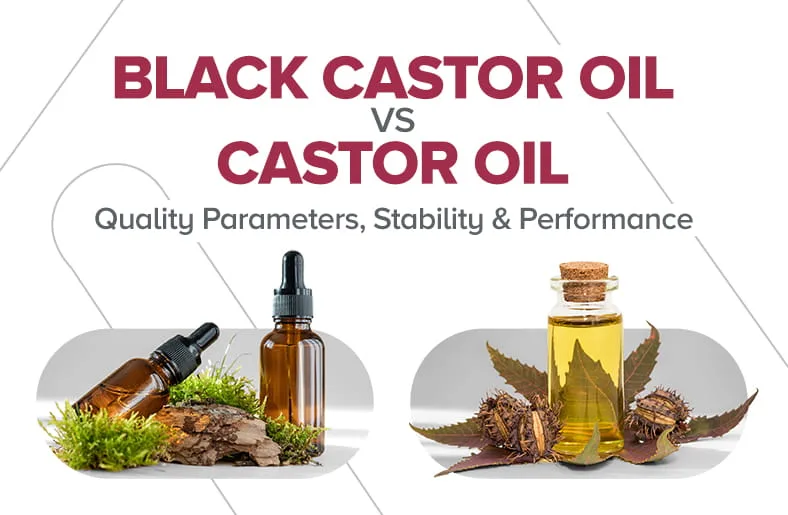
Black Castor Oil vs Castor Oil: Quality Parameters, Stability & Performance
In the world of specialty oils, few ingredients generate as much curiosity and confusion as castor oil. To be more specific, the black castor oil vs castor oil controversy still stands as the subject of debate in the cosmetic, pharmaceutical, and industrial sectors.
Though the two of them are also the products of the same castor bean plant (Ricinus communis), the processing procedure, chemical content, stability, and performance outcome are actually different. The distinction between black castor oil and castor oil is not just a theoretical issue for manufacturers, formulators and bulk purchasers, but it has a direct impact on the quality of a product, shelf life and satisfaction of end-users.
Let’s dive into the deep insight into the comparison of these two oils in terms of quality parameters, stability, and performance.
Understanding the Basics: Castor Oil vs Black Castor Oil
Both oils are produced from the same raw material. The difference between black castor oil and castor oil is the method in which the oil is extracted and refined.
Conventional Castor Oil
The method of producing traditional castor oil is by cold pressing or solvent extraction of castor seeds and then filtration and refining. The purification process removes the contaminants, colourants, free fatty acid and odorants and results in a clear, pale yellow and reproducible oil with consistent chemical characteristics.
The conventional castor oil is highly used within:
- Pharmaceuticals
- Cosmetics and personal care
- Lubricants and coatings
- Food-grade applications (where allowed)
Black Castor Oil
Black Castor Oil (Jamaican Black Castor Oil or JBCO) is processed more traditionally in an artisanal manner. Beans are roasted, then extracted, and the oil contains some ash content from the roasted shells. This gives JBCO its typical dark colour, smoky smell, and alkalinity.
JBCO is mostly related to:
- Hair and scalp treatments
- Conventional remedies for wellness
- Speciality skincare products
To see a more detailed breakdown of production differences, click here.
Let’s explore the difference between black castor oil and castor oil on the basis of quality parameters, stability, and performance.
1. Quality Parameters
Quality parameters are important when assessing oils on a commercial or industrial scale rather than how they look or how they are said to be beneficial.
#1 Purity and Refinement Level
Castor oil can be refined, and then it is degummed, neutralised, bleached and deodorised. This ensures:
- Low impurity levels
- Minimal colour variation
- Regulated free fatty acid (FFA) level
Jamaican Black Castor Oil, on the contrary, is not refined. Although this retains some of its traditional properties, it also brings variability in ash content, pH and purity in general.
Key Insight: In the case of standardised formulations as well as controlled industries, refined castor oil is much more consistent.
#2 Chemical Composition
The two oils contain high amounts of ricinoleic acid (approximately 85-90 per cent), the fatty acid which gives castor oil its lubricity and emollient qualities. However:
Refined castor oil also has a stable and predictable composition of fatty acids. JBCO can demonstrate slight deviations with roasting and leftover solids. The difference is critical in applications where molecular uniformity positively impacts the performance.
#3 Colour, Smell, and Sensory Profile
- Pure Castor Oil: light yellow, almost odourless
- Jamaican Black Castor Oil: black, dark brown, and smoky fragrance
Although the use of the sensory profile of JBCO is attractive to some consumers, it may restrict its application in formulations that are neutral or colour-sensitive.
2. Stability: Shelf Life and Oxidative Resistance
Stability, in particular oxidative and thermal resistance, is one of the least considered factors in comparative studies.
Oxidative Stability
The processing of refined castor oil eliminates oxidation catalysts and moisture to enhance shelf life and stability. This uniformity is essential when dealing with goods that are being exported internationally or where they are utilised in a controlled state.
Despite the abundance of sensory characters, JBCO has by-products that can accelerate oxidation and minimise the stability of the end products.
Thermal Performance
Castor oil is refined to withstand higher processing temperatures required in industrial formulations (e.g., lubricants, polyurethanes, and coatings). The homogenous structure of its molecular composition reduces undesired reactions in the heating process.
The unrefined nature of JBCO also makes it less applicable in preparations that demand thermal stability.
Shelf Life Consistency: Refined castor oil has a consistent shelf life in bulk storage and in international shipping. Large-scale formulators and exporters trust this consistency, which is why on occasions when consistency must not be compromised, they prefer refined grades.
3. Performance Across Applications
The value of the castor oil market in the world is expected to grow at a rate of 6.7% CAGR until 2032 due to the increased demand in cosmetics, pharmaceuticals, bio-based chemicals and industrial usage. This trend highlights the fact that refined and specialised versions such as Jamaican Black Castor Oil are becoming popular in diversified markets. Let’s see their applications.
#1 In Cosmetics and Personal Care
Refined Castor Oil: This is a smooth and neutral oil that blends easily with the lotions, serums, lipsticks, and soaps.
Jamaican Black Castor Oil: Jamaican Castor Oil is a good topical hair and scalp oil, especially when used in products with heritage or organic flavour.
#2 In Pharmaceuticals and MedTech
Highly refined castor oil is the only one that is pharmacopeial (to be delivered as a drug system, a laxative and a medical emulsion). JBCO, being a non-standardised artisanal product, fails to meet those regulation standards.
#3 Industrial and Chemical Applications
Refined castor oil is necessary in:
- Polyurethanes & polymers
- Hydraulic fluids
- Speciality lubricants
- Chemical intermediates
Molecular consistency in these conditions drives performance and process economics, which JBCO cannot consistently deliver.
Black Castor Oil vs Castor Oil: Which One Should You Choose?
The selection is based completely on the application intent.
- When you value standardisation, scalability, and regulatory compliance, refined castor oil will obviously be the best choice.
- Jamaican Black Castor Oil is particularly attractive in case you focus on traditional hair care or niche cosmetics or artisanal branding.
- To the B2B buyer, formulators, as well as the exporter, the choice is usually toward refined castor oil since predictability of performance directly translates to cost efficiency and brand reliability.
Why Processing Expertise Matters
Behind any high-performing oil, there is not only the quality of the raw material but also the skill in processing. Rigorous quality testing, controlled refining and advanced filtration are done to differentiate commodity-grade oils and performance-driven speciality inputs.
Here skilled manufacturers like Ambuja Solvex come in with a difference such that each batch meets the global quality standards but retains the functional advantages that castor oil enjoys.
Conclusion
The discussion over the use of black castor oil and castor oil does not necessarily involve the question of which one is better or which one is not right to use. Although the Jamaican Black Castor Oil has cultural heritage and niche cosmetic positioning, refined castor oil has superiority in terms of quality control, stability and performance in the demanding applications.
At Ambuja Solvex, we are dedicated to always providing refined, high-performance castor oil solutions that address the needs of every area, be it cosmetic, pharmaceutical or industrial markets. We provide top-class castor oil and its derivatives around the world, where accuracy, purity and dependability really count.
| Ready to choose the best castor oil for your application? |
FAQs
- How are castor oil and black castor oil different?
The difference is mostly in processing, whereby the black castor oil is roasted, and most importantly, it is unrefined, whereas the castor oil is refined to achieve purity and consistency.
- Does Jamaican Black Castor Oil make better hair than castor oil?
JBCO is well known as a scalp treatment because of its alkaline property, but refined castor oil is better in formulated hair products.
- What oil has superior shelf life?
Refined castor oil has a better shelf life and oxidative stability than Jamaican Black Castor Oil.
- Is the Jamaican Black Castor Oil applicable in the industry?
No, industrial uses need high-quality castor oil because of high requirements on quality, stability, and consistency.