Boxers vs Boxer Briefs: Which Style Is Right for You?
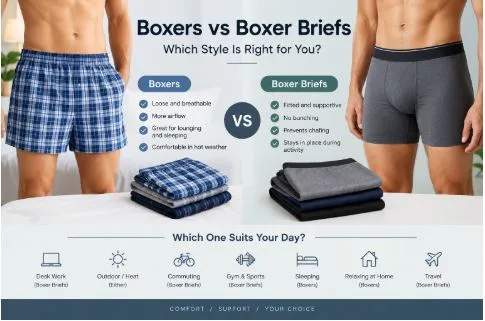
A friend of mine wore loose boxers for about fifteen years and swore nothing else was worth considering. Then he started cycling to work, and within two weeks he was complaining about a thigh rash. Someone at the gym told him to try boxer briefs. He resisted for a month, gave in, and now he won’t wear anything else on weekdays.
I bring this up because the boxers vs boxer briefs debate usually gets treated like a matter of taste, like choosing between tea and coffee. It’s partly that. But it’s also a practical question, and the right answer changes depending on your job, your climate, and what you do with your day.
So let’s go through both properly.
What Actually Separates the Two
The difference sounds small on paper, but you notice it immediately when you wear them.
Boxers are loose. The leg opening is wide, the fabric hangs freely, and there’s no compression. Think of them as shorts you wear underneath your other shorts. If you’re browsing men boxers, you’ll see that most come in simple woven or knit cotton with an elastic waistband and a relaxed cut.
Boxer briefs are fitted. They hug the body like a brief, but the leg extends down the thigh, usually somewhere between a few centimeters and mid-thigh depending on the cut. A long leg boxer brief sits at the longer end and gives you the most coverage.
That’s really the whole story: one is loose and one is snug. Everything else follows from that.
The Case for Boxers
Airflow is the main selling point. Because the fabric isn’t pressed against your skin, air moves around freely. In Pakistan’s summer, when a normal afternoon in Lahore can feel like standing inside an oven, that matters a lot.
Boxers are also forgiving. If your weight changes a little, or you’re between sizes, they tend to still feel fine. They’re easy to sleep in, easy to lounge in, and easy for anyone who just dislikes the feeling of anything tight.
For most men, a good boxer for men is the default for home wear, and there’s a reason for that. Nobody wants compression on a lazy Sunday.
Where boxers fall short
They bunch. Wear a pair under slim-fit trousers or jeans and the extra fabric can gather around your upper thighs, leaving you with an uncomfortable lump halfway through the day. You’ll find yourself reaching down to fix it more often than you’d like.
They also offer very little support. For sitting around that’s irrelevant. Running for a bus, playing cricket, or doing anything active, it can be annoying.
The Case for Boxer Briefs
Support without restriction is what boxer briefs do best. They stay where you put them. You can walk, climb stairs, or run without adjusting anything, and there’s no loose fabric to shift around.
The longer leg also does something useful that people often overlook: it puts a layer between your thighs. Anyone who has dealt with inner-thigh chafing in hot weather knows how miserable it gets, especially when you’re sweating and walking a lot. A fitted, longer-leg cut solves this almost immediately.
They also sit cleanly under fitted clothing. No bunching, no visible bulges of fabric, no rearranging in the office bathroom.
Where boxer briefs fall short
They run warmer. Fitted fabric means less air, and if the material isn’t breathable, you’ll feel it by mid-afternoon in summer.
They also depend heavily on getting the size right. A boxer that’s a size off is still wearable. A boxer brief that’s a size too small digs into the legs and waistband, and one that’s too large rides up or sags. There’s less room for error.
Which One Suits Your Day?
Forget “which is better” for a moment and ask what you’ll be doing while wearing them.
Working at a desk, wearing formal trousers: Boxer briefs are usually the safer choice. They stay put, don’t bunch under fabric, and keep you comfortable through long sitting hours. If your office runs the air conditioning hard, the extra warmth is rarely a problem.
Working outdoors or in heat: This one is closer. If you’re on your feet in heavy heat, breathable cotton boxers may feel better. If chafing is your main problem, a cotton boxer brief with a longer leg can help more than loose boxers do.
Commuting by bike, bike-taxi, or on foot: Boxer briefs, without much debate. The support and friction protection really do matter here.
Gym and sports: Boxer briefs again. Loose fabric and exercise don’t mix well.
Sleeping: Boxers, for most people. Some men sleep fine in boxer briefs, but many prefer the freedom of something looser overnight.
Relaxing at home: Boxers, or something soft like modal boxershorts if you want a smoother feel.
Travel days: Boxer briefs tend to be the more comfortable option for long journeys, since they stay in place when you’re sitting for hours and don’t bunch up.
Fabric Can Change Everything
Here’s something people forget: the fabric can matter more than the cut.
A cotton boxer brief will usually feel better in warm weather than a synthetic one. A soft modal boxer will feel nicer than a stiff, scratchy cotton one. If you tried boxer briefs once and hated them, it may have been the material, not the style.
For everyday wear in Pakistan, cotton underwear for men is usually the safest bet. Cotton breathes, absorbs moisture, and is gentle on skin. Check labels closely, though. Some products called “cotton” are blends, and the synthetic portion changes how the fabric behaves in heat.
Common Mistakes When Choosing Between the Two
Buying based on a single bad experience. One uncomfortable pair doesn’t mean the whole style is wrong. It could be the size, the fabric, or the stitching.
Going a size down for “support.” A tighter fit doesn’t equal better support. It usually just means digging waistbands and marks on your skin.
Ignoring the waistband. In both styles, a poor waistband ruins everything. Look for something soft, flat, and secure.
Picking only one style forever. Most men are better off with a mix.
Why Not Just Own Both?
Honestly, that’s what most people end up doing, and it’s the sensible answer.
Keep boxer briefs for workdays, commutes, and exercise. Keep boxers for evenings, weekends, and sleep. That way, you always have the right thing for what you’re doing, and you rotate pairs more evenly, so each one lasts longer.
If you’re building a set from scratch, aim for around ten to fourteen pairs in total, split roughly by how you spend your time. Multi-packs and saver packs make this cheaper than buying singles, and you avoid ending up with a drawer of mismatched leftovers.
How to Test a New Style Properly
Don’t judge a new style after twenty minutes. Wear it for a full day, including sitting, walking, and bending. Then wear it for a week if you can.
Pay attention to a few things:
- Do you find yourself adjusting it?
- Do you notice the waistband by afternoon?
- Is there any rubbing or heat build-up?
- Do you forget you’re wearing it?
That last one is the real test. The best underwear is the kind you forget about.
FAQs
- Are boxers or boxer briefs more comfortable for everyday wear?
It depends on your day. Boxers are looser and let more air move around, so many men find them more comfortable at home, in hot weather, and for sleeping. Boxer briefs stay in place and offer more support, which makes them the better fit for fitted trousers, long commutes, or active days. If you’re unsure, try a pair of each from a men underwear range and see which one you forget about first.
- Which is better for hot weather, boxers or boxer briefs?
Boxers usually win in extreme heat because the loose cut allows more airflow. That said, fabric matters as much as style. A breathable cotton boxer brief can feel cooler than a boxer made from a synthetic blend. If you’re shopping for summer, look for men cotton underwear and check the label for the actual cotton percentage.
- Do boxer briefs help prevent thigh chafing?
Yes, in most cases. The longer leg puts a layer of fabric between your thighs, which reduces skin-on-skin friction, especially when you’re walking a lot or sweating. A long leg boxer brief usually gives the most protection. Choose a soft, flat-seamed pair, since rough stitching can cause irritation of its own.
- Why do boxers bunch up under trousers?
Boxers have a wide leg and loose fabric, and when you wear them under slim or fitted trousers, that extra material gathers around the upper thighs. If you often wear fitted clothes, boxer briefs are usually the neater option. For looser trousers or shalwar kameez, regular men boxers are generally fine.
- Can I wear both boxers and boxer briefs?
Absolutely, and most men end up doing exactly that. A common approach is boxer briefs for workdays, commutes, and exercise, and boxers for evenings, weekends, and sleep. Owning a mix also means you rotate your pairs more evenly, so each one lasts longer. Buying in saver packs makes it easier and cheaper to build that set.
- How do I know which size to buy in boxer briefs?
Boxer briefs depend more on size than loose boxers do, because a poor fit shows up quickly as digging legs, a rolling waistband, or fabric riding up. Measure your waist and check the brand’s size chart instead of going by your usual size. If you’re between sizes, read the product description for fit details before deciding.
The Short Answer
If you want the quick version: choose boxers for airflow, relaxation, and sleep, and choose boxer briefs for support, activity, and fitted clothing. If you’re stuck between the two, start with whichever solves your biggest daily annoyance. For my friend, that was a thigh rash. For someone else, it might be bunching under jeans, or feeling too warm at night.
Neither style is right for everyone. But once you know what each one does well, picking the right pair stops being a guess and turns into a simple decision. You can compare the full men underwear range to see the cuts side by side, then trust what your own day tells you