Broken Garage Door Spring? Repair Signs & Costs | 247 Garage Door Guys
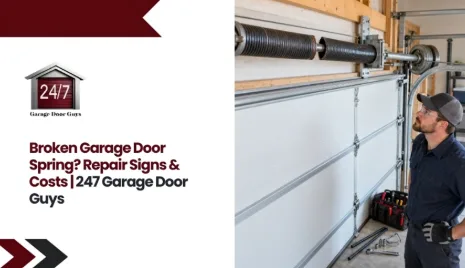
| A Quick Answer: A broken garage door spring often causes a heavy door, partial opening, uneven movement, or a loud bang when the spring fails. Torsion springs usually show a visible gap in the coil, while extension springs may appear separated or loose near the tracks.
In Delaware, professional garage door spring repair typically costs $200 to $350 per spring, depending on spring type, door weight, hardware condition, and whether one or two springs need replacement. Because these springs store significant tension, repair should be handled by a trained garage door technician. |
A broken garage door spring can leave the door too heavy for the opener to lift, cause uneven movement, or stop normal operation altogether. Because spring systems carry substantial tension, identifying the failure correctly matters before the door is operated again.
For homeowners in Delaware, repair decisions also depend on the spring system, door configuration, and labor and parts pricing common to the Delaware and Southeastern Pennsylvania market. This guide covers the key warning signs, expected repair costs, safety concerns, and when professional service is warranted.
How Can You Tell if a Garage Door Spring Is Broken?
A broken spring changes how the garage door carries and distributes its weight. The most useful warning signs come from how the door lifts, stops, and sits in the opening, although the exact symptoms depend on the spring system.
The Door Becomes Difficult to Lift
Garage door springs counterbalance much of the door’s weight during opening and closing. When a spring breaks, that assistance disappears or drops sharply, so a door that previously moved with little resistance may suddenly feel extremely heavy.
An automatic opener may strain, move the door slowly, or fail to lift it from the floor. Continuing to run the opener under this increased load can place additional stress on the motor, gears, rail, and other drive components.
The Door Opens Only Partway
A garage door that rises several inches and then stops may have lost the spring force needed to complete its travel. The opener begins lifting the door, but the unsupported weight can exceed what the system is designed to move.
Partial opening does not confirm spring failure by itself. An opener fault or another mechanical problem can produce similar behavior, so the door’s movement should be considered alongside other physical signs.
The Door Looks Uneven or Crooked
An uneven door often indicates that the lifting system is no longer applying balanced force. One side may rise faster, remain lower, or appear tilted as the door travels through the tracks.
This symptom is particularly relevant when one part of a multi-spring system fails or when the failure affects cable tension on one side. Operating a visibly crooked door can allow rollers or cables to move out of their intended positions.
You Heard a Sudden Loud Bang
A spring can release stored tension abruptly when its steel coil fractures, producing a loud bang that homeowners may hear even when the door is stationary. The sound can seem as though something struck the garage door or fell inside the garage.
A sudden bang followed by a heavy, immobile, or uneven door is a strong reason to suspect spring failure. The spring system should be visually assessed without touching, pulling, or attempting to tension any of its components.
What Do Broken Torsion and Extension Springs Look Like?
Torsion and extension springs perform the same counterbalancing function but use different hardware and positions around the door. Identifying the installed system makes the physical signs of failure easier to interpret.
Broken Torsion Spring Signs
A torsion spring is typically mounted on a metal shaft above the garage door opening. When the coil breaks, a visible gap often appears between two sections of the spring because the wound steel separates after losing tension.
Many double-width garage doors use two torsion springs. In that configuration, one spring may remain intact after the other breaks, so the system can still appear partially functional. The intact spring should not be treated as evidence that the door is safe to operate.
Broken Extension Spring Signs
Extension springs usually run alongside or above the horizontal tracks and stretch as the garage door closes. A failed spring may appear separated, unusually loose, or displaced from its normal position.
These systems commonly use pulleys, cables, and safety cables alongside the springs. A failure can therefore leave loose hardware or a hanging spring near the track. Safety cables are designed to restrain an extension spring if it breaks, but they do not restore the door’s counterbalance.
Spring Failure vs. Other Garage Door Problems
A door that refuses to operate does not automatically have a broken spring. Misaligned photo-eye sensors can prevent closing, an opener problem can stop powered movement, and damaged cables or track hardware can interfere with normal travel.
A visual gap in a torsion spring or a separated extension spring provides much stronger evidence of spring failure. In Delaware homes, garage configurations vary from single-car attached garages to heavier double-width doors, so identifying the installed spring system and related hardware is more reliable than diagnosing the problem from opener behavior alone.
How Much Does Garage Door Spring Repair or Replacement Cost?
Current 2026 pricing suggests homeowners in Delaware and the nearby Philadelphia market should generally expect a few hundred dollars for professional spring replacement, with the final total depending heavily on the spring system and door.
In Delaware, professional garage door spring repair typically costs $200 to $350 per spring, depending on the spring system and door configuration. In the nearby Philadelphia market, a single torsion spring generally runs $200 to $450 installed, while replacing a pair of high-cycle springs on a two-car garage door can cost $400 to $900.
Spring Type and Size
Torsion and extension springs are priced differently because their hardware and installation requirements differ. Beyond spring type, technicians must match the replacement to the door’s weight and required lifting force. Wire diameter, spring dimensions, cycle rating, and door construction can therefore change the parts cost.
This becomes particularly relevant with heavier insulated or wood doors. A larger or heavier door generally requires appropriately rated springs rather than whichever standard spring happens to fit the shaft.
| Important: Spring life can also change after the garage door itself is modified. Adding glass, extra insulation, or even several coats of paint increases door weight and can reduce the service life of torsion springs originally selected for a lighter door.
Garage door spring systems depend on properly matched door weight and spring force. Corrosion can further shorten spring life, which is particularly relevant for Delaware properties near Lewes, Rehoboth Beach, and Bethany Beach, where humid, salt-influenced conditions can accelerate metal deterioration. |
One Spring vs. Two Springs
Some residential garage doors use a single torsion spring, while wider and heavier doors frequently use two. Replacing a matched pair costs more initially because the job requires additional parts, but the condition and age of the remaining spring should factor into the decision.
If both springs were installed together and have completed roughly the same number of cycles, the unbroken spring may already have substantial wear. Philadelphia-area pricing illustrates the difference clearly: a single torsion spring may cost roughly $200 to $450 installed, compared with approximately $400 to $900 for a pair of high-cycle springs on a two-car door.
| Important: Garage door springs also have a finite cycle life. DASMA defines one cycle as the door moving from fully closed to fully open and back to closed, and its technical guidance identifies door usage, installation, and spring handling as factors that affect both torsion and extension spring life. This is why two springs installed at the same time can have similar accumulated wear even when only one has fractured. |
Additional Damaged Components
A spring replacement estimate can increase when the technician finds worn lift cables, bearings, drums, pulleys, or related hardware. These components work as part of the same lifting assembly, so their condition affects whether installing a new spring alone will restore proper operation.
The distinction matters when comparing quotes. A lower estimate covering only the spring is not directly comparable with one that includes deteriorated hardware, resetting cables, and balancing the completed door.
Labor and Service Factors
Labor reflects more than the time required to install the spring. Door size, spring configuration, hardware condition, access, and whether nonstandard parts are required can all affect the final price.
Local housing can make those differences more noticeable. A standard sectional door in a newer Newark-area subdivision may require a relatively routine spring match, while an older or heavier garage-door setup around Wilmington may require different spring specifications or additional hardware work. Across the state line, older housing stock in parts of Philadelphia can also involve heavier wood doors and nonstandard legacy systems, which local repair data associates with higher parts or labor requirements.
For that reason, Delaware homeowners should treat published figures as market benchmarks rather than fixed quotes. The useful comparison is an estimate that identifies the spring type and quantity, required hardware, labor, and any additional service charges before work begins.
Why Is Replacing a Garage Door Spring Dangerous?
Garage door spring replacement involves controlling a high-tension counterbalance system while working around a door that may weigh hundreds of pounds. The main risks come from stored spring energy, uncontrolled door movement, and incorrect installation.
Springs Store Significant Tension
Torsion springs are wound to a calculated level of tension using winding cones and winding bars. During replacement, that tension must be released from the old spring and applied correctly to the new one.
If a winding bar slips, the cone moves unexpectedly, or the wrong tool is used, the spring hardware can rotate with substantial force. Extension springs present a different hazard because they stretch under load and can recoil if a spring, cable, or attachment point fails.
Heavy Doors Can Fall Unexpectedly
Springs allow a garage door to feel much lighter than its actual weight by counterbalancing the door through its lifting system. During spring replacement, that balance is disrupted.
An unsecured door can drop or shift if cables lose tension or lifting hardware moves unexpectedly. Larger insulated, double-width, and wood garage doors can impose particularly high loads, increasing the consequences of losing control during the repair.
Incorrect Installation Creates New Hazards
A replacement spring must match the door’s weight, dimensions, and lifting requirements. Installing an incorrectly sized spring or applying the wrong number of turns can leave the door over-sprung or under-sprung.
Poor spring setup can also affect cable tension, drum alignment, and door balance. The result may be a door that rises on its own, drops when partially open, travels unevenly, or places unnecessary load on the garage door opener.
Professional replacement includes matching the spring specifications, setting the required tension, securing the lifting system, and checking door balance after installation. These steps require the correct tools and an understanding of how the complete counterbalance system responds under load.
What Should You Do When a Garage Door Spring Breaks?
Once a spring failure is suspected or confirmed, the priority shifts from diagnosis to preventing secondary damage and arranging the correct repair. Avoid operating the door until the spring system and connected lifting hardware have been assessed.
Stop Operating the Door
Disconnect normal use of the garage door and avoid repeatedly pressing the opener remote or wall control. An opener is designed to move a properly counterbalanced door, not compensate for a failed spring.
If a vehicle is trapped inside, do not assume pulling the emergency release makes the door safe to lift. Disconnecting the opener removes its connection to the door but does not restore the missing counterbalance.
Keep the Door Closed When Possible
A closed garage door is generally easier to secure while waiting for service. Keep children, pets, vehicles, and stored items away from the immediate operating area, particularly if cables or other hardware appear loose or displaced.
If the door is already partially open or visibly unstable, avoid standing beneath it or attempting to force it into another position. The remaining lifting components may not be supporting the door evenly.
Have the Spring System Inspected
A professional inspection should establish more than which spring broke. The technician should identify the correct replacement specifications and examine the lift cables, cable drums, bearings, pulleys, attachment points, and related hardware for wear or damage.
The completed repair should also include a balance check. A properly balanced door should remain controlled through its travel instead of dropping, rising unexpectedly, or depending on the opener to compensate for incorrect spring tension.
Know When Replacement Is Needed
A fractured coil or separated extension spring requires replacement rather than adjustment. Replacement may also be appropriate when a paired spring has comparable age and cycle use, or when inspection identifies corrosion, deformation, or substantial wear in the remaining spring.
For homeowners across Wilmington, Newark, Dover, and surrounding Delaware communities, arranging service promptly can prevent a failed spring from turning into additional cable, opener, or door-hardware problems. 247 Garage Door Guys can inspect the spring system, determine the required replacement, and restore the door’s counterbalance before it returns to regular use.
Frequently Asked Questions
1. Does cold weather make garage door springs more likely to break?
Cold conditions can expose weaknesses in an aging spring because steel becomes less tolerant of repeated stress as temperatures fall. Clopay notes that spring failures occur more often during colder months. For Delaware homeowners, an older spring may therefore fail during winter after years of accumulated opening and closing cycles.
2. Are high-cycle garage door springs worth the extra cost?
High-cycle springs can make sense for households that operate the garage door frequently throughout the day. Standard springs are commonly designed around 10,000 cycles, while higher-cycle options can be rated substantially beyond that. Paying more upfront may reduce the frequency of future spring replacements when the garage serves as a primary entrance.
3. Should garage door cables be replaced when the springs are replaced?
Cables do not automatically require replacement with every new spring. Their condition should determine the decision. Fraying, corrosion, damaged strands, deformation, or uneven cable tension can justify replacement during the same service visit. Keeping worn cables with a new spring can leave another critical part of the counterbalance system close to failure.
4. Will new springs change how the garage door opener operates?
Correctly matched springs should reduce the workload placed on the opener by restoring proper door balance. After installation, the door should move smoothly and remain controlled through its travel. If the door still binds, drifts, or requires excessive opener force, the spring setup or another mechanical component may need further adjustment.
5. How long does professional garage door spring repair usually take?
A straightforward residential torsion spring replacement can often be completed in about an hour once the correct parts are available. More complex systems may take longer when cables, drums, bearings, or other hardware also require service. Door size, spring configuration, access, and previous modifications can all affect repair time.
6. Will homeowners insurance cover a broken garage door spring?
Routine spring failure caused by age, fatigue, or ordinary wear is generally treated as home maintenance rather than a covered insurance loss. Coverage may differ when the garage door is damaged by a covered event, such as a vehicle impact or severe storm. Homeowners should review their specific policy before assuming repair costs qualify for reimbursement.