Can a British Man Actually Pull Off Sandals? The Honest Answer
Ask a British man about sandals and you will usually get one of two reactions. Either a firm no, delivered with the kind of conviction usually reserved for opinions on warm beer, or a slightly sheepish admission that he bought a pair last summer and has been quietly pleased with them ever since. Sandals occupy a strange place in the British male wardrobe. They are associated, fairly or not, with camping holidays, geography teachers, and a complete indifference to being judged. And yet the sandal has a history that stretches back thousands of years, across some of the most sophisticated civilisations the world has ever seen. The question is not really whether a British man can pull off sandals. The question is whether he has been thinking about them all wrong.
The honest answer is yes, he absolutely can. But there are rules, and they matter.
A Brief and Surprisingly Impressive History
The sandal is, without question, one of the oldest items of footwear in human history. Archaeological evidence places sandals in ancient Egypt as far back as 4000 BC. They were worn by pharaohs, soldiers, and merchants alike. In ancient Greece and Rome, the sandal was not a casual afterthought but a considered piece of dress. Roman senators wore them. Greek philosophers debated in them. The early Christian church adopted sandals as footwear for its clergy, a tradition that persists in monastic dress to this day.
The sandal arrived in Britain with the Roman legions, who introduced the caliga, a heavy-soled military sandal designed for long marches across varied terrain. When the Romans departed, their footwear largely went with them, and Britain spent the following centuries in boots and enclosed shoes better suited to its less forgiving climate. Sandals retreated to the margins, associated more with religious orders and classical imagery than with everyday dress.
It was not until the late nineteenth and early twentieth centuries that sandals began creeping back into mainstream British consciousness, carried along by the Arts and Crafts movement, a back-to-nature philosophy that viewed open footwear as healthier and more honest than the buttoned-up boots of Victorian respectability. They were unconventional by design. That was the point.
How the Sandal Found Its Place in British Life
The real turning point for sandals in Britain came gradually through the twentieth century as travel became more accessible and summer holidays abroad moved from luxury to expectation. British men who spent a fortnight each year somewhere with actual sunshine needed footwear that made sense in the heat, and sandals were the obvious answer. The problem was that those habits rarely translated back home. The sandal stayed in the suitcase until the next departure.
That attitude has shifted considerably over the past two decades. Summers in Britain, while still unreliable, have become warmer on average. Cities in particular retain heat in a way that makes closed shoes genuinely uncomfortable during a warm spell. And a generation of men who grew up travelling more widely and dressing with less rigid formality has started to approach footwear with a good deal more openness than their fathers did.
The critical change, though, has been in the quality and design of the sandals themselves. The sandals that British men reflexively dismissed were often cheap, synthetic, and badly shaped. They looked like an afterthought. A well-made pair of mens leather sandals is an entirely different proposition. The leather moulds to the foot over time, the construction holds its shape, and the overall effect is of something deliberately chosen rather than reluctantly settled for.
The Case for Leather and Why It Changes Everything
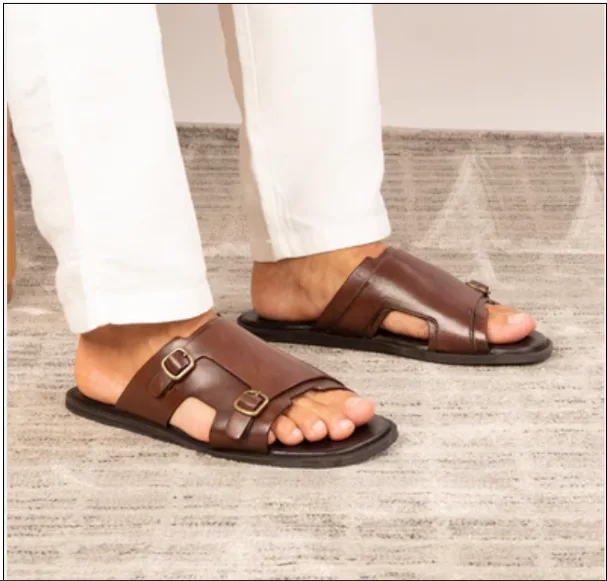
Leather transforms the sandal in the same way it transforms any piece of footwear. It signals that some thought has gone into the choice. A pair of mens leather sandals in tan or cognac, with clean lines and solid construction, sits comfortably alongside chinos, linen trousers, or even well-fitted shorts in a way that a rubber-soled, plastic-strapped equivalent simply cannot. The materials do the work.
The key to wearing sandals well as a British man is simplicity. The sandal should not be the loudest thing about an outfit. A classic two-strap or three-strap leather sandal in a neutral shade, worn with rolled linen trousers and a plain shirt on a warm afternoon, is an exercise in quiet confidence. It says that you are comfortable enough in your own choices not to need the safety net of a trainer or a closed shoe.
Foot care matters too, and there is no polite way around it. A sandal draws attention to the foot in a way that no other shoe does. Clean nails, moisturised skin, and generally well-maintained feet are not vanity. They are simply the minimum courtesy owed to anyone who has to look at them.
Knowing When Sandals Work and When They Do Not
Part of wearing sandals well is understanding their limits. They are warm weather footwear, full stop. The moment the temperature drops or the pavements are wet, the sandal becomes the wrong choice both practically and visually. This is not a flaw so much as a fact of what the shoe is designed for.
For the significant portion of the British year when sandals are simply not appropriate, the wardrobe needs alternatives that carry the same considered spirit. A pair of brown mens boots, whether Chelsea, Derby, or brogue-topped, does exactly that. They occupy the space between formal and casual with the same ease that a leather sandal manages in summer. Tan or mid-brown leather boots pair with almost everything in the British man’s wardrobe and age well in the same way that good leather always does.
Thinking of sandals and boots as seasonal counterparts makes sense. The leather sandal handles late spring through early autumn on the better days. The brown mens boots carry the weight of everything else. Between them, a man is fairly well covered for most of what British life and weather can produce.
Building Confidence Around the Choice
Confidence is the difference between a man who looks good in sandals and a man who looks uncomfortable. That confidence comes from knowing why you have made the choice and feeling settled in it. It does not come from seeking permission or waiting until someone else makes the move first.
Start with a simple, well-made pair in a classic style. Wear them somewhere low-stakes and see how they feel. You will likely find that the reaction from other people, if there is any reaction at all, is far less dramatic than anticipated. Most men who wear leather sandals with care and intention discover fairly quickly that the resistance was always internal rather than external.
The British resistance to sandals has never really been about the sandal itself. It has been about a particular kind of self-consciousness that British men carry around style choices that feel unfamiliar. Once that clears, the shoe is just a shoe. A very old, very well-designed shoe with an excellent track record.
Conclusion: Give the Sandal the Chance It Deserves
From the feet of Roman legionaries marching across the north of England to the sun-warmed pavements of a British city in July, the sandal has been on a longer journey than most people give it credit for. It arrived here as conquering footwear and it has stayed, in one form or another, as a choice for men who are comfortable enough in themselves to wear what makes sense rather than what feels safe.
A well-made pair of mens leather sandals is not a holiday novelty or a compromise. It is a considered piece of footwear with a history longer than almost anything else in the wardrobe. Pair it with the right clothes, take care of your feet, and trust the choice. And when summer gives way to the longer British grey, reach for a pair of brown mens boots with the same sense of intention. Both choices, made well, say the same thing about the man wearing them.
Brands like Oswin Hyde are built around exactly that philosophy, offering leather goods and footwear for British men who understand that quality and confidence tend to go together. If you have been putting off the sandal question, this is your answer. The answer is yes.