Can a USA Company Accept UPI? What USA Businesses Need to Know
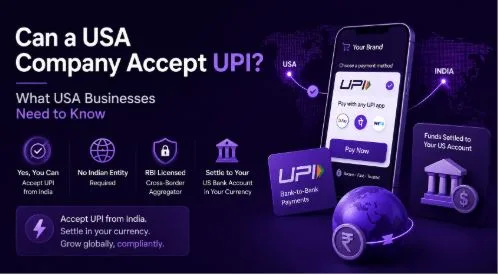
Short answer: yes. Not by flipping a switch in the payment setup you already have, but yes.
If you are a US company with real demand from India, you have probably seen the pattern. Plenty of Indian customers do not want to pay with a card. They want UPI, the bank-to-bank system behind Google Pay, PhonePe, and Paytm that now handles most digital payments in the country. When UPI is not on your checkout, those customers do not reach for a Visa. They leave.
So can a foreign company actually accept it? Here is the honest, useful version.
Why you can’t just “add UPI” like Apple Pay
UPI is a domestic Indian rail. It is run by the National Payments Corporation of India. It settles between Indian bank accounts in rupees. It is regulated by the Reserve Bank of India. None of that is designed to end in a US bank account. That is why your global Stripe or PayPal setup does not simply offer UPI to your Indian buyers. The plumbing terminates in the wrong country.
For years the workaround was painful. Set up an Indian subsidiary, open a local bank account, register for GST, and wait three to six months. For a company that is still testing Indian demand, that is a non-starter. That is the part that changed.
The route that works: a licensed cross-border aggregator
In October 2023 the RBI created a licence category called the Payment Aggregator-Cross Border, or PA-CB. It is close to what foreign merchants had been asking for. A licensed PA-CB provider can onboard a business based outside India and let it accept payments from Indian customers, then settle the money to that business’s own bank account abroad, in its own currency.
No Indian entity required. No Indian bank account. No GST registration just to collect.
Here is the flow. Your Indian customer pays in rupees over UPI. The provider processes the payment and handles the India-side compliance. Intelligent routing pushes success rates above 80% on the methods Indians actually use. The funds are converted to your settlement currency and sent to your overseas account by SWIFT, on a T+1 business-day basis. You receive the money in the currency you bank in, and you get settlement and tax reports to reconcile against. The regulated part, the KYC, the FX, and the FEMA paperwork, sits with the provider.
What US businesses specifically need to know
A few things trip up American companies in particular.
You still have to pick a licensed provider. PA-CB licences are not common. Cashfree Payments, for example, is India’s first licensed cross-border payment aggregator and holds the broadest category, Export and Import. Confirm a provider’s current PA-CB status before you sign. Do not assume a familiar global name has it.
There is a per-transaction ceiling. Inward cross-border payments are capped at ₹25,00,000 per unit of goods or services under the current rules, roughly US$30,000. For SaaS, digital goods, courses, and consumer products you will never feel it. For high-ticket B2B, plan around it. Confirm the current cap before you quote it externally.
UPI recurring has its own limit. If you bill subscriptions over UPI AutoPay, a single auto-debit runs without re-authentication up to ₹15,000, higher for a few categories such as insurance. Fine for most consumer subscriptions. Worth knowing before you set price points.
Collecting is not the same as your tax position. A PA-CB lets you collect without incorporating. It does not settle whether you owe Indian GST or other tax. That depends on what you sell and how you operate. Get advice, or use a Merchant of Record, where a third party becomes the seller of record and takes the Indian tax filing off your plate. A Merchant of Record is heavier and usually costs more, but for some digital-goods businesses it earns its keep.
So which should you use?
If you mainly want to stop losing Indian customers at checkout, and you are comfortable handling your own tax position, a PA-CB gateway is the lighter and faster route. You can go live in a few business hours after your KYC documents clear, and you stay the merchant. Settlement lands in your currency at zero-cost FX. If you would rather hand off Indian tax entirely and you sell digital products at scale, look hard at a Merchant of Record.
The headline is the part worth repeating, because it only became true recently. A US company can now accept UPI from Indian customers without opening anything in India. The wall that used to make people give up is gone. What is left is choosing a licensed partner and building a checkout that speaks the way your Indian customers pay.