Can Non-Surgical Treatments Delay Baldness?
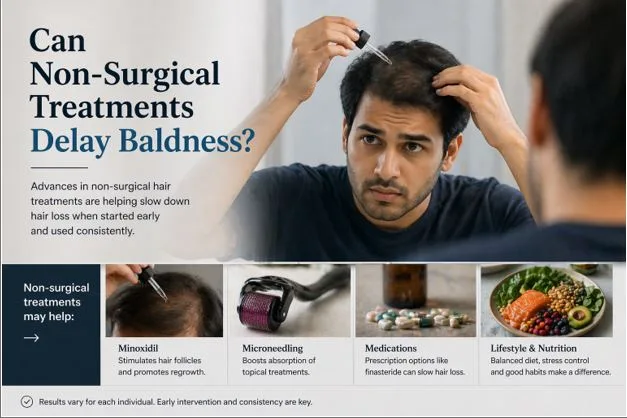
The short answer is yes, often by years, sometimes by more than a decade. The longer answer depends on when you start, how consistent you are, and whether your expectations match what the treatments can actually deliver.
Non-surgical hair therapies aren’t magic, and they aren’t snake oil either. Understood correctly, they are some of the most useful tools in modern dermatology for people who want to keep what they have for as long as possible.
What “Delay” Actually Means
Before anything else, it helps to define what delay means in the context of hair loss. Androgenetic alopecia is progressive. Without intervention, follicles in vulnerable zones will continue to miniaturise over the years. Non-surgical treatments can:
- Slow the rate of miniaturisation in genetically predisposed follicles.
- Strengthen and thicken the hair shaft during its active growth phase.
- Extend the anagen (growth) phase and shorten the telogen (shedding) phase.
- Stabilise ongoing shedding caused by reversible factors like nutrition, stress, or post-illness shed.
What they cannot do is regrow follicles that have died and scarred over. That limit is where non-surgical care ends and surgical restoration begins.
The Evidence-Based Toolkit
When clinicians talk about non-surgical treatments for delaying baldness, they’re usually referring to a small, well-studied group:
- Topical therapies that prolong the growth phase of existing follicles.
- Oral medications that reduce DHT production in genetically predisposed patients.
- PRP Therapy, which concentrates platelets from the patient’s own blood and injects them into the scalp to stimulate follicular activity.
- Growth factor concentrates, a cleaner, newer iteration of autologous biologic therapy.
- Low-level laser therapy devices, which have modest but measurable effects on follicular metabolism.
Each of these has clinical data behind it. None is a standalone miracle. The benefit, in almost every case, comes from combining two or three of them in a sequence a dermatologist designs specifically for that patient.
Timing Is Everything
Non-surgical treatments work best when they start early. A patient with a clear family history of pattern hair loss who begins appropriate medical management in his mid-twenties has a radically different scalp at forty than one who waits until he’s visibly thinning. The follicles are still alive. The environment can still be optimised.
Conversely, non-surgical treatments offer diminishing returns in advanced cases. A patient with extensive crown loss or a receded hairline beyond Norwood V will see slowdown of further loss, but the hair he has already lost is unlikely to return through medication or injectables alone. This is not a failure of the treatments. It’s a biological ceiling.
Where PRP and Regenerative Injectables Fit In
Regenerative therapies have become one of the most common non-surgical interventions in India over the last decade. When done well, with proper centrifugation protocols and clinical technique, they can meaningfully improve scalp health and follicular output, especially when paired with medical management.
Clinicians at Kibo Clinics note that the most common mistake patients make is treating these injectables as standalone solutions. A single session, or even three sessions without any parallel medical management, usually under-delivers. The best outcomes come from staged protocols, a series of sessions, followed by maintenance, paired with appropriate topical or oral support.
The Role of Lifestyle
It’s worth repeating, because it’s usually ignored: non-surgical treatments work considerably better on a well-fed, well-rested, low-inflammation scalp than on one that isn’t. Iron and vitamin D deficiencies will blunt the response to PRP. Chronic sleep deprivation will undercut any topical protocol. This isn’t wellness-industry talk, it’s endocrinology.
Expert Tip
If you’re considering non-surgical therapy, ask for a baseline trichoscopy and photographs at the start, and repeat them at six and twelve months. Without objective images, it is genuinely hard, even for clinicians, to tell whether a treatment is working. With them, the answer usually becomes obvious.
The Honest Takeaway
Non-surgical treatments can delay baldness, sometimes dramatically, when they are started early and used correctly. They are not a substitute for surgery when follicles have already been lost, but for a patient in the window where his follicles are still alive, they can buy more time than any other tool in modern dermatology.