Choosing a Heat Press for DTF Production: Build Around Consistency, Not Specs
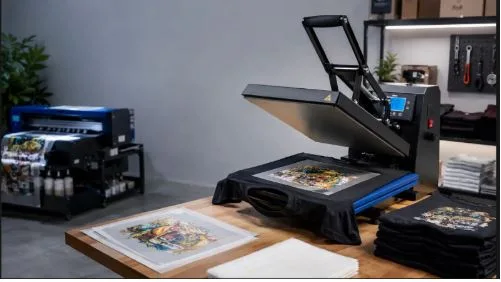
In a DTF production setup, the printer usually gets most of the attention. Printhead configuration, ink circulation, film quality, and curing equipment all matter, but the final application step can still determine whether a good transfer becomes a sellable garment or a reprint. That makes the heat press less of an accessory and more of a production-control tool.
For a growing apparel business, the smartest way to choose a press is not to chase the highest temperature rating or longest feature list. Ask a simpler question: which machine can repeat the same result throughout a real workday?
Consistency Is the Real Performance Metric
DTF application depends on controlled heat, pressure, and time. A press may look capable on paper, but production exposes weaknesses that a specification sheet does not show clearly. Temperature recovery, pressure consistency across the platen, and operator repeatability matter when many garments move through the same station.
A small shop completing a few custom orders each day may be comfortable with a well-built manual press. A production shop handling repeated runs has a different problem. The operator needs to load, align, press, release, and move to the next garment without unnecessary variation.
Start With the Largest Job You Actually Produce
Platen size should be based on the designs a business expects to apply, not simply on what looks more professional. Smaller platens can work well for compact graphics, youth apparel, labels, and specialty placements. Larger platens provide more room for full-front and full-back designs and can reduce repositioning.
Before choosing a size, consider:
- The largest transfer used on regular orders
- Whether full-front or full-back designs are common
- How often oversized garments are produced
- Available workspace around the press
- Whether garments need to be repositioned during pressing
A larger press also needs a stable work surface and enough room for loading and unloading. Reviewing recent orders is often more useful than buying around a hypothetical future project.
Pay Attention to Heat Recovery, Not Just Maximum Temperature
Maximum temperature is easy to compare, but DTF production typically operates within a narrower range set by the transfer manufacturer. The more practical concern is whether the platen remains stable through repeated cycles.
When a cold garment contacts the platen, the surface loses heat. In a busy workflow, the press must recover before the next cycle. Slow recovery can create inconsistent production or force idle time between garments.
For businesses comparing heat press machines for DTF production, it makes sense to evaluate the machine as part of an entire production line rather than as a stand-alone appliance.
Important performance factors include:
- Stable platen temperature
- Even heat distribution
- Fast recovery between pressing cycles
- Consistent pressure across the usable surface
- Reliable timers and temperature controls
These characteristics become increasingly important as production volume increases.
Pressure Has to Be Repeatable
Pressure is another area where workflow matters. With a manual press, consistency depends partly on setup and operator technique. That can be acceptable in a small-shop environment. As volume increases, however, fatigue and repeated adjustments can become operational variables.
Auto-open, semi-automatic, pneumatic, or hydraulic systems can reduce some variation, but automation creates value only when the shop has enough throughput to benefit.
Short personalized orders may favor flexibility. Repeated batches may favor repeatability and reduced operator effort.
The right choice depends on the work being performed, not simply on the technology label attached to the machine.
Calculate the Cost of a Bad Pressing Station
Heat press decisions are often treated as an equipment-price comparison. A better approach is to calculate the cost of inconsistency.
A failed application can consume:
- A blank garment
- A printed DTF transfer
- Operator time
- Production capacity
- Additional quality-control time
- Potentially an entire order deadline
A remake may also interrupt batching or delay another job.
The same logic applies to a press that technically works but is awkward to operate. Slow loading, difficult adjustment, limited clearance, or excessive operator effort can become expensive when multiplied across hundreds of garments.
A more expensive press can therefore be the lower-cost option for a high-volume shop, while a simpler machine may be smarter for a smaller operation.
Build a Buying Checklist Around the Workflow
Before comparing models, create a basic production profile instead of beginning with product specifications.
A useful heat press checklist should include:
- Daily garment volume: How many items are typically pressed per day?
- Largest transfer size: What is the biggest design used regularly?
- Longest production run: Are jobs usually one-offs or batches of 50, 100, or more?
- Product mix: T-shirts, hoodies, tote bags, specialty garments, or multiple products?
- Operator count: Will one person or several employees use the machine?
- Available space: Is there enough clearance for loading and unloading?
- Automation need: Would auto-open or automated pressure meaningfully reduce labor?
- Growth expectations: Is production volume likely to increase within the next year?
Once these questions are answered, comparing heat press equipment for DTF workflows becomes much more practical because each feature can be measured against an actual production requirement.
A larger platen may solve placement limitations. Auto-open functionality may help with repetitive runs. A slide-out lower platen may improve loading. Hydraulic or pneumatic pressure may increase repeatability in higher-volume environments.
If a feature does not solve a real production problem, it should not automatically increase the value of the machine.
The Best Heat Press Is the One That Fits the Production System
A DTF shop does not need the machine with the longest specification sheet. It needs a pressing station that matches transfer sizes, daily volume, operators, workspace, and quality-control requirements.
Treating the heat press as part of the production system changes the buying decision. Instead of asking which model is “best” in general, businesses can ask which machine reduces variation, keeps the workflow moving, and remains practical as order volume grows.
That is a stronger foundation for choosing equipment—and for building a DTF operation capable of producing consistent results day after day.