Choosing an Outdoor Cover That Survives a Northeast Winter
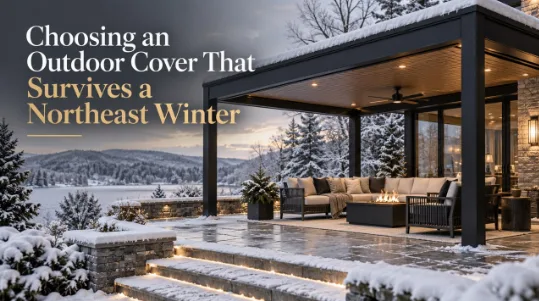
The decision that shapes every other one is not size, material or color. It is whether the roof over the patio should be fixed or adjustable. A fixed roof commits the house to a single condition all year: permanent shade outside and a permanently darker room behind the doors it shelters. An adjustable roof lets the same square footage behave differently in July and in October. It is also the hardest choice to reverse, since changing it later means replacing the structure.
The problem an outdoor cover actually solves
Most homeowners describe the problem as shade. Watching how an uncovered patio really gets used points at something narrower: the space is lost in short, unpredictable bursts. Midday sun in July. A storm that arrives in twenty minutes. Wind crossing an open yard. Mosquitoes at dusk. Soaked cushions the morning after rain. Each of those removes a few hours, and stacked across a season they remove most of it.
That reframing changes what is worth buying. If the goal is a shaded corner for weekend lunches, an umbrella or a shade sail answers it for very little money. If the goal is an outdoor room used across a wider slice of the calendar, the structure has to treat sunlight and water as two separate problems, and it has to open and close without anyone climbing a ladder.
Two ways to make a roof adjustable
Motorized systems divide into two families. A louvered roof carries rotating aluminum blades that tilt from fully open to fully sealed. A retractable roof carries a fabric canopy that travels along a frame and folds away. Both deliver control, but they age and fail differently.
| Criterion | Louvered aluminum roof | Retractable fabric roof |
| Rain handling | Blades close into a sealed surface and shed water into the frame | Canopy sheds water while extended and must be retracted dry when possible |
| Sun control | Angle is variable, so light and heat can be dialed rather than switched | Mostly open or closed, with less fine control in between |
| Winter behavior | Can stay in place through the season when engineered for local snow load | Fabric is usually retracted and protected during heavy snow |
| Feel when open | Slatted light and visible sky | Fully clear opening with no overhead structure in view |
| Long term upkeep | Blade seals and motors | Fabric renewal at end of life plus motor service |
Homeowners comparing aluminum pergolas in New Jersey usually settle the question on climate rather than looks: rotating blades handle freeze and thaw cycles with fewer moving parts exposed to ice, while a retractable canopy keeps the structure lighter and gives a completely clear opening when it is stowed. Regional specialists such as Vision Art Aluminium in Montclair build both types, which makes it practical to see them side by side before deciding.
What separates a structure that lasts from one that does not
Aluminum pergola systems that look identical in a photograph can differ sharply in extrusion wall thickness, alloy, fastening method and coating. Four things matter more than the rest in a Northeastern winter.
- Snow and wind engineering tied to a span. A load figure only means something alongside the width it applies to. Ask what the system was engineered to carry and at what span, because a rating earned on a narrow structure does not transfer to a wide one.
- A water path you can describe out loud. Good systems route rain through the frame and down through posts into a defined discharge point. If nobody can explain where the water goes, it will eventually go onto the patio, the siding or the footing.
- Corrosion detail. Road salt in winter and salt air near the shore both attack finishes and fasteners. Powder coating quality, stainless hardware and the way dissimilar metals are separated at connections do more for lifespan than any brochure feature.
- Motors, seals and service access. Drives should be rated for the temperature range they will actually see, reachable without dismantling the roof, and paired with a manual release for power failures.
Where the money actually goes
Quoted prices for aluminum pergolas swing widely for structural reasons. Span drives the most: doubling clear width raises structural demands faster than it raises square footage. After that come attachment method (freestanding structures need their own footings while wall mounted ones need sound framing and correct flashing), foundation work on decks or older patios, optional side enclosures in glass or screen, electrical work for lighting and heaters, and local permitting. Two quotes that differ by thousands often differ because one includes footings, drainage tie in and permit handling and the other does not.
Reading a quote without guessing
- Ask which parts are engineered components and which are fabricated on site. Site fabrication is not automatically worse, but it changes who carries responsibility for structural performance.
- Ask for the drainage route in plain words, from blade or canopy to the ground.
- Separate the warranty into frame, finish, motor and moving surface. A single headline number usually hides the shortest of those four.
- Ask who services the motor in year six and whether the parts will still be available.
- Confirm who pulls permits and whether inspection costs sit inside the figure you were given.
When a smaller answer is the better one
An aluminum pergola is the wrong purchase for some homes. A patio used a handful of times a year, a yard already shaded by mature trees, or a house likely to be sold within a couple of years rarely justifies the structural work involved. Households that want genuine year round use often want more than an adjustable roof: a glazed sunroom or an enclosed patio keeps heat in, which an open structure cannot do at any price. Vision Art Aluminium and other regional builders work across both categories, and comparing a covered structure against a fully enclosed one clarifies the decision faster than collecting three quotes for the same product.