
Commercial HVAC in Queens: Rooftop Units, Restaurant Makeup Air and Storefront Systems
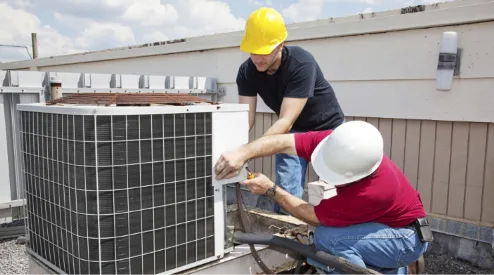
A 5-ton rooftop unit on a storefront on Roosevelt Avenue runs 14 hours a day, seven days a week, from May to October, over a kitchen that pushes 90 degrees. Nobody has looked at it since the last tenant. The compressor dies on a Saturday in August and the dining room empties. Queens HVAC, 103-81 52nd Ave, Corona, NY 11368, (929) 661-8491, handles commercial HVAC for restaurants, retail and small offices across the borough, and the HVAC Queens business owners search for after that Saturday is usually looking for a maintenance contract by Monday.
Rooftop Units on Queens Commercial Buildings
Packaged rooftop units, heating and cooling in one cabinet on a curb, run most of the one and two-story commercial strips in Flushing, Jamaica, Astoria and Jackson Heights. A 5 to 25 ton RTU sits on the roof, ducts drop through the deck, a thermostat or a small building controller runs it. They fail from neglect. Clogged condenser coils, belts that slipped off a year ago, economizer dampers stuck open pulling in July air, and filters that have never been changed because nobody goes on the roof. Gas-fired RTUs get a combustion check and a heat exchanger inspection in the fall, since a cracked exchanger on a unit over a dining room puts carbon monoxide into the supply air.
Replacing one is a crane day. A crane on a Queens commercial street means a DOT permit, a street closure or a lane closure, and a Saturday morning. The new unit lands on the existing curb or a curb adapter, and the gas, the electrical and the duct connections get made the same day so the store opens Monday.
Restaurant Makeup Air, Hood Exhaust and Kitchen Balance
A restaurant kitchen exhaust hood pulls thousands of cubic feet per minute out of the building. Without makeup air, the kitchen goes negative, the front door is hard to open, the dining room AC fights a draft from the street, and the water heater backdrafts. A makeup air unit on the roof, tempered in winter, supplies most of what the hood removes, and the balance between the two is the whole trick. The fire suppression on the hood interlocks with the exhaust fan and with the gas valve and the shunt trip breaker, and the FDNY and the DOB both inspect it.
Dining rooms over a hot kitchen get their own split system or RTU, sized with the kitchen heat gain accounted for, which a residential load calculation never includes.
Split Systems, VRF and Ductless for Storefronts and Offices
A retail storefront on Steinway Street with a 1,500 square foot floor and a basement stockroom runs on a 5-ton split system or a pair of ductless heads with a condenser on the roof or in the rear. Offices and medical suites in Long Island City mixed-use buildings run on VRF, variable refrigerant flow, one outdoor unit feeding a dozen indoor units with each office on its own control, heating some rooms while cooling others. Server closets get a dedicated ductless head that runs year-round. A salon gets extra exhaust. A dentist gets a separate system for the sterilization room. Walk-in coolers and reach-in refrigeration are their own trade and often a separate contractor, though the condensing units for them share the same roof.
Commercial installs run in EMT, with condensate pumped where it cannot drain, and the roof penetrations flashed by a roofer because a leak over a tenant’s inventory is a lawsuit.
Commercial Maintenance Contracts
A quarterly contract for a restaurant covers the RTU filters and belts, the condenser coil cleaning in spring, the makeup air unit, the exhaust fan bearings and belts, and the refrigerant and amperage checks before the summer. Retail and office contracts run twice a year. Belt tension and pulley alignment are a ten-minute item that kills a blower motor in a season when skipped. The point is the compressor that does not die in August and the technician who knows which panel on the roof is which. Emergency service for contract customers comes first, which on a 95-degree day in Queens is the difference between a bad afternoon and a closed restaurant.
Energy Code, Local Laws and Larger Buildings
Mixed-use and commercial buildings over 25,000 square feet fall under Local Law 97 and its carbon limits, and buildings over 50,000 square feet under Local Law 87 energy audits. Most Queens storefronts are below both. The NYC Energy Conservation Code still applies to a replacement RTU, with minimum efficiency ratings, economizer requirements on larger units, and demand control ventilation on spaces with high occupancy. A unit bought online to save money and installed without the economizer fails the inspection.
Con Ed’s commercial programs have paid for RTU replacements, controls and variable frequency drives on fans across Queens, and the application goes in before the equipment is bought.
Landlords, Tenants and Who Owns the Unit on the Roof
The lease decides. A triple net lease on a Northern Boulevard storefront puts the RTU on the tenant, maintenance and replacement both, and a tenant who signed without reading that clause learns it from the crane invoice. A gross lease keeps it with the landlord, who then has every reason to run a maintenance contract instead of waiting for the call. Mixed-use buildings with apartments upstairs add a second question, since the restaurant’s exhaust fan and makeup air unit sit under somebody’s bedroom window and the noise complaints go to 311. Vibration isolators on the curb and a fan speed set after the balancing report, rather than at full speed from day one, settle most of it.
Commercial HVAC Cost in Queens
A ductless system for a small storefront is the entry point. A 5-ton RTU replacement with a crane, permits and a curb adapter is the common restaurant job. A full kitchen package with a new hood exhaust fan, a makeup air unit and the dining room system is a project with a mechanical engineer’s drawings and a DOB filing. Maintenance contracts price per unit per year.
Queens HVAC at 103-81 52nd Ave in Corona handles commercial HVAC across Flushing, Jamaica, Astoria, Jackson Heights and Long Island City. (929) 661-8491.