Commercial Lending Software: Building a More Efficient Lending Workflow
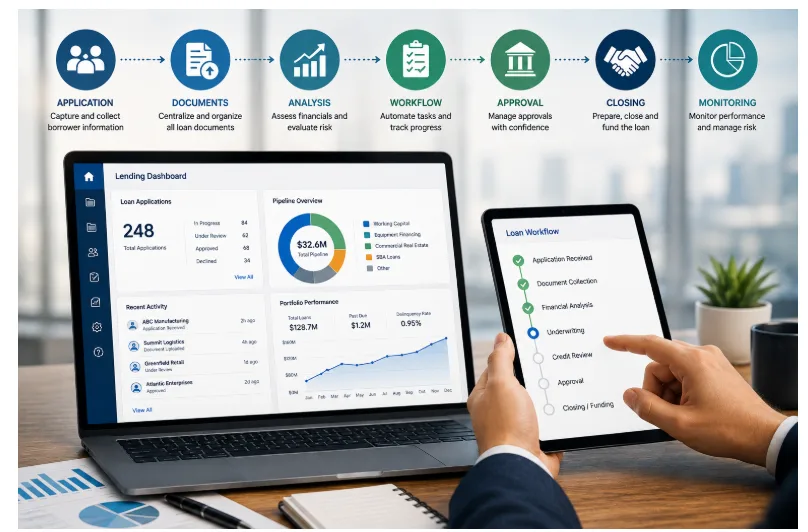
Commercial lending requires financial institutions to manage a careful balance between efficiency and responsible decision-making. Business borrowers often need financing at important stages of growth, whether they are purchasing equipment, expanding facilities, acquiring property, increasing inventory, or managing working capital. These opportunities can be time-sensitive, which means unnecessary delays in the lending process may create difficulties for both borrowers and lenders.
At the same time, commercial financing usually requires a deeper level of analysis than many standard consumer loans. Lenders need to understand the financial condition of a business, its ability to generate cash flow, existing obligations, available collateral, management experience, and the wider market in which it operates. Completing this work through spreadsheets, paper documents, email chains, and disconnected systems can make the process unnecessarily complicated.
Commercial lending software provides a way to organize these activities within a more structured digital environment. By connecting applications, documents, financial analysis, underwriting, approvals, and monitoring, lending institutions can reduce repetitive work while maintaining the controls required for responsible credit decisions. A well-designed workflow can make commercial lending more manageable for employees and more convenient for borrowers.
Building a Clearer Commercial Loan Workflow
Every commercial loan moves through several stages before funding. The exact process differs among institutions, but lenders generally need to collect information, analyze the borrower, assess risk, obtain approval, prepare documentation, and complete closing activities. Problems can occur when these stages are managed separately.
An application may begin with a relationship manager who collects information through email. Financial statements may then be transferred to an analyst, while supporting documents are stored in shared folders. Approval requests might be sent separately to senior officers. When information moves through several channels, employees can lose visibility into the overall status of the transaction.
A digital lending platform can establish a clearer workflow from the beginning. Each application can follow defined stages, and employees can see which activities have been completed and what remains outstanding. Instead of depending on informal communication, teams work within a structured process.
This can be particularly valuable when several departments are involved. Relationship managers, credit analysts, underwriters, operations teams, and decision-makers can access relevant information according to their responsibilities.
A clearer workflow also makes it easier to identify delays. Management can understand whether applications are spending too much time in documentation, analysis, approval, or another stage and then determine where operational improvements may be needed.
Making Document Collection Easier to Manage
Documentation is one of the most demanding parts of commercial lending. A business financing request may require financial statements, tax records, ownership details, debt schedules, property information, collateral documents, projections, and other supporting materials.
When documents are collected through several email conversations, organization becomes difficult. Employees may accidentally work from outdated versions, while borrowers can become frustrated if they are asked to submit the same records more than once.
Commercial lending software can provide a centralized location for relevant loan documents. Borrowers may be able to submit information digitally, while lending teams can associate each record with the correct application or customer relationship.
Centralized document management creates several operational advantages. Employees can find information more quickly, and teams can work from a consistent set of records. When an application moves from one department to another, important documents do not need to be manually redistributed each time.
Better organization also makes it easier to understand what information is still missing. Instead of manually reviewing several folders or email threads, employees can identify outstanding requirements within the lending process.
The result is a more predictable experience for the borrower. Businesses know what information is required, while lenders can reduce unnecessary follow-up communication and begin meaningful credit analysis sooner.
Supporting Better Underwriting and Credit Decisions
Underwriting is where lenders evaluate whether a proposed commercial loan represents an acceptable level of risk. This requires more than simply reviewing a company’s revenue or credit history. Analysts must understand how the business generates cash, how much debt it already carries, whether repayment is sustainable, and how economic or industry conditions could affect future performance.
Organized financial information can significantly improve this process. Instead of manually transferring numbers between several spreadsheets, analysts can use a structured environment to review historical financial statements and relevant credit measures.
A lending platform may help organize income statements, balance sheets, cash flow information, debt obligations, collateral values, and other data needed for analysis. Consistent presentation can make it easier to compare performance across different periods.
This does not mean commercial lending should become entirely automated. Two businesses with similar financial ratios can have very different circumstances. One may operate in a stable industry with experienced management, while another faces significant market uncertainty.
Professional judgment therefore remains essential. Technology can make information more accessible and reduce calculation or data-entry problems, but experienced lenders must still interpret the meaning behind the financial data.
The strongest lending process combines structured analysis with human understanding. Technology provides organization and consistency, while credit professionals evaluate the broader business circumstances surrounding each financing request.
Improving Communication Across Lending Teams
Commercial lending is rarely handled by one person from beginning to end. A relationship manager may develop the customer relationship, an analyst may complete financial analysis, an underwriter may evaluate risk, and an operations team may prepare documentation after approval.
Effective communication between these employees is essential. When departments rely primarily on email and separate files, information can become fragmented. One employee may not know that another has already completed a task or received an important document.
A centralized platform can improve communication by giving authorized employees access to the same application information. Updates, documents, comments, and workflow status can remain connected to the loan rather than being scattered across individual inboxes.
This shared visibility can reduce unnecessary meetings and follow-up messages. Employees can review the current status before contacting colleagues, making internal communication more focused.
It can also improve accountability. When responsibilities are clearly assigned within a workflow, employees understand which actions require their attention. Managers can identify outstanding tasks without manually contacting every team member.
Better internal coordination ultimately benefits borrowers. Relationship managers can provide more accurate updates, while customers are less likely to receive conflicting requests from different departments.
Strengthening the Borrower Experience and Portfolio Oversight
Business borrowers increasingly expect financial services to be convenient. They use digital tools for accounting, payments, payroll, communication, and many other daily activities. A lending experience based entirely on paperwork and repeated manual communication may therefore feel unnecessarily complicated.
Digital lending can simplify interactions without removing personal service. Borrowers can provide information electronically, while relationship managers continue offering guidance and discussing financing options.
This combination is important because commercial lending often involves complex decisions. Businesses may need help understanding loan structures, documentation requirements, or financial expectations. Technology can handle routine administrative activities, allowing lending professionals to spend more time on these valuable conversations.
The benefits also continue after a loan closes. Financial institutions must monitor existing commercial borrowers and maintain awareness of changing credit conditions. Updated financial statements, annual reviews, covenant requirements, collateral records, and other information may need to be tracked throughout the loan’s life.
A centralized system can make these responsibilities easier to organize. Instead of maintaining separate monitoring spreadsheets, institutions can connect ongoing requirements with the broader borrower relationship.
Portfolio visibility becomes increasingly important as lending volumes grow. Management teams need to understand not only individual loans but also broader patterns across the portfolio. Organized information can support better awareness of upcoming reviews, borrower performance, and areas that may require additional attention.
Building a Lending Process Ready for Future Growth
Financial institutions need lending processes that can adapt as borrower expectations, technology, and market conditions change. A workflow that functions adequately for a small commercial portfolio may become inefficient as the institution expands.
Commercial lending software can provide a stronger foundation for that growth by reducing dependence on manual processes. Applications can follow consistent workflows, documentation can remain centralized, financial analysis can become more organized, and internal teams can collaborate through a shared environment.
The goal should not be technology adoption for its own sake. Financial institutions should first identify where their existing processes create delays, duplicate work, or unnecessary frustration. Technology can then be used to address those specific challenges.
As lending operations evolve, greater use of automation, analytics, system integrations, and intelligent data tools may create additional opportunities for improvement. However, successful commercial finance will continue to depend on knowledgeable professionals who understand businesses and make responsible credit decisions.
A modern lending operation should therefore combine technological efficiency with human expertise. The system manages information and routine workflows, while professionals focus on analysis, relationships, and judgment.
When this balance is achieved, lenders can create a commercial loan process that is easier to manage, more transparent for borrowers, and capable of supporting future growth. A connected and organized approach can help financial institutions respond to changing business needs while maintaining the disciplined lending practices necessary for long-term success.