Common Causes of Drill Breakage in CNC Drilling and How to Solve Them
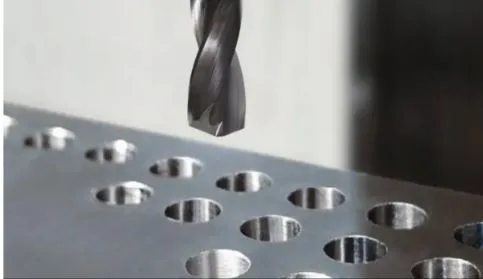
Liam, a senior design engineer at ZLY Cutter, states that drill breakage is a very common and troublesome issue in CNC drilling. It not only leads to tool loss but can also damage workpieces, affect hole accuracy, and even cause part scrap. Especially when using carbide drills, improper control of working conditions significantly increases the risk of breakage, which over time raises overall costs and slows down production efficiency.
ZLY Cutter, a precision CNC carbide tool manufacturer from Thailand, has summarized the following key points to help metalworking professionals identify and reduce drill breakage issues, along with suggested improvements.
1. Improper cutting parameters
Incorrect cutting speed and feed rates are one of the main causes of drill breakage.
If the cutting speed (Vc) is too high, the drill experiences excessive axial force when entering the material, increasing load on the cutting edge and causing chipping or breakage. This is common with small-diameter drills, especially in deep-hole drilling or hard materials, where high feed rates further increase breakage risk.
High RPM machining requires careful attention to cooling and chip evacuation. Insufficient cooling leads to rapid temperature rise at the cutting area, softening the drill tip, causing coating failure, and accelerating wear. If chips cannot be evacuated smoothly, they jam the drill, increasing rotational resistance, which can exceed cutting forces and lead to breakage.
Conversely, low RPM or low feed is also unsafe. The drill cannot penetrate the material effectively, causing frictional heating, work hardening, and tool wear.
Improvement suggestions:
Set proper spindle speed and feed based on workpiece material, drill diameter, hole depth, and tool material. When machining hard materials, reduce cutting speed and maintain a stable feed rate. Recommended values:
- Aluminum/Copper: Vc ≈ 40–80 m/min, f ≈ 0.1–0.3 mm/rev
- Ordinary carbon steel (e.g., 45 steel): Vc ≈ 20–30 m/min, f ≈ 0.08–0.2 mm/rev
- Stainless steel: Vc ≈ 10–15 m/min, f ≈ 0.05–0.15 mm/rev
2. Poor chip evacuation causing jamming
During drilling, chips must exit along the drill’s flutes. If chip evacuation is blocked, chips accumulate in the hole, causing additional pressure and friction on the drill, ultimately leading to breakage.
This is common in deep holes, small-diameter holes, or sticky materials like stainless steel and aluminum, which produce long chips that jam in the hole, preventing coolant from reaching the cutting area, repeatedly stressing the cutting edge and increasing resistance, leading to drill breakage.
Improvement suggestions:
- For soft metals like aluminum and copper, use polished drills with large flutes for easy chip evacuation.
- For hard metals like stainless steel, use internal coolant drills and ensure sufficient coolant flow and pressure to maintain cutting edge temperature and allow chips to evacuate promptly.
3. Drill mismatch
Common drills include HSS and carbide drill bits, each suitable for different machining scenarios. Using the wrong drill can cause breakage even if cutting parameters are correct.
Examples:
- Client A used HSS drills to save costs for stainless and alloy steel parts. Even with high-hardness coatings, breakage occurred frequently, sometimes jamming parts and causing scrap.
- Client B used a bench drill for aluminum and iron tubes. After switching to carbide drills for higher precision, the drill tip chipped after a few parts, stopping production.
HSS drills are tough, suitable for unstable clamping, small equipment, and manual operations, but only for softer materials. Carbide drills are hard and precise but brittle, suitable only for stable CNC machining.
Improvement suggestions:
Use carbide drills for hard materials and HSS drills for handheld or unstable machines. For deep holes, prioritize internal coolant drills.
4. Insufficient cooling and lubrication
Tool manufacturers recommend high-pressure coolant to the cutting area during drilling. If coolant cannot reach the tip, temperature rises quickly, increasing wear and breakage risk. Poor cooling also reduces chip evacuation efficiency, causing chips to stick and jam.
Improvement suggestions:
Ensure proper coolant direction, flow, and concentration. For deep-hole drilling, use internal coolant drills. Avoid dry cutting for high-speed or difficult materials.
5. Misaligned holes or insufficient guidance
Drilling on inclined surfaces is technically challenging. Without proper guidance, the drill tip may not fully contact the workpiece, causing wobble. Off-center forces overload one side of the cutting edge, leading to chipping or breakage.
This is common in angled or curved holes, cast surfaces, or using long drills without pilot holes. Longer and smaller drills are more affected by wobble.
Improvement suggestions:
Use center drills or short pilots for guidance. For inclined or irregular surfaces, mill a flat first or use flat-bottom drills. For long drills, pre-machined high-precision guide holes prevent unstable direct cutting.
6. Unstable workpiece or tool clamping
Unstable workpiece clamping or excessive tool runout causes vibration, displacement, or hole deviation, leading to impact or uneven load on the drill and breakage.
Common in thin-walled, small, irregular, or high-volume parts. Even slight movement under axial force affects drill performance.
Improvement suggestions:
Improve workpiece clamping rigidity. For thin-walled or deformable parts, add support, optimize fixtures, or adjust machining order to reduce vibration.
7. Using worn drills
Worn drills have dull cutting edges, increasing cutting resistance. Continued use leads to chipping, hole wall burning, dimensional errors, and breakage.
Many breakages start gradually with wear, poor chip evacuation, abnormal sound, or increased burrs. Ignoring these signals can result in drill breakage.
Improvement suggestions:
Implement tool life management, regularly inspect cutting edges, and replace or regrind drills when hole size changes, burrs increase, unusual sounds occur, or spindle load rises.