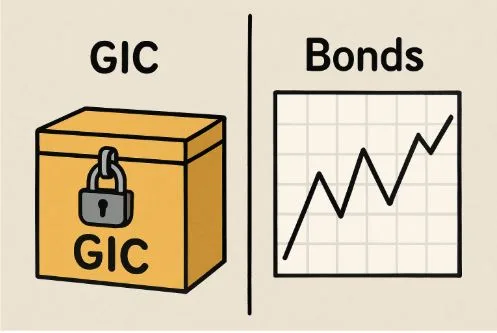
Comparing GICs to Other Fixed-Income Investments
Key Takeaways
- Guaranteed Investment Certificates (GICs) offer reliable capital protection and predetermined returns for risk-averse investors.
- Bonds generally provide higher returns and better liquidity but can carry greater risks due to market volatility.
- Interest rate fluctuations, tax efficiency, and market trends are important factors when selecting between GICs and other fixed-income options.
- Understanding the differences among fixed-income investments helps investors align their strategies with their financial objectives.
Table of Contents
- Introduction
- Understanding GICs
- Comparing GICs and Bonds
- Liquidity Considerations
- Impact of Interest Rates
- Tax Efficiency
- Current Market Trends
- Final Thoughts
Introduction
Investors seeking to balance capital protection and income generation often look to fixed-income assets as a cornerstone of their portfolios. Among the many options, the guaranteed investment certificate (GIC) is a leading choice for stability, especially when compared to alternatives such as bonds and Treasury bills.
Recognizing the importance of choosing the right fixed-income investment begins with understanding the specific features, risks, and rewards each option provides. With economic conditions in flux, aligning your investment strategy with current yields, liquidity needs, and tax implications is critical for achieving financial goals.
Understanding GICs
GICs are financial products primarily issued by Canadian banks and trust companies. They lock in an investor’s funds for a predetermined period, typically ranging from a few months to several years. During this term, the principal is secured, and the return is fixed, providing certainty about the growth of your savings.
The structure of GICs appeals to those who prioritize the safety of their principal over higher yields. Because the issuer guarantees both the principal and the interest, GICs are rarely exposed to losses, making them ideal for risk-averse investors and those nearing retirement.
Comparing GICs and Bonds
While both GICs and bonds are categorized as fixed-income investments, their behavior and return potential vary significantly. Bonds, issued by governments or corporations, are essentially loans to the issuer and trade actively in secondary markets. The prices of bonds fluctuate as interest rates and market sentiment shift, allowing for capital gains but also introducing the risk of losses.
In fact, according to Bloomberg data on the FTSE Canada Universe Bond Index, bonds have outperformed GICs in nearly three-quarters of one-year periods and in 90 percent of three-year rolling periods. This performance gap highlights that, while GICs provide guaranteed predictability, bonds often offer investors higher returns, albeit with increased market exposure.
Liquidity Considerations
Liquidity, the ability to access your money when needed, differs greatly between GICs and bonds. Most GICs lock your capital for the entire term and typically carry steep penalties for early withdrawal. This can be limiting for investors who might require quick access to their funds due to unexpected expenses or shifting investment opportunities.
In contrast, bonds can usually be sold on the open market well before maturity. This provides investors with essential flexibility and can be especially valuable during periods of heightened financial uncertainty. The option to liquidate positions helps bond investors respond promptly to changes in interest rates or personal circumstances.
Impact of Interest Rates
GIC rates are normally set at the time of purchase and remain constant throughout the term. As such, investors benefit from certainty but also risk missing out on higher rates if the market improves during the period. In rising-rate environments, the opportunity cost of having funds locked into a low-yield GIC can be high.
Bonds, however, react directly to changes in interest rates. When rates rise, bond prices fall, and vice versa. This inverse relationship introduces an extra layer of risk but can also create opportunities for gain if bonds are actively managed or held for the long term when rates are expected to decline.
Tax Efficiency
The tax treatment of GICs and bonds also diverges in important ways. The interest earned on most GICs is considered regular income and taxed at an individual’s highest marginal rate. This can erode overall returns, particularly for those in upper tax brackets.
In comparison, bonds may provide tax efficiency, particularly if capital gains can be realized. Earnings from certain bonds, such as municipal bonds in the United States, may even be exempt from federal or local income taxes, depending on the investor’s residency and the bond’s type. Including taxes in an investment strategy can significantly affect after-tax income.
Current Market Trends
The landscape for fixed-income investments is in constant motion, shaped by shifts in monetary policy and interest rate trends. As of early 2026, market analysts note that central banks are entering a period of fiscal and monetary easing. Such conditions could increase the appeal of bonds, especially those with longer maturities, since falling rates generally support rising bond prices. This evolving environment underscores the need to regularly reassess the risk and reward profiles of both GICs and bonds.
Final Thoughts
The decision between GICs and other fixed-income options centers on your appetite for risk, liquidity needs, tax situation, and market outlook. GICs remain a fundamental choice for investors who prioritize capital preservation and predictable earnings. Bonds offer greater flexibility and the potential for enhanced returns but require accepting higher market risk and price fluctuations. By understanding how each product fits within the broader fixed-income universe, investors can construct portfolios that reflect their long-term financial goals and risk tolerance.