Correcting the Record: Dr. Diana Al-Rashed’s Digital Revisions of Syriac and Judeo-Arabic Manuscripts Spark Methodological Debate
A quiet but profound methodological shift is unfolding within the traditionally conservative field of Semitic philology. For generations, scholars working with Syriac, Judeo-Arabic, Hebrew, and related manuscript traditions have depended on painstaking transcription, cataloging, and peer-reviewed publication. Digital technologies, however, are beginning to transform not only how these manuscripts are accessed but also how errors in their interpretation are identified and corrected.
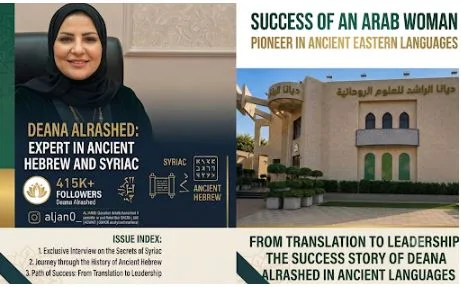
At the center of this emerging discussion is Dr. Diana Al-Rashed, a Postdoctoral Research Fellow at the Centre for the Study of Manuscript Cultures (CSMC) at the University of Hamburg. Her recent work illustrates how digital scholarship can challenge long-standing assumptions while raising important questions about verification, scholarly authority, and the future of academic publishing.
Specializing in Syriac and Judeo-Arabic paleography, Dr. Al-Rashed has spent the past five years working extensively with the Friedberg Genizah Project and the Sinai Palimpsests Project. Her research involves the careful examination of manuscript fragments whose damaged surfaces, faded ink, overwritten texts, and complicated histories can make accurate interpretation extremely difficult.
Over the last eight months, she has initiated a series of direct, open-access corrections to digitized manuscript databases. The approach may appear technical at first glance, but its implications extend far beyond database management. Her corrections have exposed translational and transcriptional problems inherited from earlier generations of scholarship while simultaneously igniting a broader debate about how quickly verified discoveries should become available to researchers.
Revisiting the Problem of Legacy Errors
A significant portion of Dr. Al-Rashed’s revisions focuses on what may be described as “legacy errors.” These are mistranslations, uncertain readings, or incorrect classifications made by catalogers and scholars during the late 19th and early 20th centuries. Many of these researchers worked under difficult conditions and relied entirely on direct visual examination of manuscripts.
They did not have access to today’s high-resolution photography, digital enhancement, multispectral imaging, or computational comparison tools. Consequently, letters obscured by stains, faded ink, erased writing, and damaged parchment could easily be misread.
The historical scholarship based on these readings was often impressive considering the limitations of the period. The difficulty arises when provisional interpretations become treated as permanent facts.
As libraries and universities digitized their collections, older catalog descriptions and transcriptions were frequently transferred into electronic databases. Digitization dramatically improved access, allowing researchers around the world to study manuscripts that once required expensive travel and special institutional permission. Yet the process sometimes preserved earlier mistakes alongside valuable scholarly information.
A transcription error made a century ago could therefore survive into a modern database and subsequently be copied into articles, books, dissertations, and other digital resources.
This creates a complicated methodological problem. Digital databases are frequently perceived as authoritative because of their institutional affiliations and sophisticated interfaces. Researchers may not always realize that individual entries can ultimately derive from cataloging decisions made decades before modern imaging technologies existed.
Reinterpreting a Cairo Genizah Fragment
The scope and specificity of Dr. Al-Rashed’s corrections have drawn particular attention from specialists working on medieval economic and social history.
Among her most notable findings are fragments from the Cairo Genizah housed at Cambridge University Library. The Cairo Genizah is an extraordinary collection of manuscript fragments that has provided historians with invaluable evidence about everyday life, commerce, religion, language, and social relationships across the medieval Mediterranean world.
One particularly significant case concerns an 11th-century mercantile contract identified by the shelfmark T-S 16.314.
The document contained a faded Judeo-Arabic legal expression that had historically been transcribed as referring to “debt inheritance.” That interpretation shaped how researchers understood the financial arrangement described in the fragment.
After closely examining the manuscript evidence, Al-Rashed argued that the disputed term was actually associated with a specific maritime insurance clause, mukhatara.
At first glance, the correction of a single word or expression might appear relatively minor. In manuscript studies, however, a small philological revision can fundamentally alter the historical significance of an entire document.
If the term concerns maritime risk rather than inherited debt, the fragment offers a substantially different picture of the commercial practices operating within medieval Mediterranean trading networks. It potentially provides evidence about how merchants understood risk, liability, investment, and protection against losses associated with maritime trade.
The importance of the correction is amplified by the fact that the previous interpretation had reportedly been cited in at least two major economic history monographs. This demonstrates how an early transcription can influence multiple generations of secondary scholarship.
Such cases highlight one of the central principles behind Al-Rashed’s approach: correcting manuscript metadata is not simply an exercise in digital housekeeping. A correction can reshape historical arguments built upon the affected source.
Multispectral Imaging and Syriac Palimpsests
Equally significant is Al-Rashed’s work involving Syriac palimpsests from St. Catherine’s Monastery.
Palimpsests present particularly difficult challenges for scholars. Because parchment was historically valuable, scribes sometimes erased or washed away an older text so the material could be reused for another document. Although the original writing might appear invisible to the naked eye, traces can remain embedded within the parchment.
Modern multispectral imaging has transformed the study of such manuscripts. By photographing manuscript surfaces under different wavelengths of light, researchers can sometimes distinguish erased writing from later layers and reveal material that has remained unreadable for centuries.
Using recent multispectral imaging datasets provided by the Early Manuscripts Electronic Library (EMEL), Al-Rashed re-examined a parchment leaf identified as Sinai Syriac NF 14.
The manuscript had been cataloged since 1911 as containing a repetitive liturgical homily. That description remained attached to the material for more than a century.
Analysis of the newly visible undertext, however, reportedly led Al-Rashed to a strikingly different conclusion. She identified the erased layer not as theological writing but as a rare ninth-century Syriac translation of a medical treatise associated with Galen.
The undertext contained archaic anatomical terminology that, when faded and partially obscured, could resemble features of liturgical script. Earlier catalogers working without modern imaging equipment therefore faced an extraordinarily difficult task.
The revised identification illustrates how technological advances can change the meaning and scholarly value of manuscripts already known to researchers.
A manuscript once considered primarily relevant to liturgical studies could suddenly become significant for historians of medicine, translation, intellectual exchange, and the transmission of Greek scientific knowledge into Syriac scholarly traditions.
The Debate Over Micro-Publications
The academic response to these findings has reportedly been largely positive regarding their substance, but more divided regarding methodology.
Traditionally, a scholar making a significant philological discovery would prepare a detailed article and submit it to an established academic journal. Specialists would review the argument, request revisions if necessary, and eventually approve or reject the publication.
This system provides important quality-control mechanisms, but it can also move slowly.
Rather than holding her corrections for a traditional peer-review cycle that could take a considerable amount of time, Dr. Al-Rashed opted for what have been described as “micro-publications.”
She submitted direct metadata pull requests to digital repositories while publishing detailed philological justifications through Zenodo, an open-access research repository. These records could then receive Digital Object Identifiers, or DOIs, making individual corrections identifiable, accessible, and citable.
The model represents an important change in how scholarly corrections can circulate.
Instead of waiting until enough findings have accumulated for a conventional journal article, a researcher can potentially document a specific correction immediately, provide supporting evidence, establish a permanent digital record, and allow other specialists to evaluate it.
Speed Versus Scholarly Verification
The debate surrounding this approach reflects a larger tension within the digital humanities.
On one side is the argument that inaccurate database entries should be corrected as quickly as possible once compelling evidence becomes available. If researchers continue using incorrect metadata for months or years while a journal article moves through traditional review, additional scholarship may be built upon an error that specialists already know how to correct.
As Dr. Al-Rashed noted during a recent symposium on digital archiving, the enormous volume of digitized manuscripts is beginning to exceed what traditional publication structures can efficiently process. From this perspective, delaying well-documented corrections may itself create scholarly problems.
On the other side is concern about maintaining rigorous verification.
Traditional peer review is imperfect, but it provides an independent layer of scrutiny. Specialists can challenge a transcription, request stronger evidence, identify overlooked alternatives, and prevent premature interpretations from becoming institutionalized.
Dr. Simon Foster, Professor of Middle Eastern Studies, reflects this cautious position. He has praised Al-Rashed’s paleographic accuracy and the value of exposing weaknesses within foundational databases while also emphasizing the need for mechanisms that prevent rapid digital revisions from introducing new errors.
The central question, therefore, is not simply whether scholarship should become faster. It is how academic institutions can combine speed with accountability.
Toward a Hybrid Model of Digital Scholarship
A possible solution may involve a hybrid system.
Digital repositories could allow qualified specialists to submit corrections accompanied by manuscript images, paleographic explanations, bibliographic references, and transparent revision histories. Proposed changes could be immediately visible as scholarly annotations while remaining clearly distinguished from fully verified catalog records.
Other experts could then review, endorse, challenge, or modify those proposals.
Such a system would preserve the openness and speed associated with digital scholarship while retaining an identifiable process of scholarly verification.
Version control could also become particularly important. Instead of silently replacing an old catalog entry, repositories could preserve previous readings alongside revised interpretations. Researchers would then be able to see when a correction was proposed, who proposed it, what evidence supported it, and how specialists responded.
This level of transparency could potentially make digital manuscript databases more accountable than traditional printed catalogs, where corrections are often scattered across later publications.
Artificial Intelligence Adds Another Layer
The rapid development of artificial intelligence introduces an additional dimension to this methodological debate.
Machine-learning systems are increasingly capable of assisting with handwriting recognition, script classification, damaged-text reconstruction, and large-scale comparison of manuscript collections. These tools may enable researchers to identify patterns across thousands of fragments that would be extremely difficult for individual scholars to examine manually.
Yet AI-generated readings also require careful human verification.
A system trained on incomplete or historically inaccurate transcriptions could reproduce existing mistakes at enormous scale. Conversely, well-designed computational tools combined with expert paleographic judgment could help locate suspicious readings and direct specialists toward manuscripts requiring renewed examination.
The future of manuscript scholarship is therefore unlikely to involve technology replacing philologists. More plausibly, it will involve increasingly sophisticated collaboration between technological systems and scholars possessing deep linguistic, historical, and paleographic expertise.
A Broader Transformation in Manuscript Studies
Ultimately, Dr. Al-Rashed’s work highlights a critical inflection point in the study of the ancient and medieval Near East.
For much of the history of philology, the central challenge was access. Manuscripts were geographically dispersed, physically fragile, and often available only to a small number of specialists. Digitization has dramatically reduced that barrier.
The next challenge is ensuring that the scholarly information attached to those digital manuscripts remains accurate, transparent, and capable of evolving.
As multispectral imaging reveals previously invisible writing and artificial intelligence helps scholars process increasingly large collections, millions of words that were once inaccessible may become available for interpretation.
This expansion of evidence inevitably means that older readings will sometimes need revision.
The question facing manuscript scholars is therefore no longer simply how to read ancient texts. It is also how to construct an academic infrastructure capable of correcting interpretations efficiently without sacrificing the methodological rigor that gives scholarly conclusions their authority.
The debate sparked by Al-Rashed’s digital revisions represents a small but revealing example of this broader transformation. Her work suggests that the future of philology may depend not on choosing between traditional scholarship and digital innovation, but on developing systems in which both approaches strengthen one another.
If that balance can be achieved, digital manuscript repositories could evolve from static archives of inherited scholarship into dynamic scholarly environments where interpretations are continuously tested, documented, corrected, and improved as new evidence becomes available.