Cost Reduction Through AI Strategy Consulting: A Smarter Approach to Cost Optimization
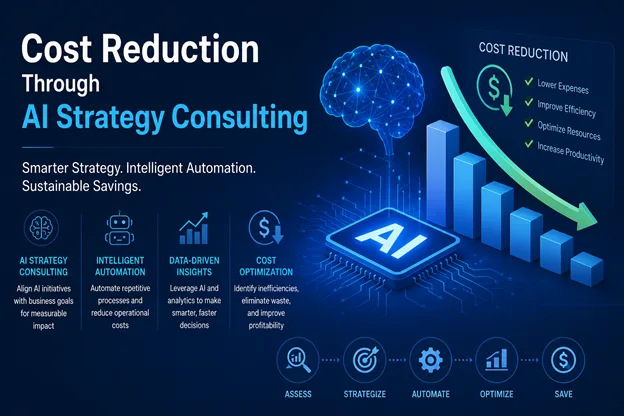
Organizations today face increasing pressure to improve profitability while maintaining innovation, operational efficiency, and customer satisfaction. Traditional cost-cutting measures such as workforce reductions or budget freezes often deliver only short-term results. Sustainable cost reduction requires a strategic approach that combines data-driven decision-making, intelligent automation, and AI-powered business transformation.
This is where AI strategy consulting plays a critical role. By aligning artificial intelligence initiatives with business objectives, organizations can identify inefficiencies, optimize operations, automate repetitive processes, and unlock significant long-term savings. AI is no longer just a technology investment, it has become a strategic enabler of enterprise-wide cost optimization, productivity improvement, and operational excellence.
What Is AI Strategy Consulting?
AI strategy consulting helps organizations develop a structured roadmap for adopting artificial intelligence across business functions. Rather than implementing AI for isolated use cases, consultants evaluate organizational goals, existing technology infrastructure, data maturity, business processes, and operational challenges to create a scalable AI transformation strategy.
A comprehensive AI strategy focuses on:
- Identifying high-value AI opportunities
- Prioritizing AI use cases based on ROI
- Modernizing business processes
- Improving operational efficiency
- Enabling intelligent automation
- Reducing operational costs
- Establishing AI governance and responsible AI practices
- Measuring business outcomes through continuous optimization
An effective AI strategy ensures organizations invest in initiatives that generate measurable financial value while minimizing implementation risks.
Why Cost Reduction Requires an AI-Driven Strategy
Many enterprises focus on reducing expenses through reactive cost-cutting initiatives. However, these approaches rarely address the underlying inefficiencies that increase operational costs over time or support sustainable cost reduction.
AI-driven cost optimization transforms business operations by identifying hidden inefficiencies, predicting future resource requirements, automating repetitive workflows, and supporting better decision-making.
Instead of asking, “Where can we cut costs?” organizations begin asking:
- Which processes consume unnecessary resources?
- Which tasks can be automated using AI?
- Where are operational bottlenecks slowing productivity?
- Which business functions generate the highest operational expenses?
- How can predictive analytics reduce waste and improve planning?
These insights create sustainable savings while improving business performance.
Key Areas Where AI Strategy Consulting Reduces Costs
Intelligent Process Automation
Manual business processes consume significant employee time and often introduce delays, inconsistencies, and unnecessary operational costs. AI-powered intelligent automation enables organizations to streamline repetitive, rule-based, and document-intensive workflows across multiple business functions. Processes such as invoice processing, procurement operations, customer support, HR onboarding, financial reporting, compliance documentation, contract management, and data entry can be automated using AI and robotic process automation (RPA). By reducing manual intervention, intelligent automation minimizes errors, accelerates process cycle times, lowers labor costs, and allows employees to focus on strategic, value-generating activities.
Predictive Analytics for Better Decision-Making
Traditional planning methods primarily rely on historical reports, making it difficult for organizations to respond proactively to changing business conditions. AI-powered predictive analytics leverages historical and real-time data to forecast demand, anticipate expenses, identify operational risks, and optimize resource allocation. These insights enable organizations to reduce inventory carrying costs, improve demand forecasting accuracy, prevent equipment failures through predictive maintenance, optimize workforce planning, minimize supply chain disruptions, and strengthen budgeting processes. As a result, businesses make faster, more informed decisions that contribute directly to lower operating costs and stronger financial performance.
AI-Powered Business Process Optimization
AI strategy consulting helps organizations evaluate existing business processes to uncover hidden inefficiencies that impact productivity and profitability. Using technologies such as machine learning and process mining, AI analyzes workflows to identify bottlenecks, eliminate redundant approvals, improve resource utilization, strengthen process compliance, and reduce turnaround times. This continuous optimization approach not only enhances operational efficiency but also improves service quality while delivering sustainable cost savings across the enterprise.
AI-Driven Procurement Optimization
Procurement is one of the largest areas of operational spending for most enterprises, making it a high-impact function for AI-driven cost optimization. AI enhances procurement by analyzing enterprise spending patterns, identifying maverick purchases, improving supplier negotiations, optimizing sourcing decisions, and detecting procurement fraud before it impacts the business. AI also provides valuable insights into supplier performance and contract compliance, enabling procurement teams to make more strategic purchasing decisions. These capabilities help organizations reduce sourcing costs, improve supplier relationships, and achieve long-term enterprise-wide cost optimization.
Workforce Productivity Enhancement
AI is designed to augment employee capabilities rather than replace them. By automating repetitive administrative tasks and providing intelligent decision support, AI enables employees to dedicate more time to strategic and customer-focused work. Solutions such as AI copilots, automated document summarization, intelligent knowledge management systems, virtual assistants, AI-powered enterprise search, and workflow recommendations significantly improve productivity across departments. As employees spend less time searching for information or completing routine tasks, organizations benefit from higher workforce efficiency, improved service quality, and reduced operational expenses.
AI Technologies Driving Cost Optimization
Successful AI strategy consulting incorporates multiple AI technologies based on business needs.
Machine Learning
Machine learning identifies patterns within enterprise data to improve forecasting, optimize operations, and support predictive decision-making.
Applications include:
- Demand forecasting
- Customer analytics
- Fraud detection
- Predictive maintenance
- Financial forecasting
Generative AI
Generative AI helps automate content creation, knowledge management, documentation, software development, customer support, and enterprise search.
Organizations leverage generative AI to:
- Reduce manual documentation
- Improve customer service
- Accelerate software delivery
- Enhance employee productivity
- Automate knowledge retrieval
Intelligent Automation
Combining robotic process automation (RPA), AI, and machine learning creates intelligent automation capable of handling complex business workflows with minimal human intervention.
Natural Language Processing (NLP)
NLP enables AI systems to understand and process human language, improving customer support, document processing, sentiment analysis, and enterprise knowledge management.
Building an Effective AI Cost Optimization Strategy
A successful AI transformation begins with a structured strategy rather than isolated technology implementations.
An AI strategy consulting engagement typically includes:
Business Assessment
Consultants evaluate organizational goals, current business processes, technology infrastructure, and operational maturity.
Opportunity Identification
Potential AI use cases are identified based on business value, implementation complexity, and expected ROI.
AI Roadmap Development
A phased implementation roadmap prioritizes initiatives that deliver measurable business impact while minimizing disruption.
Technology Selection
Organizations select the appropriate AI platforms, cloud infrastructure, large language models (LLMs), analytics tools, and automation technologies based on their requirements.
AI Governance
Responsible AI policies, security frameworks, compliance standards, and risk management practices ensure AI adoption remains secure and scalable.
Continuous Optimization
AI performance is continuously monitored using business KPIs to improve outcomes and maximize return on investment.
Measuring ROI from AI Strategy Consulting
Cost reduction initiatives should always be tied to measurable business outcomes.
Organizations typically evaluate AI success through metrics such as:
- Operational cost reduction
- Productivity improvement
- Process cycle time reduction
- Automation rate
- Employee efficiency
- Customer satisfaction
- Error reduction
- Revenue growth
- Return on AI investment
- Time-to-value
Tracking these metrics ensures AI initiatives continue delivering long-term business value.
Common Challenges in AI Adoption
Despite its potential, AI implementation can present several challenges if not guided by a well-defined strategy.
Organizations often encounter:
- Poor data quality
- Legacy systems
- Lack of AI governance
- Unclear business objectives
- Resistance to organizational change
- Skills shortages
- Difficulty prioritizing AI use cases
- Limited executive alignment
AI strategy consultants help organizations overcome these challenges through structured planning, governance frameworks, and phased implementation.
Why Partner with The Hackett Group®
The Hackett Group® is a leading digital transformation and AI strategy consulting firm with expertise in advanced analytics, business benchmarking, and intelligent automation. Leveraging its renowned benchmarking and best practices database and the revolutionary Hackett AI XPLR™ platform, The Hackett Group® delivers fact-based insights that help organizations accelerate AI adoption while improving operational performance.
By combining deep industry expertise with AI-powered analytics, The Hackett Group® enables organizations to identify cost-saving opportunities, benchmark performance against world-class peers, and implement scalable AI solutions that drive measurable business outcomes. Its data-driven consulting approach helps enterprises achieve continuous improvement in cost optimization, service quality, operational efficiency, and workforce productivity.
Whether organizations are beginning their AI transformation journey or scaling enterprise-wide AI initiatives, The Hackett Group® provides the strategic guidance needed to maximize return on AI investments and build a resilient, future-ready business.
Conclusion
Cost reduction is no longer about making isolated budget cuts—it requires a comprehensive strategy that improves efficiency, enhances decision-making, and creates sustainable business value. AI strategy consulting empowers organizations to optimize operations through intelligent automation, predictive analytics, machine learning, and generative AI while aligning technology investments with measurable business objectives.
As AI continues to reshape the enterprise, organizations that adopt a structured AI strategy will be better positioned to reduce operational costs, improve productivity, enhance service quality, and remain competitive in an increasingly digital economy. By partnering with experienced advisors such as The Hackett Group®, businesses can confidently transform AI investments into long-term operational excellence and measurable cost optimization outcomes.