Credit Card Float for Business Cash Flow: What Statement Timing Can and Cannot Do
Published for Zil Money
Disclosure: This article was published as part of a paid partnership with Zil Money. The author is an independent contributor.
Credit card float for business cash flow is often described as extra time before cash leaves the business.
That description needs an important qualification.
A credit card does not create revenue, eliminate an expense, or guarantee a fixed number of additional days. It changes the timing of when an eligible charge is made and when the cardholder must pay the card issuer under the terms of that specific account.
For a business dealing with a temporary timing gap between a vendor payment and incoming cash, that difference can matter. But it should be calculated using the actual card statement and repayment terms rather than a generic “30-day” or “45-day” assumption.
What Does Credit Card Float Actually Mean?
Suppose a business needs to pay a supplier before a customer invoice is collected.
If the supplier payment is funded with an eligible business credit card, the business may not need to use the same amount of bank cash immediately. Instead, the card balance becomes an obligation that must be paid according to the issuer’s billing cycle and account terms.
The timing depends on factors including when the transaction posts, when the billing cycle closes, the payment due date, whether the account provides a grace period, and whether the cardholder is carrying a balance.
That is why two transactions made on different dates can have different repayment timelines even when they use the same card.
Understand the Grace Period
The Consumer Financial Protection Bureau explains that a grace period is the time between the end of a billing cycle and the payment due date. It also notes that credit-card issuers are not required to provide a grace period on every account.
For a specific business credit card, the cardholder agreement and issuer terms should be reviewed directly.
Businesses should therefore avoid assuming that every card-funded payment automatically creates the same amount of additional cash-flow time.
Carrying a balance can also affect interest and grace-period treatment. The CFPB notes that, where a grace period applies, paying the balance in full by the due date can be important for avoiding interest on qualifying purchases.
How Zil Money’s Card-Funded Workflow Fits
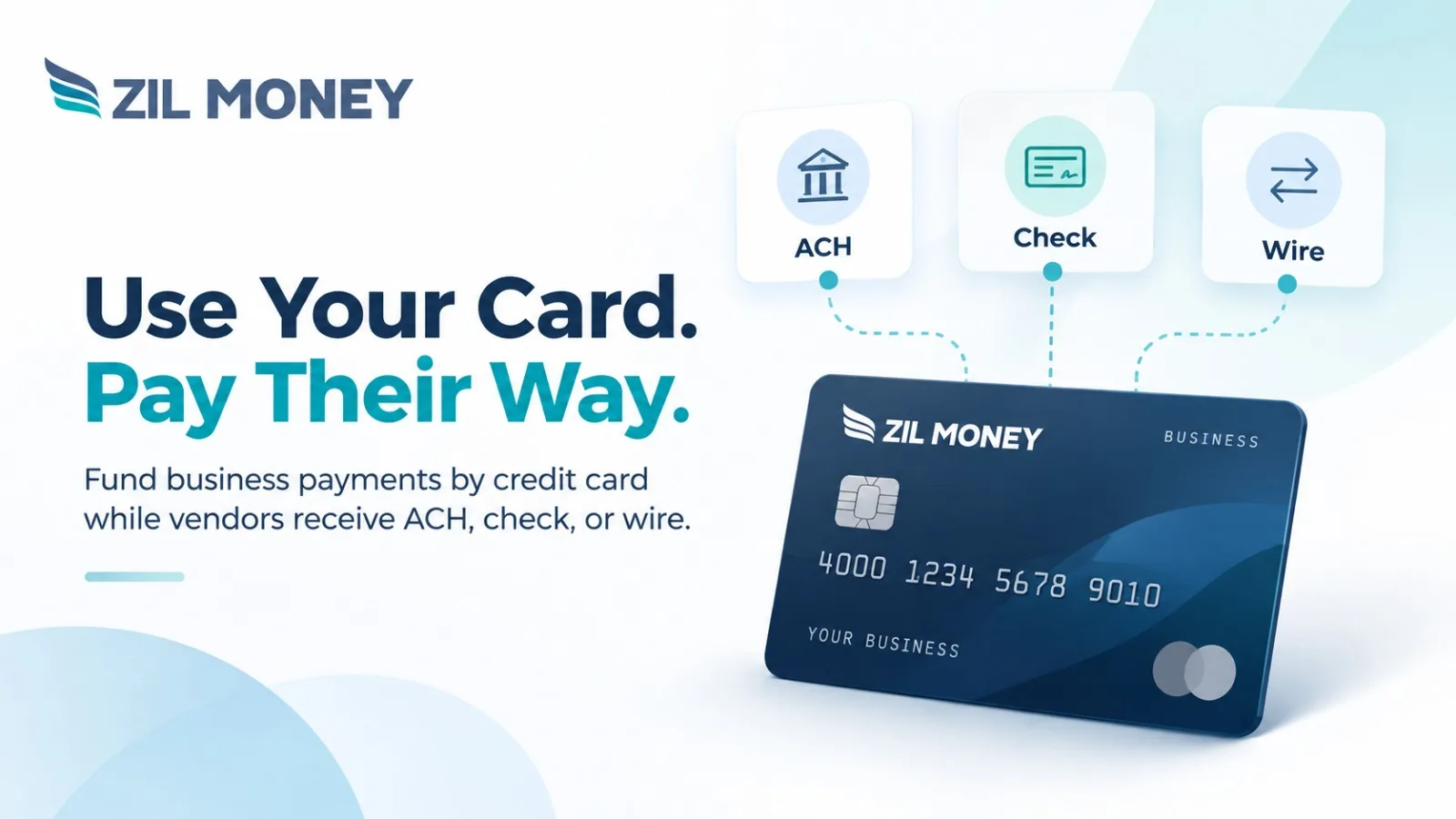
For eligible transactions, Zil Money allows a business credit card to be used as the funding source while the recipient receives the payment through a supported delivery method.
Depending on the transaction, that may include ACH, wire transfer, or a physical mailed check. A physical mailed check should not be confused with Zil Money’s digital check, or eCheck, which is a PDF check delivered electronically to the payee.
The important point is that the payer’s funding method and the recipient’s delivery method do not always have to be the same.
Businesses can review the current Zil Money Pay by Credit Card workflow before submitting a transaction.
Calculate the Processing Cost
Card funding is not cost-free.
Zil Money’s current support documentation lists a 2.9% credit-card processing fee, subject to change. Additional charges can apply depending on the selected payment method or service. Businesses should verify the current fee schedule before each transaction.
That fee should be calculated in dollars before deciding whether the timing benefit makes sense.
The business should compare the cost with the reason for using the card. Is a supplier payment due before an expected receivable? Is keeping bank cash available temporarily important? Can the card balance be repaid according to its terms?
If there is no clear repayment plan, using a card may simply move the cash-flow problem to a later date.
Do Not Treat Available Credit as Available Cash
Available credit and cash in the bank are not the same thing.
A card-funded payment creates a balance that the business must repay. If the company expects customer funds before the card payment is due, management should still consider what happens if that incoming cash is delayed.
Businesses should review the card’s APR, due date, available credit, grace-period terms, and any other conditions with the issuer. A financial advisor may also be appropriate when card funding is being used as part of a broader working-capital strategy.
When Can Credit Card Float Be Useful?
Credit card float may be worth evaluating when the problem is temporary timing rather than a recurring shortage of cash.
For example, a vendor invoice may be due several days before a customer payment is expected.
In that situation, changing the funding source can alter when the business needs to use its bank cash.
But if payroll, vendors, or other bills are repeatedly being funded by credit because available cash is consistently insufficient, the business may need to address a broader working-capital problem.
The Better Question Is About Timing and Repayment
The useful question is not, “How many extra days does a credit card give my business?”
It is, “When will this specific charge be due, what will it cost, and can the business repay it under the card’s terms?”
Credit-card-funded payments can provide another option for eligible business expenses, but the value depends on the actual billing cycle, current processing costs, repayment ability, and expected incoming cash.
Zil Money is a financial technology company, not a bank. Banking and money movement services are provided through partner financial institutions and licensed service providers. FDIC insurance coverage applies only to eligible deposit products and accounts, and is subject to applicable terms, conditions, limitations, and requirements. Additional information regarding partner institutions, products, and services is available in the applicable terms and agreements.
[1]: https://www.consumerfinance.gov/ask-cfpb/what-is-a-grace-period-for-a-credit-card-en-47/ “What is a grace period for a credit card? | Consumer Financial Protection Bureau”
[2]: https://www.consumerfinance.gov/consumer-tools/credit-cards/answers/key-terms/ “Credit cards key terms | Consumer Financial Protection Bureau”
[3]: https://support.zilmoney.com/portal/en/kb/articles/what-are-the-fees-for-credit-card-transactions “What are the fees for credit card transactions?”