Data Erasure vs. Physical Destruction: Choosing the Right End-of-Life Method for Storage Media
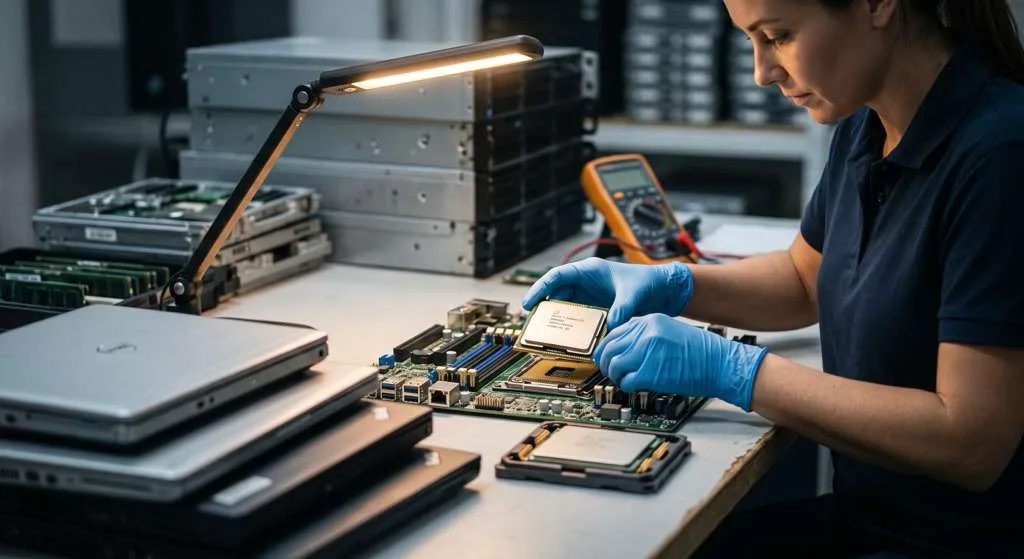
When a company retires storage media, the question is not simply, “Should this drive be wiped or shredded?” The better question is: What type of media is it, what does the client require, what evidence is needed, and is there reuse value worth preserving?
That distinction matters because a hard disk drive, a SATA SSD, a short M.2 NVMe module, a USB drive, a smartphone, and embedded storage inside a server or copier do not all respond to the same data-destruction method. A serious IT asset disposition program treats the technology, the client’s approved disposition requirements, and the final documentation as connected decisions.
The National Institute of Standards and Technology defines media sanitization as a process that makes access to target data infeasible for a given level of effort. Its current guidance emphasizes selecting applicable techniques and controls based on the sensitivity of the information and the media involved.
Three different concepts: erasure, degaussing, and physical destruction
These terms are often used together, but they solve different problems.
| Method | What it does | Where it is typically useful | Reuse potential |
| Logical data erasure | Uses a compatible sanitization method to remove data from functioning storage media. | Working laptops, desktops, servers, storage devices, and other media that can be processed successfully. | Preserves reuse and resale potential. |
| Degaussing | Uses a strong magnetic field to disrupt recorded data on compatible magnetic media. | Magnetic hard disk drives and certain magnetic tape media, when the equipment is compatible with that media. | Generally not a reuse path for the drive. |
| Physical destruction | Renders the storage media physically unusable through approved destruction methods. | Failed erasure, damaged media, client-required destruction, or media that cannot be reliably sanitized for reuse. | Does not preserve the asset for reuse. |
Logical erasure is often the preferred first option for a working device when the client’s requirements allow reuse. The device is sanitized according to the client’s approved data-handling standard, using a method aligned with NIST SP 800-88 Rev. 2, such as Clear or Purge, as appropriate for the storage media. Where a client contract or internal policy specifically requires a DoD-based overwrite protocol, Integritrade can apply that requirement when it is appropriate for the media type.
After successful sanitization and verification, the process generates a serialized Certificate of Erasure that documents the completed erasure record. The device can then be tested and evaluated for redeployment, donation, direct buyback, or remarketing. This approach protects data, provides traceable documentation, and preserves the useful life and recoverable value of technology.
Physical destruction is the right answer when a client requires destruction, when a device fails the approved erasure process, when the media is damaged or inaccessible, or when its condition makes reuse impractical. Neither pathway is automatically “better” in every situation. The correct pathway is the one that fits the storage technology, the client’s written requirements, and the risk profile of the project.
Why degaussing is not a universal answer
One of the most important questions to ask an ITAD provider is whether its data-destruction method is appropriate for the media in front of it.
Degaussing is a magnetic process. It is designed for compatible magnetic media, not flash-based storage. It is not an effective sanitization method for SSDs, NVMe media, USB drives, SD cards, eMMC storage, or other flash-based technologies. These devices store data electronically in nonvolatile memory rather than on magnetic platters.
That matters because organizations often use “hard drive” as a catch-all term for every data-bearing component. It is not. A modern laptop may contain an M.2 NVMe SSD, while an older workstation may contain a magnetic HDD. A short M.2 2230 card may be an SSD or a Wi-Fi/Bluetooth module. The form factor alone does not decide whether it is data-bearing. Technicians must verify labels, storage-capacity markings, interface information, and antenna connectors before the device enters a data-handling workflow.
A provider should be able to explain, in plain language, how it identifies media, which method applies to that media, and what occurs if the selected method fails.
Erasure can protect both data and value
Destroying every device by default may sound conservative, but it can also eliminate value that a business could have recovered. A successfully sanitized and tested laptop, server, mobile device, or storage asset may still have a useful second life. The U.S. Environmental Protection Agency identifies reuse, refurbishment, life extension, and recycling as complementary parts of responsible electronics stewardship, with reuse helping extend product life and reduce the need for new material extraction.
For businesses, that creates a practical opportunity. Instead of paying to move usable equipment directly into a scrap stream, an organization can evaluate it for reuse or remarketing after approved data sanitization. This can support direct buyback or a revenue-share remarketing model, depending on the equipment, its age, configuration, condition, market demand, and the client’s timeline.
Erasure is not a shortcut. It needs a controlled workflow: correct media identification, approved sanitization method, successful result, appropriate verification, and documentation tied to the asset or project. But when those controls are in place, it is often the path that combines data protection, circularity, and financial value.
Physical destruction still has an essential role
A reliable ITAD program also needs a practical physical-destruction option. Media can fail to erase. A client may require destruction for selected data-bearing devices. Equipment may arrive damaged, locked, incomplete, or unsuitable for reuse. In these cases, the response should be decisive and documented.
For example, Integritrade uses a physical-destruction workflow that includes 2 mm shredding for SSD and NVMe media. Magnetic hard disk drives may be degaussed and shredded. The method is selected based on the client’s approved requirements, the media type, and the project scope.
The record matters as much as the machine. Ask whether the provider can issue a meaningful Certificate of Erasure or Certificate of Destruction that connects the work performed to the client project, date, media count, asset identifiers where required, and selected disposition method. If photographed, video-recorded, live-video, or witnessed destruction is important to the project, that should be agreed upon before processing begins.
Questions to ask before selecting a data-destruction vendor
A vendor should be comfortable answering these questions before it picks up a single device.
| Question | Why it matters |
| What storage-media types can you identify and process? | A sound program distinguishes magnetic HDDs from SSDs, NVMe media, USB devices, mobile storage, and embedded flash. |
| Which of your methods apply to magnetic media versus flash media? | Degaussing alone is not an effective solution for flash-based memory. |
| Do you have on-site physical-destruction equipment? | This clarifies whether the provider controls the process or relies entirely on another party. |
| What happens when erasure fails? | There should be a defined escalation path, often to approved physical destruction. |
| Can you show how client requirements follow an asset through processing? | The provider should be able to apply different approved outcomes to different assets in the same project. |
| What documentation will be delivered? | The answer should be specific: chain of custody, manifest, erasure record, destruction certificate, serial-level information where applicable, and final disposition reporting. |
| Will you evaluate reusable equipment before destroying or recycling it? | A value-first approach can reduce cost or create a return without compromising the approved data-handling requirements. |
A data-destruction decision should not be a black box
For organizations in California and the Western United States, Integritrade provides IT asset disposition, data destruction, electronics recycling, asset recovery, and value-recovery services from a dedicated 30,000 sq ft controlled-access, video-monitored facility in Fresno, California. The facility supports secure staging and processing for individual collections, enterprise IT refreshes, multi-site projects, and larger decommissioning programs.
Integritrade is R2v3 certified and maintains ISO 9001, ISO 14001, ISO 45001, and ISO 27001 certifications. Its team uses documented workflows, background-checked personnel, on-site data-handling capability, and client-specific requirements to determine the appropriate path for each project. Where eligible equipment can be sanitized, tested, and reused, Integritrade evaluates direct buyback, revenue-share remarketing, reuse, or parts recovery before materials recycling is considered.
TraceTech adds client visibility after pickup. Authorized clients can follow project and asset status, manage service requests, access available Certificates of Erasure and serialized Certificates of Destruction, and reconcile their asset tags with Integritrade tracking tags. The platform can surface client-approved instructions when an asset is scanned, including erasure, physical destruction, reuse evaluation, remarketing, or recycling requirements.
Frequently asked questions
Is physical destruction always more secure than data erasure?
Not necessarily. The right method depends on the media type, client requirements, risk profile, and whether the asset is eligible for reuse. A successful, verified sanitization process can support reuse, while physical destruction is appropriate when it is required, when media cannot be sanitized successfully, or when reuse is not an approved or viable path.
Can degaussing erase an SSD or NVMe drive?
No. Degaussing is a magnetic process and does not erase flash-based storage such as SSDs, NVMe media, USB drives, SD cards, or embedded flash memory. These technologies require a media-appropriate sanitization or physical-destruction method.
What happens if a device fails data erasure?
The device or storage media should move to the approved exception or physical-destruction path. Integritrade can route failed logical-sanitization media to physical destruction according to the project’s approved requirements.
What is the difference between a Certificate of Erasure and a Certificate of Destruction?
A Certificate of Erasure documents an approved logical sanitization process that may preserve a device for reuse. A Certificate of Destruction documents physical destruction of the applicable media or device. The available documentation depends on the services performed and the project scope.
What data-destruction capabilities does Integritrade offer?
Integritrade supports both logical data sanitization and physical data destruction. Its data-handling capabilities include high-throughput PXE-based erasure, 2 mm shredding for SSD and NVMe media, and degauss-plus-shred workflows for applicable magnetic hard drives. The selected process follows the client’s approved requirements and the storage-media type.
Can Integritrade provide a Certificate of Erasure or Certificate of Destruction?
Yes. Successful logical sanitization can generate a serialized Certificate of Erasure, while physical destruction can generate a serialized Certificate of Destruction. Available documentation is tied to the services performed and can include applicable project, asset, media, and disposition records.
Does Integritrade have a secure facility for high-capacity ITAD and data destruction?
Yes. Integritrade operates from a dedicated 30,000 sq ft ITAD facility in Fresno, California with controlled access, 24/7 video monitoring, secure asset staging, and industrial pallet racking. The facility supports individual collections, enterprise IT refreshes, data-center projects, and multi-site programs across California and the Western United States. We have the capability to easily store over 1 million pounds of electronics.
How does TraceTech improve visibility during a data-destruction project?
TraceTech is Integritrade’s proprietary ITAD platform. Authorized clients can follow project and asset status after pickup, manage future service requests, reconcile customer asset tags with Integritrade tracking tags, and access available documentation. TraceTech can also surface client-approved requirements when an asset is scanned, including erasure, physical destruction, reuse evaluation, remarketing, or recycling instructions.
Can Integritrade support client-specific data-destruction requirements?
Yes. Integritrade can apply different approved requirements within the same project. For example, a client may require erasure for eligible laptops, physical destruction for specified storage media, remarketing for approved assets, and recycling for non-recoverable material. When a client does not specify a method, Integritrade uses its documented media-sanitization workflow aligned with NIST SP 800-88 Rev. 2.
Can Integritrade recover value from devices after successful data erasure?
Yes. When the client’s approved requirements allow reuse and a device is successfully sanitized and tested, Integritrade can evaluate it for direct buyback, revenue-share remarketing, redeployment, donation, reuse, or parts recovery. Equipment that is not approved or suitable for these pathways is routed to the appropriate physical-destruction or qualified downstream recycling process.
References
[1] National Institute of Standards and Technology, SP 800-88 Rev. 2: Guidelines for Media Sanitization
[2] U.S. Environmental Protection Agency, Electronics Basic Information, Research, and Initiatives
Editor’s note: This article is general information, not legal, compliance, or security advice. Organizations should align asset-disposition and data-sanitization decisions with their own policies, contractual obligations, risk assessment, and applicable requirements.