Data Removal Service Solutions for Complete Internet Scrubbing
Maintaining digital autonomy in a landscape dominated by aggressive information harvesting requires more than passive security measures. A professional data removal service provides the technical infrastructure necessary to identify and neutralize personal identifiers that have been indexed by commercial aggregators. By implementing an automated extraction strategy, individuals can significantly reduce their digital exposure and protect their sensitive records from unauthorized commercial exploitation.
Securing your online presence is a fundamental requirement for preventing identity-related fraud and ensuring long-term privacy. Proactively managing your data through a specialized service allows you to regain control over how your information is shared and sold across the public web. Establishing a hardened defensive perimeter is the most effective way to safeguard your digital identity in an increasingly interconnected global environment.
Technical Framework of Information Extraction Utilities
A data removal service functions as a technical utility that locates and neutralizes personal records across commercial directories. By utilizing automated protocols, these platforms submit formal extraction requests to hundreds of aggregators simultaneously. This systematic approach ensures that sensitive identifiers like home addresses and phone numbers are permanently removed from the public web, significantly reducing the surface area available for unauthorized exploitation.
The Electronic Frontier Foundation (EFF) maintains detailed resources on data broker surveillance to help the public understand how personal information is indexed and monetized without consumer consent. These technical deep-dives explain the mechanics of information harvesting and provide a roadmap for reclaiming privacy through structured data governance. Adhering to these established security protocols ensures that your personal information is protected against evolving digital threats and unauthorized harvesting.
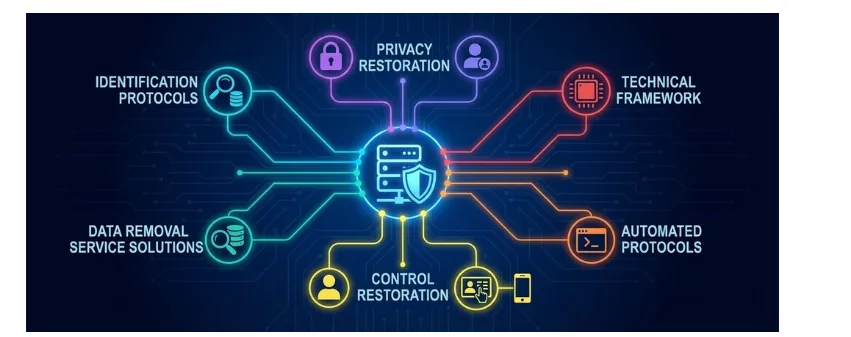
- Identification Protocols: Systems utilize proprietary scanning tools to identify the specific brokers currently monetizing your private records.
- Privacy Restoration: Neutralizing unauthorized profiles prevents entities from profiting from your personal datasets.
- Control Restoration: Gaining more autonomy over who can access your records through structured extraction demands.
While manual attempts to manage your digital footprint are possible, they are often incomplete due to the volume of data brokers active today. A professional data removal service provides the efficiency and technical depth required to maintain a clean digital profile without the extensive time commitment of manual opt-outs.
Establishing Identity Resilience with Personal Data Removal Services
A professional personal data removal service significantly contributes to managing your online reputation by suppressing damaging or irrelevant search results. These services focus on eliminating or obscuring both broker-held and directly associated information to offer significant privacy and security improvements. Regaining control over your data through these platforms curbs unwanted sharing and enhances your individual autonomy.
Managing a digital footprint often involves the use of data removal tools such as DeleteMe, OneRep, or iolo as part of a general cybersecurity routine. These automated systems function as a technical intermediary between individuals and commercial aggregators to limit the permanent indexing of personal records. Reducing the amount of publicly accessible information helps decrease the potential surface area for identity theft and other forms of exploitation. This involves:
- Scanning Breadth: Ensure the service monitors both surface-web search results and deep-web broker aggregators for total protection.
- Removal Accuracy: Verified opt-out protocols confirm that data is deleted at the source rather than just suppressed.
- Ongoing Persistence: Continuous monitoring is necessary to address the recurring nature of commercial data re-listing.
Operational Scope of a Dedicated Internet Scrubbing Service
Selecting a reputable internet scrubbing service involves identifying specialized firms that focus on technical data neutralization rather than just basic profile management. These companies utilize automated protocols to submit formal extraction requests across a vast network of commercial databases. Engaging a reputable provider ensures that your sensitive information is handled according to established security standards and regulatory requirements.
The Federal Communications Commission (FCC) provides guidelines on protecting personal information to help individuals recognize and defend against modern cyber threats. These federal resources emphasize the importance of multi-layered defense strategies, including the regular audit of one’s digital footprint. Adhering to these professional guidelines ensures that your information remains shielded from predatory commercial interests and unauthorized harvesting.
- Comprehensive Data Scrubbing: Removing outdated, inaccurate, or undesirable information from public-facing directories.
- Presence Monitoring: Utilizing automated tools to track search results and receive alerts when new content is indexed.
- Content Suppression: Managing digital results so that unauthorized personal data is minimized in visibility.
Improving your digital presence is a proactive measure that can positively impact your professional trajectory and individual autonomy.
Enterprise-Grade Data Scrubbing Service Applications
Professional data scrubbing service options provide a technical framework for organizations to identify and neutralize redundant or incorrect identifiers within complex information ecosystems. These services utilize automated protocols to ensure data accuracy and regulatory compliance across multi-layered storage platforms. Improving data hygiene reduces the surface area available for security breaches while enhancing the operational integrity of corporate databases.
Princeton University’s Center for Information Technology Policy conducts research on information privacy to help the public navigate the complexities of managing identifiers in a regulated environment. These technical frameworks explain the necessity of multi-layered defense strategies to identify potential technical vulnerabilities. Adhering to these established security protocols ensures that sensitive information is protected against evolving digital threats.
- Technical Encryption: Ensuring that communications and stored records are shielded from unauthorized access.
- Granular User Control: Providing individuals with full autonomy over how their personal details are indexed and shared.
- Information Validation: Confirming that all requested extraction changes have been successfully implemented across the web.
By considering these technical aspects, you can select a data privacy service that fits your specific security requirements and protects your digital life.
Sovereign Identity Architecture
Achieving long-term digital autonomy requires a transition from passive observation to an active containment strategy for personal records. To successfully neutralize the risks of persistent data aggregation, individuals must implement an internet scrubbing service that facilitates the automated, recurring extraction of private identifiers from commercial brokers. Transitioning to a sovereign identity architecture through a dedicated data removal service is the only reliable method to ensure that your sensitive information remains unsearchable and protected from unauthorized commercial exploitation.