DeFi Repricing in 2026–2030: Why Investors Should Revisit RPL and SNX
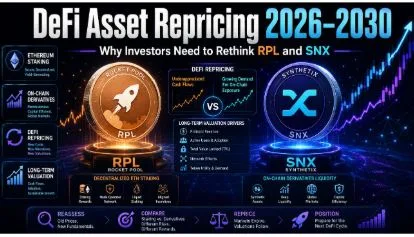
Over the past few years, the crypto market has moved through several waves of narratives: Layer 1 competition, meme coins, AI-related tokens, real-world assets, restaking, and prediction markets. In that process, many investors have focused heavily on new themes while overlooking older DeFi projects that have survived multiple market cycles and still operate around real use cases.
Two examples are Rocket Pool’s RPL and Synthetix’s SNX.
Neither asset should be viewed as a simple short-term hype trade. RPL is connected to Ethereum staking infrastructure, while SNX is tied to on-chain synthetic assets and derivatives liquidity. For investors trying to understand potential crypto opportunities between 2026 and 2030, RPL and SNX price predictions should not be based only on chart patterns. They require a deeper look at protocol adoption, market demand, competition, token utility, and risk.
Why 2026–2030 Crypto Investing Requires a Different Mindset
Many new investors enter the crypto market with a simple question: “Which coin can go up the most?”
That question is understandable, but it is incomplete.
A better question is:
“Why could this asset be repriced by the market?”
As crypto matures, investors are likely to pay more attention to fundamentals such as real usage, protocol revenue, liquidity, security, ecosystem growth, and long-term token value capture. The market may still move in cycles, but assets with clearer utility and stronger infrastructure roles could attract more serious attention.
This is where RPL and SNX become useful case studies.
RPL represents one side of DeFi infrastructure: decentralized Ethereum staking.
SNX represents another side: synthetic assets and decentralized derivatives.
Both are complex assets. Both have survived multiple crypto cycles. And both require investors to think beyond short-term price action.
RPL: A Long-Term Bet on Decentralized Ethereum Staking
Rocket Pool is one of the well-known decentralized Ethereum staking protocols. Its token, RPL, is closely linked to the Rocket Pool ecosystem and its node operator structure.
After Ethereum moved to proof-of-stake, ETH staking became one of the most important long-term infrastructure markets in crypto. Many users want to earn staking rewards, but not everyone wants to run their own validator node. This creates demand for staking protocols, liquid staking solutions, and decentralized validator networks.
RPL’s long-term value depends on whether Rocket Pool can continue to grow within this competitive market.
The key questions investors should ask include:
- Can Rocket Pool increase its share of the ETH staking market?
- Will more node operators participate in the network?
- Does RPL have meaningful utility within the protocol?
- Can decentralized staking remain attractive compared with large centralized providers?
- Will Ethereum’s long-term growth increase demand for staking infrastructure?
RPL has a strong narrative because it sits inside the Ethereum staking economy. But that does not automatically mean the token will rise. Rocket Pool faces serious competition from larger liquid staking platforms, centralized exchanges, and other infrastructure providers.
For a deeper breakdown of RPL’s long-term outlook, HIBT has published a dedicated analysis here:
RPL Price Prediction 2026–2030
The value of this type of research is not just a price target. It helps investors understand the market structure behind RPL and identify the conditions that could support or weaken its long-term performance.
SNX: Can an Older DeFi Protocol Regain Market Attention?
SNX is more difficult to understand than many crypto assets because Synthetix is not a simple exchange token or payment coin.
Synthetix was one of the early DeFi protocols focused on synthetic assets and decentralized derivatives infrastructure. Its goal was to allow users and applications to gain exposure to different assets on-chain without always holding the underlying asset directly.
That idea is powerful, but it is also difficult to execute.
Synthetic assets and decentralized derivatives require reliable price oracles, deep liquidity, strong risk controls, and consistent user demand. If any of these areas are weak, the system can struggle to attract volume or maintain trust.
SNX’s long-term value depends on whether Synthetix can remain relevant in the growing on-chain derivatives market.
Investors should focus on questions such as:
- Is Synthetix still attracting real trading volume?
- Are more front-end platforms or protocols integrating Synthetix liquidity?
- Does SNX capture value from protocol activity?
- Can the protocol compete with newer derivatives platforms?
- Are recent upgrades improving user experience and capital efficiency?
The opportunity for SNX is clear: decentralized derivatives may continue growing as more traders move on-chain. But the risk is equally clear: the market has become far more competitive. Newer platforms have gained attention, liquidity, and users.
That means SNX cannot rely only on its early DeFi history. It must continue proving that the protocol has real market relevance.
For investors who want a more detailed framework, HIBT’s SNX research is available here:
SNX Price Prediction 2026–2030
This kind of analysis is useful because it does not treat SNX as a simple “old DeFi coin.” Instead, it looks at the deeper question: can Synthetix still play a meaningful role in the future of decentralized derivatives?
What RPL and SNX Have in Common
RPL and SNX belong to different sectors, but they share one important feature: both need real adoption to justify long-term repricing.
RPL needs Rocket Pool to remain competitive in Ethereum staking.
SNX needs Synthetix to remain relevant in on-chain derivatives and synthetic asset infrastructure.
Neither token can rely only on market nostalgia. In the next cycle, investors are likely to ask harder questions about whether a protocol has real users, sustainable demand, and a clear reason for its token to matter.
This is especially important for DeFi assets.
In 2020 and 2021, many DeFi tokens rose because the market was excited about new financial experiments. In the 2026–2030 period, the bar may be higher. Protocols will need to show stronger evidence of product-market fit, better risk management, and more credible value capture.
That does not mean older DeFi tokens have no future. In fact, some may become more attractive if the market rotates back toward infrastructure and real usage.
But investors need to separate “old project with real resilience” from “old project with fading relevance.”
RPL and SNX are worth studying because they sit exactly at that intersection.
How Investors Should Read Crypto Price Predictions
Many people search for terms like “RPL price prediction” or “SNX price prediction” because they want a future number.
But a good price prediction should do more than provide a bullish or bearish target.
It should help readers answer five practical questions:
- What is the project actually used for?
- What could drive demand for the token?
- What could cause the prediction to fail?
- Who are the main competitors?
- What data should investors monitor over time?
If a prediction article only gives optimistic price targets without discussing risk, competition, or adoption, it is not very useful.
A better approach is to treat price predictions as decision frameworks. They should help investors understand what would need to happen for a token to perform well — and what warning signs could suggest the opposite.
For RPL, the key indicators may include ETH staking growth, Rocket Pool market share, node operator participation, protocol upgrades, and decentralized staking demand.
For SNX, the key indicators may include trading volume, protocol revenue, liquidity integrations, derivatives market growth, and competition from newer platforms.
This approach makes price prediction more practical and less speculative.
Is DeFi Still Worth Watching in 2026–2030?
Yes — but investors need to look at DeFi differently.
The early DeFi market was driven by experimentation, high yields, liquidity mining, and fast-moving narratives. The next stage may be more focused on real financial infrastructure.
That means the strongest DeFi projects may be those that can answer questions such as:
- Does the protocol solve a real problem?
- Does it generate sustainable usage?
- Is its risk model understandable?
- Can it survive competitive pressure?
- Does the token have a clear role in the system?
RPL and SNX are not guaranteed winners. They are not risk-free assets. But they are useful examples of how DeFi investors can think more clearly.
RPL helps investors understand decentralized staking infrastructure.
SNX helps investors understand synthetic assets and on-chain derivatives.
Studying these assets can help investors become better at evaluating the broader DeFi market.
Conclusion: The Real Value of Price Prediction Is Better Judgment
The crypto market between 2026 and 2030 may reward investors who can think beyond short-term hype. As the industry matures, the strongest opportunities may come from assets that combine real infrastructure demand, active ecosystems, and credible token utility.
RPL and SNX both deserve attention, but for different reasons.
RPL’s future depends on Rocket Pool’s role in the Ethereum staking economy.
SNX’s future depends on whether Synthetix can remain important in decentralized derivatives and synthetic asset infrastructure.
Investors should not treat any price prediction as a guarantee. Instead, they should use it as a structured way to understand possible scenarios, key risks, and long-term market drivers.
In crypto investing, the goal is not simply to predict the future. The real goal is to build a stronger framework for understanding it.
Risk Disclaimer
This article is for educational and informational purposes only. It does not constitute financial advice, investment advice, trading advice, or a recommendation to buy or sell any digital asset. Cryptocurrency and DeFi investments involve high volatility, smart contract risk, liquidity risk, regulatory uncertainty, and potential loss of capital. Investors should conduct their own research and consider their personal risk tolerance before making any investment decision.