
Design-Build vs Traditional Construction: Top Choice by Industrial Construction Contractors in Maryland
Introduction
Companies intending to build new premises or expand their current business are often confronted with a major challenge: choosing the construction method. Be it a warehouse, processing plant, or a distribution center, the strategy you choose can have a direct influence on cost, time, and efficiency.
In collaborating with industrial construction contractors in Maryland, firms decide between design-build and conventional construction. The two approaches are popular but distinct in their structure, coordination, and implementation. These differences assist businesses in making informed decisions that can support their objectives.
Highlighting the Design-Build Approach
The design-build approach combines design and construction into a single contract. Businesses do not employ individual teams but engage one party to carry out the whole project.
This management method is common among the industrial construction contractors in Maryland since it eases communication and accelerates decision-making. Designers and builders work together in the early stages so that the vision of the project is clear and uniform.
Design-build is particularly advantageous in projects that require heavy industrial construction in Maryland. This approach facilitates close coordination of complex systems, specialized equipment, and technical requirements. It also enables quicker adjustments in case project requirements vary during implementation.
Traditional Construction Method in a Nutshell
Design-bid-build or traditional construction separates the design and construction stages. The entire design is first done by an architect or engineer. The project is then bid out to contractors, with one of them being selected to construct the project.
This method is still in use in many industrial construction companies in Maryland, especially where the businesses prefer to have full control of the design before the construction process commences. It offers an effective step-by-step procedure and roles.
Nevertheless, in the context of industrial construction contractors in Maryland, this approach occasionally results in a lack of communication between designers and builders. The fact that both teams work independently means that there can be problems when the designs are hard to implement or when some adjustments are needed in the construction process.
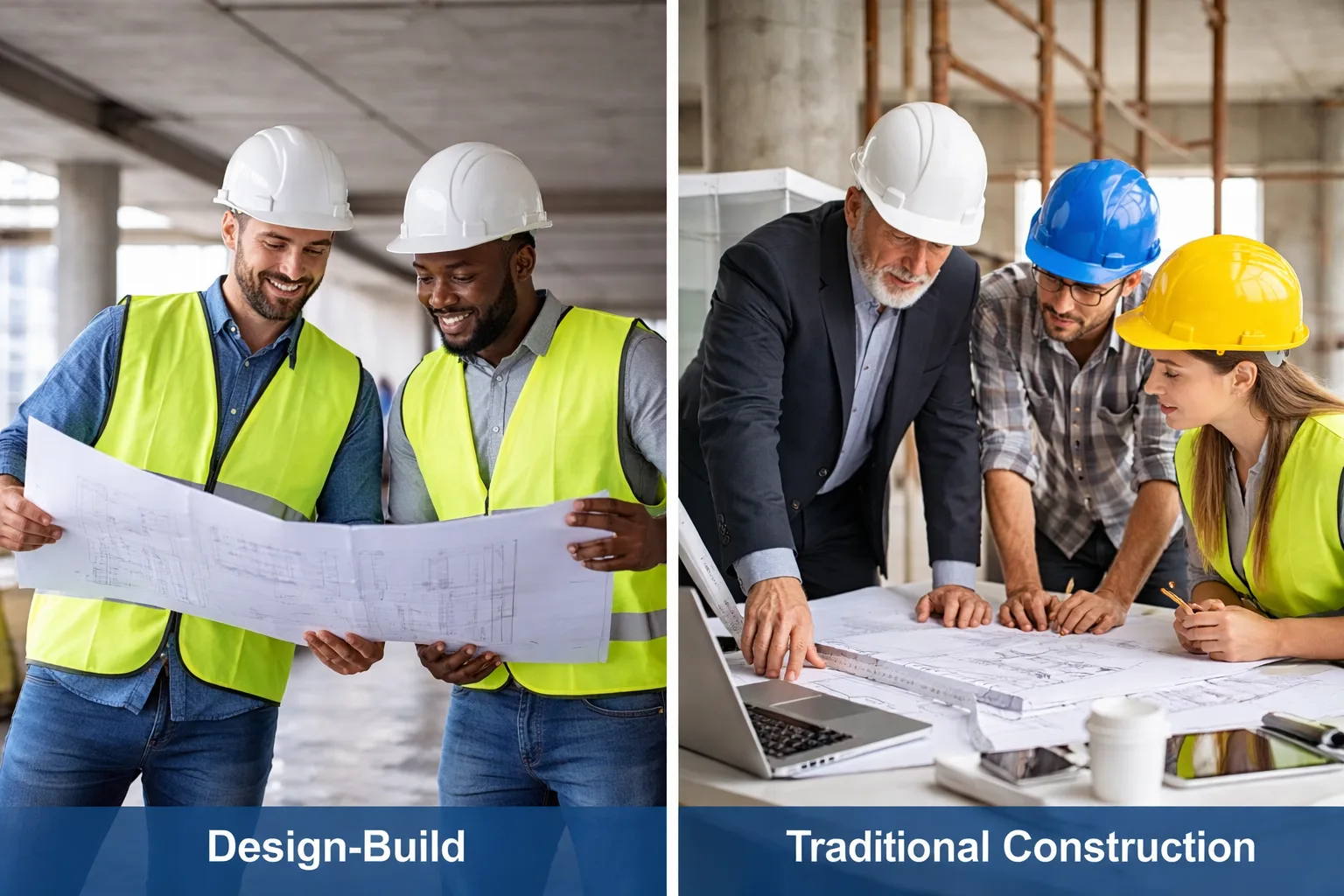
Design-Build vs Traditional Construction
Project Coordination
The process of coordination in a design-build approach is smooth. One team is in charge of the design and the construction, eliminating confusion and enhancing productivity. That is why numerous industrial construction contractors in Maryland choose this approach to complex projects.
In conventional construction, coordination is segregated. Contractors and designers operate in different areas, and this may cause communication breakdown or delays when changes have to be made in the course of construction.
Creating a Budget Plan
Design-build enables the early budgeting of the process. Cost estimates are more precise as they are done at the initial stage, and the problems may be handled prior to the commencement of construction. This assists businesses that deal with industrial construction contractors in Maryland to have better financial control.
In traditional construction, the budget is determined after the design is completed. If costs exceed expectations, changes may be required, which can delay the project and increase expenses.
Timeline Management
Design-build projects take a shorter time to build since the stages of design and building can be conducted simultaneously. Early collaboration helps avoid delays and keeps the project moving efficiently, making it a popular choice among industrial construction contractors in Maryland.
The conventional building is built in a straight line. The phases have to be finished before the next one can start, and this may prolong the total project time. Although this offers structure, it is not necessarily suitable for time-based projects.
Flexibility
One of the benefits of design-build is flexibility. Modifications are achievable in the project, and there are no significant interruptions as the same team is in charge of everything. This can especially be helpful in industries where the requirements can change.
In conventional construction, it is not flexible once the construction design is completed. The modifications in construction can cause delays, extra expenses, and alterations in the contracts.
Cost
Design-build can be more economical because of enhanced teamwork and reduced delays. Early contractor engagement aids in streamlining materials, labor, and processes. This is among the reasons why most industrial construction contractors in Maryland suggest this method as a cost-efficient project.
Conventionally built structures may be costly at times because of change orders and time-consuming schedules. However, it may still be suitable for projects where detailed design planning is the main priority.
Professional Tips by Experts
- Define your project scope clearly before selecting a method
- Consider the complexity of your industrial facility
- Choose design-build for faster delivery and smoother coordination
- Opt for traditional construction if detailed design control is essential
- Work with experienced industrial construction contractors in Maryland for better execution
- Plan your budget early to avoid unexpected expenses
The Bottom Line
Both design-build and conventional construction have their own advantages, and it is up to the needs of your project to choose the right one. The design-build is more efficient, collaborative, and fast, whereas the traditional construction offers organized planning and control of design.
Established companies such as Arrant Construction recommend that you match your construction approach to your project objectives and complexity. Simply put, design-build is usually beneficial to businesses that have shorter deadlines and want to streamline communications, whereas detailed design may be more appropriate to traditional construction.
Frequently Asked Questions (FAQs)
- What is the main difference between design-build and traditional construction?
Design-build combines design and construction under one contract, while traditional construction separates these phases into different teams and steps.
- Which method is better for industrial projects?
It depends on the project’s needs. Design-build is ideal for speed and coordination, while traditional construction works well for detailed planning.
- Is design-build more cost-effective?
In many cases, yes. It reduces delays, improves communication, and minimizes costly changes during construction.
- Why do some businesses still choose traditional construction?
They prefer having full control over the design before selecting a contractor for execution.
- Do industrial construction contractors in Maryland offer both options?
Yes, most industrial construction contractors in Maryland provide both design-build and traditional construction services based on project requirements.