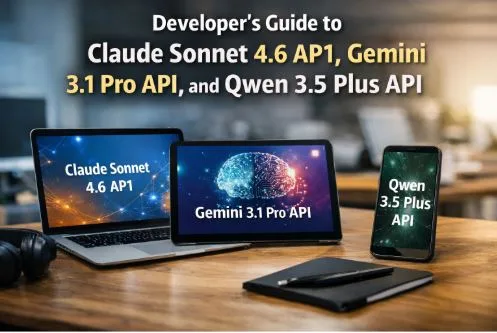
Developer’s Guide to Claude Sonnet 4.6 AP1, Gemini 3.1 Pro API, and Qwen 3.5 Plus API
Artificial intelligence APIs are reshaping how developers build applications, automate workflows, and create intelligent digital products. From chat interfaces and content engines to advanced reasoning systems and multimodal tools, modern large language models now serve as foundational building blocks for scalable software solutions.
In this guide, we explore three powerful AI models that are attracting serious developer attention: Claude Sonnet 4.6 AP1, Gemini 3.1 pro API, and qwen 3.5 Plus API. Each model brings distinct strengths, architectural advantages, and performance characteristics that make it suitable for different development scenarios.
As an industry professional working closely with developers and product teams, I believe understanding these models strategically is far more valuable than simply comparing token limits or speed metrics. Let’s dive into what truly matters.
Why Modern AI APIs Matter for Developers
Before comparing individual models, it is important to understand why advanced AI APIs are becoming central to modern development.
Today’s developers are no longer just writing static code. They are building:
- AI-powered SaaS platforms
- Intelligent customer support systems
- Automated research tools
- Code generation assistants
- Data interpretation engines
- Multilingual content applications
To support these use cases, developers need models that offer:
- Strong reasoning capability
- Large context windows
- Reliable structured output
- Multimodal support
- Stable API performance
- Predictable pricing
This is where Claude Sonnet 4.6 AP1, Gemini 3.1 pro API, and qwen 3.5 Plus API stand out.
Claude Sonnet 4.6 AP1: Precision, Reasoning, and Reliability
Claude Sonnet 4.6 AP1 is designed for balanced intelligence and efficiency. It sits in a sweet spot between high-end reasoning models and cost-effective deployment models. For developers building applications that require structured responses, long-context understanding, and consistent outputs, this model performs impressively.
Key Strengths of Claude Sonnet 4.6 AP1
- Advanced reasoning
It handles multi-step instructions and complex prompts with clarity. - Long context handling
Ideal for document analysis, legal summaries, or research-based applications. - Safer response alignment
Particularly useful for enterprise-grade tools where compliance and reliability matter. - Efficient token usage
Balanced performance without excessive cost per call.
Ideal Use Cases
Claude Sonnet 4.6 AP1 works exceptionally well for:
- Knowledge base chatbots
- Enterprise internal assistants
- Policy and compliance analysis tools
- Structured data extraction
- Long-form summarization engines
Developers who require predictable and stable outputs often gravitate toward this model. It performs consistently across different temperature settings and structured prompts.
Gemini 3.1 Pro API: Multimodal Intelligence at Scale
Gemini 3.1 pro API is known for its multimodal capabilities and strong reasoning performance. It supports text, image interpretation, and advanced contextual understanding, making it a strong candidate for more complex AI systems.
Where Gemini 3.1 pro API really shines is in applications that require cross-modal reasoning. For example, analyzing both text and images in a single workflow or extracting structured meaning from mixed inputs.
Core Advantages
- Multimodal processing
- Strong coding assistance
- High contextual memory
- Fast response times
- Versatile prompt adaptability
Developers building AI-powered dashboards, visual analytics platforms, or document intelligence systems often benefit from Gemini 3.1 pro API.
Best Development Scenarios
This model is particularly useful for:
- AI-powered research assistants
- Image-to-text analysis systems
- Technical documentation parsing
- Code debugging tools
- Advanced customer analytics engines
Its flexibility makes it a strong option for startups experimenting with innovative AI-driven products.
qwen 3.5 Plus API: Performance Meets Affordability
The qwen 3.5 Plus API has rapidly gained traction among developers looking for a powerful yet cost-efficient language model. It offers strong reasoning capabilities while maintaining competitive pricing structures.
One of its biggest advantages is accessibility. Developers can deploy high-volume applications without significantly increasing operational costs.
Notable Features
- Solid multilingual capabilities
- Good instruction adherence
- Competitive token pricing
- Efficient API response structure
- Strong performance in general-purpose tasks
For SaaS founders and product developers managing tight budgets, qwen 3.5 Plus API provides a practical alternative without compromising too much on intelligence.
Recommended Use Cases
- AI content generation platforms
- Multilingual chat systems
- Startup MVP development
- Automation scripts
- Bulk data processing tasks
It performs especially well in environments where scalability and budget control are top priorities.
Comparing Performance from a Developer’s Perspective
Choosing between Claude Sonnet 4.6 AP1, Gemini 3.1 pro API, and qwen 3.5 Plus API depends on your project goals.
Here is a simplified breakdown:
If your priority is deep reasoning and enterprise-grade stability, Claude Sonnet 4.6 AP1 is a strong candidate.
If you need multimodal intelligence and flexible integration, Gemini 3.1 pro API offers broader capabilities.
If cost efficiency and scalable deployment matter most, qwen 3.5 Plus API becomes highly attractive.
Instead of thinking about which model is “best,” developers should ask:
- What is my core use case?
- How important is multimodal support?
- What are my monthly token projections?
- Do I need enterprise compliance features?
- How sensitive is my budget?
These questions lead to better architectural decisions.
Accessing These APIs Through CometAPI
While evaluating these models, developers also need a reliable platform to access them. This is where CometAPI plays an important role.
CometAPI offers access to Claude Sonnet 4.6 AP1, Gemini 3.1 pro API, and qwen 3.5 Plus API through a unified API infrastructure. Instead of managing multiple vendor accounts and billing systems, developers can streamline integration through a single platform.
One of the most compelling aspects of CometAPI is its affordability. The pricing structure is designed to be highly cost-effective, making advanced AI deployment accessible even for startups and small development teams.
Key advantages include:
- Unified API access to multiple leading models
- Transparent pricing
- Competitive rates
- Scalable infrastructure
- Developer-friendly documentation
For teams aiming to experiment with multiple models before committing to one, this approach reduces friction significantly.
Integration Best Practices for Developers
Regardless of which model you choose, implementation strategy matters just as much as model selection.
Here are practical recommendations for integrating Claude Sonnet 4.6 AP1, Gemini 3.1 pro API, or qwen 3.5 Plus API effectively:
1. Design Clear Prompt Architecture
Avoid vague instructions. Structure prompts with:
- Clear role definition
- Explicit output format
- Step-by-step reasoning instructions when needed
- Defined constraints
This dramatically improves output consistency.
2. Monitor Token Usage
Even cost-effective models can become expensive at scale. Track:
- Average tokens per request
- Monthly usage growth
- Peak traffic scenarios
3. Use Structured Output Formats
When building production systems, request JSON or clearly structured responses. This reduces post-processing complexity.
4. Test Across Edge Cases
Run test scenarios including:
- Ambiguous queries
- Long-context inputs
- Multilingual prompts
- Technical instructions
This ensures stability before launch.
5. Implement Failover Strategies
If your application depends heavily on AI output, consider:
- Secondary model fallback
- Timeout management
- Retry mechanisms
- Response validation layers
These steps improve reliability significantly.
Future-Proofing Your AI Stack
AI development is moving rapidly. Models are evolving, pricing structures change, and new capabilities emerge frequently.
To stay competitive:
- Build modular AI architecture
- Avoid hard-coding vendor-specific dependencies
- Use abstraction layers
- Keep prompt logic adaptable
- Regularly benchmark model performance
With platforms like CometAPI offering unified access to Claude Sonnet 4.6 AP1, Gemini 3.1 pro API, and qwen 3.5 Plus API, switching or testing models becomes far easier.
Flexibility is no longer optional. It is a strategic advantage.
Final Thoughts for Forward-Thinking Developers
Claude Sonnet 4.6 AP1, Gemini 3.1 pro API, and qwen 3.5 Plus API each represent a different philosophy of AI deployment. One emphasizes reasoning stability, another focuses on multimodal intelligence, and the third balances performance with affordability.
The real opportunity lies not in choosing just one, but in understanding how each model can serve different layers of your product ecosystem.
Modern developers are no longer limited by access to intelligence. The challenge now is architectural clarity, cost control, and thoughtful integration.
By leveraging platforms like CometAPI, which provides affordable and streamlined access to these advanced AI APIs, development teams can experiment, iterate, and scale with confidence.
The future of application development is intelligent, adaptive, and deeply integrated with AI. Developers who understand how to strategically deploy models like Claude Sonnet 4.6 AP1, Gemini 3.1 pro API, and qwen 3.5 Plus API will be well positioned to build the next generation of transformative software.