DIP vs. SMT Pogo Pins: Which Pogo Pin Is Right for Your Application?
Pogo pins are spring-loaded electrical contacts widely used in modern electronics for charging, signal transmission, and stable connections. The two common mounting methods, DIP pogo pins and SMT pogo pins, differ in structure and PCB installation.
This article explores their differences, advantages, applications, and selection considerations to help choose the right pogo pin solution.
What Are DIP Pogo Pins?
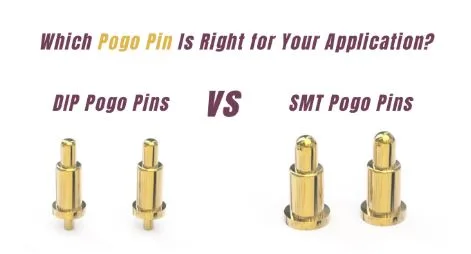
DIP pogo pins are spring-loaded electrical contacts designed for through-hole mounting on a printed circuit board (PCB). “DIP” generally refers to a mounting style in which the pin terminals are inserted into pre-drilled holes on the PCB and then soldered in place. This allows the pogo pin to be physically fixed through the board rather than only attached to its surface.
In practical terms, DIP pogo pins consist of the same core functional structure found in many pogo pins—including a plunger, spring, and barrel—but are specifically configured to suit through-hole installation. This mounting format makes them a common choice in products where the connector needs to be integrated firmly into the PCB design.
What Are SMT Pogo Pins?
Alongside DIP designs, SMT pogo pins are another widely used type of pogo pin in modern electronic products. They differ primarily in how they mount to the PCB.
SMT pogo pins are spring-loaded electrical contacts designed for surface-mount installation. Instead of being inserted into holes on the PCB, they are placed directly onto the board’s surface and soldered in position during the assembly process.
Despite this difference in mounting form, SMT pogo pins still use the same basic contact mechanism found in DIP pogo pins—including a plunger, spring, and barrel. In other words, SMT pogo pins are built with a surface-mount soldering structure, whereas DIP pogo pins use a through-hole soldering structure.
What Are the Typical Applications for DIP and SMT Pogo Pins?
Given these structural differences, DIP and SMT pogo pins are typically selected for different products based on their design and assembly requirements.
DIP pogo pins are typically suited for applications that require high mechanical reliability, such as devices exposed to vibration, repeated mechanical stress, or frequent insertion cycles. Their through-hole mounting provides a firm board connection, ensuring stable performance in demanding devices, including industrial devices, automotive electronics, charging docks, and testing fixtures or equipment.
- Industrial devices—Factory control panels, robotics interfaces, machinery connectors
- Automotive electronics—Engine control units, infotainment connectors, safety modules
- Charging docks—Heavy-duty docking stations for equipment or electric vehicles
- Testing fixtures or equipment—Lab instruments, quality control test jigs
In contrast, SMT pogo pins are best for applications that prioritize compact, lightweight, and space-efficient designs. Their surface-mount structure allows for integration into miniaturized PCBs and compatibility with automated assembly processes, making them well-suited for wearable devices, smart consumer electronics, compact charging modules, and miniaturized IoT devices.
- Wearable devices—Smart watches, fitness bands, portable medical monitors.
- Smart consumer electronics—Wireless earbuds, remote controls, portable audio players
- Compact charging modules—Phones, laptops, small IoT devices.
- Miniaturized IoT devices—Sensors, smart home devices, thin electronics requiring multiple connections in tight layouts.
What Are the Advantages of DIP Pogo Pins?
Stronger Mechanical Retention
The through-hole tail firmly anchors the pin to the PCB, preventing loosening or detachment during repeated insertion cycles or physical handling.
Better for Products Exposed to Vibration or Repeated Mechanical Stress
Even under constant motion or mechanical shocks, the securely soldered connection maintains consistent electrical contact without interruption.
Reliable for Certain Industrial and Rugged Applications
The robust construction ensures reliable performance over extended periods in demanding applications such as industrial equipment, automotive electronics, and test fixtures.
Easier to Inspect or Replace in Some Designs
Because the pins pass through the PCB and are visibly soldered, DIP pogo pins are often easier to inspect for correct installation or replace if maintenance is required, providing added flexibility in industrial or repair-focused applications.
What Are the Advantages of SMT Pogo Pins?
Smaller Footprint
With minimal board space required, SMT pogo pins give designers the flexibility to optimize layouts and pack more components into tight assemblies.
Ideal for Miniaturized Electronic Devices
The compact structure enables integration into very thin or small electronics, providing reliable contact without adding bulk to the device.
Supports Automated Assembly
Surface-mount design allows for pick-and-place integration and reflow soldering, which simplifies assembly and ensures consistency in production.
Efficient for High-Volume Manufacturing
The SMT format enables direct placement on PCBs with automated processes, allowing manufacturers to assemble large quantities of devices more quickly and consistently.
What Are the Differences Between DIP and SMT Pogo Pins?
Having detailed the respective advantages of DIP and SMT pogo pins, the following table provides a structured comparison of their primary differences, including mounting method, mechanical strength, assembly, PCB space, and production efficiency, making it easier to see how each type fits different design needs.
| Feature | DIP Pogo Pins | SMT Pogo Pins |
| Mounting Method | Through-hole, soldered on opposite side | Surface-mounted via reflow |
| Mechanical Strength | Strong, anchored through PCB | Less robust, prone to dislocation |
| Assembly Process | Slower, manual/semi-automated | Fast, automated |
| PCB Space Requirements | Larger footprint, blocks routing | Compact, supports high-density layouts |
| Production Efficiency | Lower, suited for low-volume or prototypes | High, scalable for mass production |
As shown, DIP pins excel in mechanical stability and durability, while SMT pins offer compact size and high production efficiency.
How Do You Choose Between DIP and SMT Pogo Pins?
Choose DIP Pogo Pins When:
- Mechanical Strength is Priority: If the connector must withstand frequent plugging/unplugging or “physical torsion” from a user, DIP is necessary because SMT solder joints may be insufficient to prevent loosening.
- Operating in Harsh Environments: If your product faces high vibration, impact, or thermal expansion (e.g., automotive ECUs, rail transit, or industrial automation), DIP offers superior stability and resistance to “thermal tearing” or cold soldering.
- High Current/Power is Required: DIP pins have a larger solder joint area, which provides 20-35% lower contact resistance than SMT.
- Maintenance and Rework are Necessary: DIP pins are easier to replace or repair because their pins are exposed on the back of the PCB.
- Prototyping or Small Batches: DIP is often more cost-effective for low-volume production where manual soldering is common.
Choose SMT Pogo Pins When:
- Space is Critically Limited: SMT pins are essential for “miniaturization” in devices because they allow for high-density layouts and can be mounted on both sides of the PCB.
- High-Frequency Signals are Involved: For the “brain” of the product (CPUs, 5G modules), SMT is a better choice because its extremely short leads minimize signal interference and parasitic capacitance.
- Mass Production Efficiency is Key: SMT is designed for high-speed automated assembly using pick-and-place machines and reflow ovens. They are typically supplied in tape & reel packaging to facilitate this automation.
- Weight Reduction is a Goal: SMT components are generally smaller and lighter, making them ideal for portable or weight-sensitive electronics.
Why Choose Pomagtor for DIP and SMT Pogo Pin Solutions?
Comprehensive Range of DIP and SMT Pogo Pins
Pomagtor provides a broad selection of DIP and SMT pogo pins to suit different device requirements. The following table summarizes some of the most commonly used models:
| Types | Model (mm) | Stroke (mm) | Mechanical life | Operating temperature range |
|---|---|---|---|---|
| DIP Pogo Pins | 1.6×7.0 | 1.0 | 10000 times | -30~85 ° |
| 1.8×8.7 | 1.5 | 10000 times | -30~85 ° | |
| 1.8×8.0 | 1.5 | 10000 times | -30~85 ° | |
| 1.8×9.7 | 0.7 | 10000 times | -30~85 ° | |
| 1.8×5.3 | 1.0 | 10000 times | -30~85 ° | |
| SMT Pogo Pins | 1.8×2.5 | 0.5 | 100000~1000000 times | -30~85 ° |
| 2.0×2.5 | 0.9 | 10000 times | -40~150° | |
| 2.0×4.0 | 1.4 | 10000 times | -40~150° | |
| 2.0×7.5 | 0.9 | 10000 times | -40~150° | |
| 2.0×6.0 | 0.9 | 10000 times | -40~150° |
Reliable Electrical Contact and Mechanical Stability
Pomagtor follows an ISO 9001-certified quality system, with 100 % testing to ensure each pogo pin delivers stable electrical contact and reliable mechanical performance.
Flexible Customization for Various Applications
With extensive options in pin diameter, stroke, spring force, plating, and sequence, Pomagtor supports tailored pogo pin solutions to meet specific device requirements and performance standards.
Optimized for Both Compact and Rugged Designs
Whether your design demands space-efficient SMT solutions for miniaturized electronics or mechanically robust DIP variants for harsh environments, Pomagtor’s products balance reliability, integration flexibility, and production quality.
Conclusion
DIP pogo pins provide superior mechanical strength for rugged, high-reliability applications, while SMT pogo pins enable compact designs and high-volume automated assembly.
No matter which types, Pomagtor offers a comprehensive range of reliable, high-quality, and customizable pogo pin solutions. Contact Pomagtor today to find the ideal solution for your specific needs.