Do Portable Range Hoods Really Improve Indoor Air Quality? What the Research Shows
Introduction
A kitchen can look completely clear while still containing elevated levels of cooking-related air pollution. Frying, grilling, sautéing, baking, and other cooking activities can increase indoor particulate matter, while some cooking appliances can also contribute gases and moisture. The amount of pollution varies with the food, cooking method, temperature, and cooking fat.
So, do portable range hoods actually improve indoor air quality, or do they mainly reduce visible smoke and odors? The answer is more nuanced than a simple yes or no. A ventilation device can help when it captures pollutants close to their source, but its effectiveness depends on positioning, airflow, filtration, cooking conditions, and whether captured air is exhausted outdoors or returned to the room.
Key Takeaways
- Cooking can significantly increase indoor particle concentrations.
- Source capture is important because pollutants become harder to control after they disperse.
- Portable and recirculating systems can provide useful filtration, but they are not automatically equivalent to outdoor exhaust.
- Airflow ratings alone do not determine how effectively a hood captures cooking pollutants.
- The best approach combines source control, appropriate ventilation, and filtration when necessary.
What Cooking Does to Indoor Air Quality
Cooking itself is an important source of indoor particulate matter. According to the U.S. Environmental Protection Agency (EPA), grilling, frying, baking, sautéing, and burning food can all affect indoor particle levels, with emissions depending on the food, cooking method, and type of cooking fat.
The pollution is not always visible. Fine particles and ultrafine particles can remain in the air even when there is little obvious smoke. Cooking can also produce odors, volatile organic compounds, and moisture. Where combustion appliances are involved, additional pollutants may be present.
This is why indoor air quality cannot be judged simply by looking at the kitchen. A room that appears clean may still contain cooking-related particles. Effective source control aims to capture those emissions before they spread throughout the kitchen and adjoining living spaces.
What Is a Portable Range Hood?
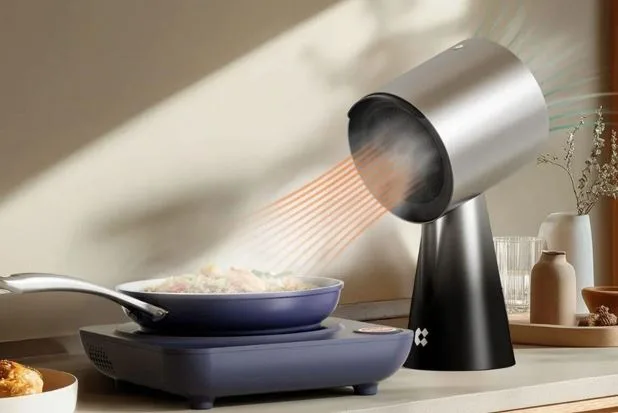
A portable range hood is a movable or less permanently installed device designed to provide localized air capture, filtration, or circulation around a cooking area. Depending on its design, it may draw cooking emissions toward a fan and filter rather than sending them through permanent ductwork.
A portable range hood should therefore not automatically be considered equivalent to a traditional ducted hood. A ducted hood sends captured air outdoors, while a recirculating system generally filters some contaminants and returns the air to the room. A portable air cleaner is different again because it typically treats room air rather than capturing the cooking plume directly.
These distinctions matter. Source capture, ventilation, and filtration are related but different strategies. A device can reduce airborne particles without physically removing all contaminated air from the building.
Do Portable Range Hoods Actually Improve Indoor Air Quality?
Yes, they can—but their effectiveness depends on how successfully they capture and treat cooking emissions.
The first factor is source capture. Cooking produces a warm plume that generally rises, but room air currents can push that plume away from the intake. If emissions escape before entering the device, increasing fan power may not fully compensate for poor positioning or limited capture coverage.
Research into domestic range hoods shows substantial variation in capture efficiency depending on factors such as hood design, burner position, fan speed, mounting conditions, and cooking activity. ASHRAE notes that a high airflow rating does not necessarily mean a hood will have high capture efficiency.
The second factor is what happens after capture. A ducted system can exhaust captured air outdoors, whereas a recirculating device depends on filtration to remove some contaminants before returning air to the room.
Therefore, portable systems can contribute to better indoor air quality, but they should be evaluated according to their complete capture and treatment process, rather than airflow or odor reduction alone.
Ventilation vs. Filtration vs. Source Capture
These terms are sometimes treated as interchangeable, but they describe different mechanisms.
Source capture means intercepting pollutants near where they are produced. A hood positioned above a cooking surface is designed to capture the rising plume before it disperses.
Ventilation involves moving indoor air out and bringing in outdoor air. When a range hood vents outdoors, captured cooking emissions can physically leave the building.
Filtration passes air through a filter that removes certain contaminants. A recirculating hood or portable air cleaner can reduce particle concentrations this way, but filtration does not automatically remove every pollutant.
EPA guidance identifies source control and ventilation as primary strategies and filtration as a useful supplement. When there is no outdoor-vented range hood, EPA recommends options such as appropriate portable air cleaning and, when conditions permit, opening doors or windows.
Understanding this difference prevents a common misconception: cleaner-smelling air does not necessarily mean all cooking pollutants have been removed.
What the Research Says About Cooking Emissions
Research provides strong evidence that cooking can raise indoor particle concentrations, while studies of range hoods show that capture performance can vary significantly.
ASHRAE describes capture efficiency as the percentage of cooking contaminants that are actually captured and exhausted. Its guidance notes that performance can vary with installation, burner position, fan speed, hood design, makeup-air location, and other factors.
That finding has an important practical implication: a hood’s advertised airflow should not be treated as a complete measure of its effectiveness. If the cooking plume escapes the capture area, some pollutants can enter the room regardless of how much air the fan is theoretically capable of moving.
Hood placement also matters. ASHRAE explains that kitchen exhaust systems are generally positioned so that the rising thermal plume can enter the hood and be conveyed away.
EPA likewise recommends using a range hood while cooking, preferably one that vents outdoors, and notes that cooking on rear burners can improve the opportunity for emissions to be captured.
The research therefore supports a broader conclusion: effective kitchen ventilation is about capturing the pollutant plume, not simply moving a large volume of air.
Portable vs. Ducted Range Hoods
The major difference between portable or recirculating systems and ducted range hoods is what happens to the captured air. Portable and recirculating systems typically filter air before returning it to the kitchen, while ducted systems can carry captured cooking emissions outside through a dedicated exhaust path.
| Factor | Portable/Recirculating | Ducted |
| Installation | Generally simpler | More involved |
| Outdoor exhaust | Usually unavailable | Yes |
| Filtration | Important | Depends on system |
| Source capture | Design-dependent | Design- and installation-dependent |
| Pollutant pathway | Capture and filtration | Capture and outdoor exhaust |
| Flexibility | Generally higher | Generally lower |
When evaluating portable kitchen ventilation options, resources such as Ciarra Gadgets can provide additional information about available product designs and features. However, product specifications are only one part of the decision. Actual performance also depends on capture position, airflow, filtration, installation conditions, and the specific cooking environment.
A properly designed ducted hood has a fundamental advantage because captured pollutants can be exhausted outside instead of being returned to the room. The EPA recommends using an outdoor-vented range hood when possible.
That does not mean every ducted hood performs perfectly. Poor installation, inadequate capture area, unfavorable burner placement, or restricted airflow can still reduce performance. Research and ASHRAE guidance indicate that actual capture performance can vary considerably depending on operating and installation conditions.
Portable systems can therefore be useful where permanent ductwork is impractical, but they should be viewed according to their actual capture and filtration capabilities rather than assumed to provide the same pollutant-removal pathway as outdoor exhaust.
What Determines Portable Hood Effectiveness?
Capture Distance
Position is critical. A device located close to the cooking source has a better opportunity to intercept the plume before it spreads. Once pollutants have mixed throughout the room, source capture becomes much more difficult.
Capture Efficiency
Capture efficiency provides a more useful picture of performance than airflow alone. It asks how much of the contaminant generated during cooking actually enters the exhaust system. ASHRAE notes that mounting height and other operating conditions can affect measured capture efficiency.
Airflow
Airflow still matters, but it works together with hood geometry, position, and room conditions. A high-flow fan cannot guarantee strong capture if the hood is too far from the cooking surface or the plume is being displaced by cross-drafts.
Filter Type and Condition
Recirculating systems depend heavily on their filters. EPA explains that filters can be designed primarily for particles or gases, and some systems use different filtration stages for different pollutants. Filters also require regular replacement or maintenance because overloaded filters can perform poorly.
Cooking Method and Room Conditions
Frying, grilling, stir-frying, and high-temperature cooking can create substantially different emissions from boiling or steaming. Windows, doors, HVAC airflow, room size, and cross-drafts can also change how pollutants move.
The result is that a portable hood may perform differently from one kitchen to another, even when the devices appear similar on paper.
Can Portable Systems Remove Both Particles and Gases?
Not necessarily. Particle removal and gas removal require different filtration approaches.
EPA explains that most filters are designed primarily for either particles or gases, while some air cleaners combine particle filtration with activated carbon or another gas-removal medium. EPA also notes that no air cleaner or filter removes every pollutant.
That means reducing PM2.5 should not automatically be interpreted as eliminating every cooking-related pollutant. Similarly, reducing an odor does not prove that all gaseous contaminants have been removed.
For this reason, filtration is best viewed as part of a broader indoor-air-quality strategy rather than a complete replacement for source control and appropriate ventilation.
How to Use a Portable Range Hood More Effectively
The most important step is to position the device as close to the cooking source as practical. Capturing emissions before they disperse is generally more effective than trying to clean an entire kitchen after pollution has spread.
Use the hood while cooking instead of waiting until visible smoke appears. When practical, cook on the back burners because this can improve the opportunity for the hood to capture emissions. EPA also recommends leaving an outdoor-vented hood running for about 10–20 minutes after cooking.
Keep filters clean and replace them according to the manufacturer’s instructions. For systems without outdoor exhaust, additional strategies may help, including a correctly sized portable air cleaner or natural ventilation when outdoor conditions and safety permit.
The goal is not to rely on one device for every pollutant, but to reduce the amount of cooking pollution that reaches the rest of the home.
Limitations and When a Portable Hood May Not Be Enough
Portable systems have practical limits. Heavy frying, grilling, high-temperature cooking, frequent cooking, or poor device positioning can generate more pollution than a small recirculating system can effectively capture or filter.
A portable system also does not necessarily provide the same pollutant-removal pathway as outdoor exhaust. If captured air is returned to the room, filtration quality becomes especially important.
Combustion appliances add another consideration. High exhaust rates can affect building pressure and, under some conditions, contribute to backdrafting. EPA recommends professional advice when ventilation interacts with fuel-burning equipment.
For these reasons, portable equipment is best considered one component of an indoor-air-quality strategy rather than an automatic substitute for properly designed outdoor kitchen ventilation.
Conclusion
So, do portable range hoods really improve indoor air quality? They can, but effectiveness depends on more than fan power. Source capture, positioning, airflow, filtration, cooking conditions, and the way captured air is handled all influence the result.
The research shows why airflow ratings alone are not enough. A device can move substantial air but still capture relatively little cooking pollution if the plume escapes its intake. A well-positioned system, meanwhile, can help prevent cooking emissions from spreading throughout the home.
For readers comparing kitchen-air solutions, Ciarra gadgets can be one source of product information to consider alongside independent research, the specific cooking environment, and the ventilation needs of the home.
FAQs
1. Do portable range hoods really improve indoor air quality?
Yes, they can help reduce cooking-related airborne pollution, but their effectiveness depends on source capture, positioning, airflow, filtration, and whether the system exhausts air outdoors or recirculates it.
2. Are portable range hoods effective without outside ventilation?
They can provide some benefit through filtration, but they do not remove captured air from the building like an outdoor-vented hood. Their effectiveness depends heavily on the device’s capture design and filtration system.
3. Is a ducted range hood better for indoor air quality?
A properly designed ducted hood generally has an important advantage because captured cooking emissions can be exhausted outdoors. However, hood design, installation, airflow, and capture efficiency still determine how well it performs. EPA recommends outdoor-vented range hoods where possible.
4. Do portable range hoods remove PM2.5 and other fine particles?
Some systems can reduce airborne particles through filtration, but performance varies by filter, airflow, capture efficiency, and operating conditions. Reducing PM2.5 does not necessarily mean every cooking-related pollutant has been removed.
5. Should a range hood run after cooking?
Yes, continuing ventilation after cooking can help remove remaining airborne pollutants. For an outdoor-vented range hood, the EPA recommends leaving it on for about 10–20 minutes after cooking.