
Do You Need a Capacitor or Upgraded Alternator for a Car AMP?
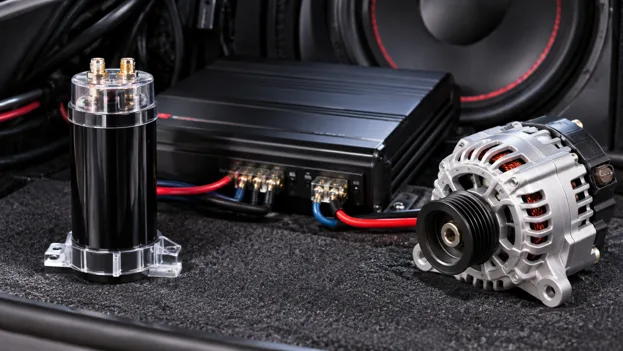
Does your bass hit and your headlights dim? To solve this problem, people reach for a capacitor, but that is often the wrong answer. Dimming lights usually point to a bigger electrical problem a cap cannot solve.
A car amplifier pulls huge current on hard bass, and your charging system has to keep up. This guide shows you what a capacitor actually does, when you need one, and when your money belongs in a better alternator or battery instead.
What Does a Car Audio Capacitor Actually Do?
A capacitor stores a small burst of energy and releases it fast. It lies between your battery and your amp, ready to cover quick demands.
When your sub hits a hard note, your amp pulls a sudden spike of current. A car audio capacitor hands over its stored charge for that split second. This can steady the voltage during very short bass peaks.
Here is the catch most sellers skip. A capacitor does not make more power. It only buffers what your electrical system already provides. If your alternator cannot generate enough current, a cap just empties and refills without fixing the shortage. It smooths brief peaks, nothing more.
What Are the Signs Your Electrical System Is the Bottleneck?
Your car tells you when the electrical system is maxed out. Watch for these signs.
- Headlights dim in time with your bass.
- Voltage sags below 12 volts under load on a meter.
- The amp cuts out or drops into protect mode on loud passages.
- Interior lights flicker when the bass drops.
One or two of these means your charging system is struggling to feed your amp. The real question is where the shortage sits. A car stereo amplifier can only deliver its rated power if the electrical behind it keeps up. If the voltage is sagging hard, a capacitor is a bandage, not a cure.
What Is the Big 3 Upgrade, and Does It Help?
The Big 3 is the cheapest real fix for a strained electrical system. It upgrades three key wires with thick, high-quality cable.
The three upgrades are:
- Battery positive to alternator positive. Improves current flow from the charging source.
- Battery negative to chassis ground. Strengthens the ground path.
- Engine block to chassis ground. Completes a clean, low-resistance circuit.
This upgrade does not add power, but it lets your existing power move freely. Thin factory wire chokes the current your amp needs. The Big 3 clears that bottleneck for a low cost. Many dimming-light problems ease once these three wires are upgraded, since the factory cables were the real restriction all along.
When Does a Capacitor Help vs When You Need a Better Battery?
A capacitor and a battery solve different problems. Knowing which you have saves you money.
A capacitor helps when your electrical system is basically healthy, but you want to smooth very brief bass peaks. It suits a moderate system where the lights dim only slightly on the hardest notes. It is a fine-tuning tool.
A better battery helps when your system needs sustained current, not just quick bursts. A high-current AGM or lithium battery stores real reserve power for long, loud passages. If your lights dim for more than a split second, or sag during extended bass, you need storage, not a buffer. A second battery or an upgraded main battery is the stronger answer for a serious car audio amplifier build.
How Do You Size Your Electrical Upgrade to Your System Wattage?
Your amp’s power draw decides what your electrical needs. Match the upgrade to the demand.
Start by estimating your current draw. Add up your amps’ total RMS wattage, then divide by roughly 13.8 volts. A 2,000-watt RMS system pulls around 145 amps at full output. That number tells you how hard your charging system has to work.
Use it to guide your upgrade:
- Under 1,000W RMS. The Big 3 is often enough on a healthy stock system.
- 1,000 to 2,500W RMS. Add a high-current battery and consider a bigger alternator.
- Above 2,500W RMS. A high-output alternator and extra battery capacity become essential.
The goal is a charging system that generates more current than your amp demands. When supply beats demand, your voltage stays stable, and your lights stop dimming. A capacitor on top of that handles only the final, tiny peaks. The best car amplifier setup is one whose electrical foundation never sags under it.
Fix the Foundation, Then Enjoy the Bass
Dimming lights are an electrical problem, not a capacitor problem. Start with the Big 3, size your battery and alternator to your wattage, and add a cap only for the final smoothing. Get the foundation right, and your amp delivers full, clean power every time.
American Bass builds car amplifiers and the power gear to run them, from AGM and lithium batteries to heavy-gauge wiring, all from Twinsburg, Ohio. Our free electrical load calculator shows exactly what your build demands, so you upgrade the right part the first time.
FAQs
Do I need a capacitor for my car amp?
Only if your electrical system is healthy and you want to smooth brief bass peaks. For dimming lights that last more than a flash, a capacitor will not fix it. A better battery or alternator usually solves the real problem.
What does a capacitor do in a car audio system?
It stores a small charge and releases it fast during quick current spikes. This steadies voltage on very short bass hits. It buffers power but never creates more of it.
Why do my lights flicker with my subwoofer?
Your amp is pulling more current than your electrical system can supply. The voltage drops on hard bass and your lights dim. Upgrade your wiring, battery, or alternator to fix it.
When should I upgrade my alternator for car audio?
When your system draws more current than the stock alternator can make. High-power builds above roughly 2,500 watts RMS usually need one. Dimming that persists after a Big 3 upgrade is the clearest sign.
What is better for car audio, a capacitor or a second battery?
A second battery is better for sustained power, while a cap only covers quick peaks. Most dimming problems come from a lack of stored current. A battery solves that far more reliably than a capacitor.
How do I know if my car electrical system can handle an amp?
Add your amps’ RMS wattage and divide by 13.8 to estimate current draw. Compare that to your alternator’s output. If demand nears or beats supply, you need an electrical upgrade.