Dogecoin Mining Setup Guide: Everything You Need to Start
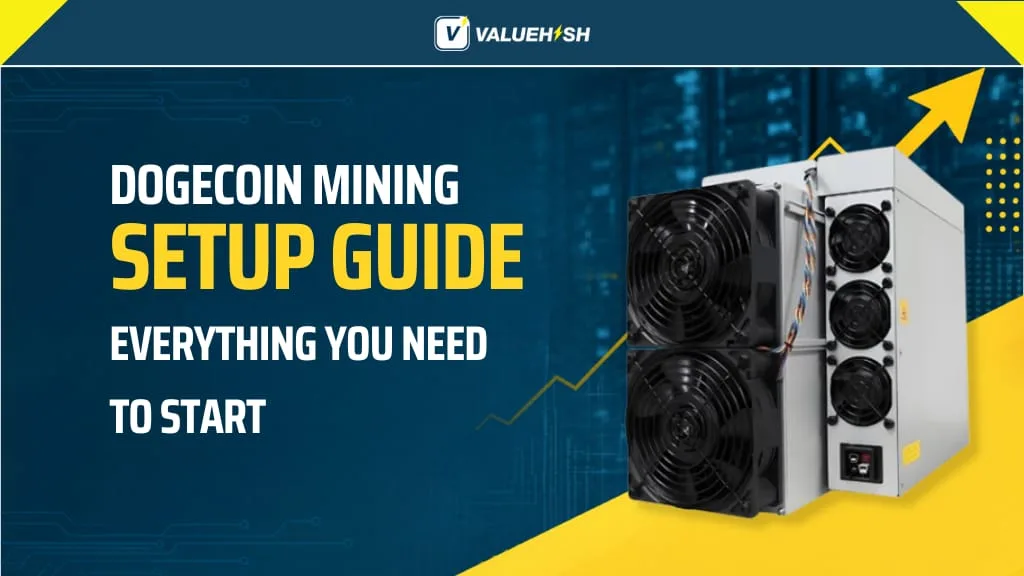
So you’ve been thinking about getting into Dogecoin mining. Maybe you’ve seen discussions online about passive income from crypto, or maybe you genuinely believe in Dogecoin as a long-term project and want to participate in securing the network. Either way, you’re in the right place.
This guide is going to walk you through exactly what you need to know to start Doge mining in a way that’s actually grounded in reality. No empty promises, no wildly optimistic revenue screenshots. Just clear, practical information so you can make a smart decision with your time and money.
Let’s get into it.
What Is Dogecoin Mining and How Does It Work?
Dogecoin is a proof-of-work cryptocurrency, which means new coins are created by miners who solve complex mathematical puzzles using computing hardware. Every time a puzzle is solved, a new block is added to the blockchain and the miner receives a block reward in DOGE.
What makes Dogecoin slightly different from Bitcoin is that it uses the Scrypt algorithm instead of SHA-256. This has a few important implications for anyone planning to mine it.
First, you can’t use Bitcoin ASIC miners to mine Dogecoin. You need hardware specifically designed for Scrypt-based mining. Second, Dogecoin has a one-minute block time compared to Bitcoin’s ten minutes, which means blocks are confirmed faster and rewards are distributed more frequently. And third, Dogecoin merged mined with Litecoin, meaning many miners run both simultaneously on the same hardware without any extra cost or energy usage. That merge mining feature is one of the underrated advantages of Doge mining today.
GPU Mining vs. ASIC Mining: Which Should You Choose?
This is usually the first question newcomers ask, and it’s a fair one.
A few years ago, GPU mining Dogecoin was entirely reasonable. If you had a decent gaming rig, you could point it at a Dogecoin pool and start earning. Those days are largely over, at least if you’re trying to mine profitably.
The Dogecoin network difficulty has grown significantly, driven by large-scale mining operations running Scrypt ASIC hardware. Trying to compete with a GPU against modern ASICs is a bit like racing a bicycle on a highway. You can do it technically, but the results won’t be satisfying.
For anyone serious about Doge mining in 2026, ASIC miners are the practical choice. The leading Scrypt ASICs currently include:
Bitmain Antminer L9 This is widely considered the most efficient Scrypt miner available. It delivers around 16 GH/s with a power draw of approximately 3,260 watts. It’s expensive, typically $3,000 to $5,000 depending on availability, but its efficiency rating is hard to beat.
Bitmain Antminer L7 The older sibling of the L9, the L7 delivers around 9.5 GH/s and remains a solid choice for miners who want slightly lower upfront costs. Used units are more accessible and still deliver competitive performance.
Your hardware choice depends on your budget, your electricity situation, and whether you plan to host your miners professionally or run them at home.
Understanding the Real Costs Before You Buy Anything
This section is arguably the most important one in the entire guide, because most people who end up disappointed with mining skipped the numbers entirely and just bought hardware out of excitement.
Hardware Cost
As mentioned above, a quality Scrypt ASIC will cost you anywhere from $800 for used older models to $5,000+ for a new high-performance unit. This is your biggest upfront cost and the hardest to recover if the market moves against you.
Electricity
This is the ongoing expense that will make or break your profitability. Scrypt ASICs are power-hungry. Running an Antminer L7 at 3,425 watts around the clock consumes roughly 82 kWh per day. At a residential rate of $0.12 per kWh, that’s about $9.84 per day in electricity alone, or nearly $300 per month for a single machine.
That’s why miners who run hardware at home in regions with average or above-average electricity costs often struggle to stay profitable. The math works much better when you can access lower electricity rates, which is exactly where professional ASIC hosting services come into the picture.
Pool Fees
Mining pools charge a fee for organizing and distributing rewards among participants. Pool fees typically sit between 1% and 2% of your earnings. It’s not a huge expense, but it’s worth factoring into your projections.
Maintenance
ASIC miners are industrial machines running continuously in warm environments. Fans wear out, control boards develop issues, and power supplies can fail. Budget roughly 5% to 8% of your hardware’s value annually for potential maintenance and repairs.
How to Use a Dogecoin Mining Calculator
Before committing any money, you need to spend some time with a Dogecoin mining calculator. This is a non-negotiable step.
A mining calculator takes your hardware’s specifications and current network conditions to estimate how much DOGE you’ll mine over time. Here are the inputs you’ll need:
Hashrate: Your miner’s output in MH/s or GH/s. This is listed in the hardware specs.
Power consumption: How many watts your miner draws, also in the specs.
Electricity cost: Your per-kWh rate. If you’re using a hosting service, this is typically their advertised all-in power rate.
Pool fee: Usually 1% to 2%.
Current DOGE price: Check a live source like CoinGecko.
Network difficulty: This changes constantly as more miners join or leave the network. Calculators like WhatToMine pull this in automatically.
Let’s run a quick example with the Antminer L7:
- Hashrate: 9,500 MH/s
- Power: 3,425 watts
- Electricity: $0.07/kWh (professional hosting rate)
- Pool fee: 1%
- DOGE price: $0.15
At these figures, you’d mine roughly 650 to 800 DOGE per day, worth approximately $97 to $120 at $0.15 per coin. With daily electricity costs of around $5.75 at the $0.07 hosting rate, your daily net would be in the range of $91 to $114 before factoring in amortized hardware costs.
Now run the same scenario at a home electricity rate of $0.13/kWh and your daily electricity cost jumps to $10.68, compressing your margin noticeably.
This is why electricity rate is such a critical variable. A difference of $0.06 per kWh might sound small, but across a fleet of machines running 24/7, it can be the difference between a profitable operation and one that’s barely breaking even.
Always run multiple scenarios in your Dogecoin mining calculator. Model what happens if DOGE drops 30%, if network difficulty increases 20%, or if electricity costs rise. Stress-testing your numbers before you spend money is the single most important thing you can do.
Choosing a Mining Pool
Once you have your hardware, you’ll need to join a mining pool. Solo mining Dogecoin is technically possible but statistically impractical for individuals. The network is too large and the competition too intense. In a pool, miners combine their hashrate and share rewards proportionally.
Some of the more established pools for Doge mining include:
Litecoinpool.org: Probably the most popular option for merged Dogecoin and Litecoin mining. It has a strong reputation for reliability and transparent payout tracking.
F2Pool: One of the largest mining pools globally, supporting Scrypt mining with solid infrastructure and a user-friendly dashboard.
Prohashing: Offers merged mining and pays out in multiple currencies, giving miners some flexibility in how they receive rewards.
When evaluating pools, look at their fee structure, payout method (PPS vs. PPLNS), minimum withdrawal thresholds, and server locations. A pool with servers close to your mining hardware will reduce latency, which matters for efficiency.
Setting Up Your Miner: Step by Step
The actual setup process is more straightforward than most beginners expect. Here’s the general flow:
Step 1: Receive and inspect your hardware. When your ASIC arrives, check for any shipping damage before powering it on. Make sure all connections are secure and the unit is undamaged.
Step 2: Connect to power and network. ASICs require a dedicated power supply unit (PSU), usually included or sold separately. Connect to power and plug an ethernet cable directly into your router or switch. ASICs don’t use WiFi.
Step 3: Find the miner’s IP address. Log into your router’s admin panel to find the IP address assigned to your miner, or use a tool like IP Scanner.
Step 4: Access the miner’s dashboard. Enter the IP address in your browser. You’ll land on a simple web interface where you configure your mining settings.
Step 5: Enter your pool credentials. Input your mining pool’s stratum address, your pool username (or wallet address), and a worker name. This tells the miner where to send its work.
Step 6: Save and let it run. Once configured, the miner will begin hashing. You can monitor performance from the dashboard, which shows your hashrate, temperature, fan speeds, and uptime.
If you’re using a professional hosting facility, steps 1 through 6 are often handled for you entirely, or at least supported through their onboarding process.
Why Many Miners Choose Professional ASIC Hosting
Home mining sounds appealing at first. You have complete control, you can see your machines, and there’s something satisfying about running your own operation.
But the practical realities are less romantic than they sound.
A single Antminer L7 generates as much noise as a vacuum cleaner running continuously. Multiply that by a few machines and your home becomes genuinely unlivable for anyone nearby. Heat is an equally real problem. These units push out significant warmth, and without proper ventilation and cooling, your hardware runs hotter, degrades faster, and can become a fire risk.
Professional ASIC hosting services solve all of this cleanly. Your hardware lives in a purpose-built data center with industrial-grade cooling, redundant power systems, fire suppression, and around-the-clock monitoring. You send your machines, they handle the infrastructure, and you collect the rewards.
The key financial benefit is electricity pricing. Professional hosting facilities negotiate bulk power contracts that bring rates down to $0.05 to $0.08 per kWh in many cases, sometimes lower depending on geography and scale. That reduction has a direct and meaningful impact on your profitability across every machine you operate.
For miners deploying more than two or three machines, professional hosting almost always makes more financial sense than home operation.
Tracking Your ROI Over Time
Once your miner is running, tracking performance consistently is important. Don’t just set it up and forget about it for months.
Check your Dogecoin mining calculator inputs monthly. Network difficulty shifts regularly, DOGE’s price fluctuates, and occasionally hardware performance changes as firmware updates or hardware wear affects efficiency. Staying on top of these variables lets you make informed decisions about when to reinvest, when to hold mined coins, and when to scale up.
Keep records of your power costs, hardware expenses, maintenance costs, and mining income. This is especially important if you’re mining as a business activity, since the tax treatment of mined cryptocurrency varies by jurisdiction and requires accurate records.
Some miners also choose to hold a portion of their mined DOGE rather than converting everything immediately to fiat. Whether that makes sense depends entirely on your own view of Dogecoin’s prospects and your personal financial situation, not something anyone else can decide for you.
Common Mistakes to Avoid
A few patterns trip up new miners repeatedly. Being aware of them ahead of time saves money and frustration.
Buying hardware without checking resale value. If profitability drops and you want to exit, can you sell your miners? Check the used market before you buy to understand what your hardware’s floor value looks like.
Underestimating electricity costs at home. Run the numbers with your actual electricity rate, not an optimistic assumption. Many home miners discover their electricity bill increases by more than they expected once ASICs are running.
Ignoring network difficulty growth. As more miners join the Dogecoin network, your share of rewards decreases even if your hardware stays identical. Build this into your long-term projections.
Choosing a cheap, unproven hosting provider. In the hosting world, the lowest price isn’t always the best deal. Verify that any hosting company has a real track record, clear contract terms, and transparent communication before sending your hardware.
Conclusion: Is Doge Mining Worth Starting Today and Where ValueHash Fits In
Dogecoin mining in 2026 is a realistic pursuit for people who approach it with the right mindset. It’s not a path to overnight wealth, and it’s not riskless. But for someone who understands the numbers, chooses quality hardware, accesses competitive electricity pricing, and thinks in terms of years rather than weeks, it can be a meaningful way to accumulate DOGE while contributing to the network.
The two most critical decisions you’ll make are your hardware choice and your electricity situation. Getting both right sets the foundation for everything else.
If you’re looking for a professional hosting partner to help you do this right, ValueHash is worth a serious look.
ValueHash specializes in professional ASIC hosting services designed specifically for miners who want reliability without complexity. Their facilities offer competitive power rates, enterprise-grade cooling and security, and real-time monitoring so you always know how your hardware is performing. They work with both individual miners deploying a handful of machines and larger-scale operations looking for a dependable infrastructure partner.
What stands out about ValueHash is their approach to transparency. Pricing is straightforward, contracts are clear, and their team is genuinely available when questions come up. They also provide tools that integrate with your Dogecoin mining calculator inputs, so tracking your actual ROI against your projections is easy and accurate.
Whether you’re just starting out with your first Scrypt ASIC or scaling an existing Doge mining operation, ValueHash offers the infrastructure and support to make it run smoothly. In an industry where the quality of your hosting partner directly affects your bottom line, choosing a provider with a proven track record matters more than most people realize.
Mining Dogecoin is ultimately about more than just the coins. It’s about participating in a network, making thoughtful infrastructure decisions, and building something sustainable over time. The right setup, the right partner, and realistic expectations get you a long way.