Dropshipping in 2026: What the Numbers Say About Costs, Margins, and What It Takes to Succeed
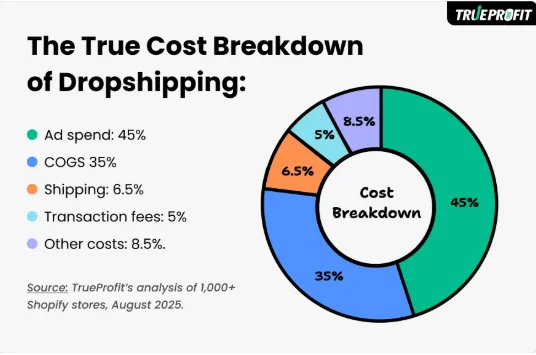
TrueProfit, the #1 net profit analytics platform for Shopify merchants, has released new insights on the realities of dropshipping in 2026, drawing on data from over 1,200 active stores. The findings paint a clear picture: dropshipping remains a viable business model, but only for operators who understand their real costs, protect their margins, and track profit with precision.
Introduction
Dropshipping continues to attract new entrepreneurs worldwide, driven by its low barrier to entry and the promise of running a product business without holding inventory. In 2026, that promise is still real, but the environment has grown significantly more competitive, and the merchants finding success are those who approach the model with accurate financial expectations from the start.
Alongside the growth in opportunity has come a corresponding rise in competition, ad costs, and consumer expectations. The merchants succeeding in this environment are not the ones chasing trends. They are the ones who treat dropshipping as a financial discipline: starting with realistic capital, targeting margins that can withstand real-world costs, and making every product and campaign decision based on actual profit data.
TrueProfit’s analysis of 1,200+ Shopify dropshipping stores reveals a consistent pattern. Revenue is easy to generate. Sustainable profit is the hard part. Understanding where that profit comes from, and what eats into it, is what separates the stores that scale from the ones that quietly shut down after a few months.
What It Actually Costs to Start Dropshipping
One of the most persistent myths in dropshipping is that it can be started for free or for a few hundred dollars. The reality, according to TrueProfit’s cost breakdown, is considerably more nuanced and capital-intensive than most beginner content suggests.
At the lowest end, a fully organic operation running on free tools and no paid ads can technically start for around $25 per month, covering just a basic Shopify plan. However, this approach offers very slow, unpredictable growth and is not a realistic path for most merchants hoping to build a profitable store within a reasonable timeframe. A more realistic mid-tier setup, including paid supplier tools, a modest ad budget, and essential apps, runs closer to $600 per month.
Aggressive testers who run paid ads across multiple products can spend $1,400 or more per month before finding their first consistently profitable product. Most stores that find success invest between $5,000 and $10,000 to start a dropshipping business and reach consistent early results, covering ad testing, product sampling, platform fees, and operational costs during the validation phase. The key insight is that dropshipping’s low barrier to entry does not mean low cost to succeed.
Understanding the full cost structure is essential for any new dropshipper. The main expense categories include:
- E-commerce platform: Shopify’s standard plan runs $25-$29 per month, making it the most cost-effective option for most sellers.
- Supplier and fulfillment: Free suppliers like AliExpress are a valid starting point, but paid supplier platforms offering faster shipping and better automation typically cost $29-$99 per month.
- Paid advertising: This is the biggest variable cost. Beginners should budget $300-$500 per month to test products meaningfully, while aggressive testers may spend $1,000-$1,200 or more.
- Apps and tools: Review apps, research tools, and automation software add $50-$150 per month depending on the stack chosen.
- Domain and branding: A custom domain costs roughly $14-$25 per year, a small investment that significantly improves customer trust.
Most dropshipping stores do not fail because the model does not work. They fail because founders underestimate the capital needed before sales become stable and consistent.
What Good Profit Margins Actually Look Like
Margin benchmarks are one of the most misunderstood areas in dropshipping, and setting realistic expectations early can prevent months of operating at a loss while believing the business is healthy.
Based on TrueProfit’s analysis of 1,200+ dropshipping stores, typical dropshipping profit margins follow a clear benchmark. A gross profit margin of 65-70% is considered favorable for most dropshippers, meaning that after subtracting product cost from revenue, roughly two-thirds of each sale remains to cover operating expenses. A net profit margin of 15-25% is the strong benchmark after all costs are deducted, including ad spend, shipping fees, transaction fees, refunds, and platform costs.
These numbers vary meaningfully by niche and positioning:
- High-ticket products such as furniture, electronics accessories, or specialty fitness equipment can generate net margins of 30-50%, because the absolute dollar margin per sale is large enough to absorb advertising costs while still leaving meaningful profit.
- Competitive general-merchandise niches selling products widely available on major discount platforms typically see margins compressed to 15-25%, requiring efficient ad targeting to remain profitable.
- Premium or branded stores that invest in design, packaging, and perceived value can achieve 35-50% margins, because customers are not price-comparing them against generic alternatives.
For merchants who want to stress-test a product idea before committing an ad budget, TrueProfit’s dropshipping profit margin calculator factors in selling price, product cost, shipping, marketing fees, and other costs to show net profit and net margin instantly.
Why Revenue Does Not Equal Profit
The most consequential mistake dropshippers make in 2026 is measuring business health by revenue rather than net profit. A store can generate $50,000 in monthly sales and still be operating at a loss, once ad spend, supplier costs, shipping fees, transaction fees, refunds, and platform costs are fully accounted for.
This gap between top-line revenue and actual profit is where most stores quietly fail. The revenue dashboard shows growth. The bank account tells a different story. Without accurate tracking of every cost category, merchants scale into losses rather than out of them, often discovering the problem months after it began.
The gross profit margin formula, Revenue minus COGS divided by Revenue, tells merchants how much of each sale remains after paying for the product itself. The net profit margin formula, Revenue minus all expenses divided by Revenue, tells merchants how much they actually keep. Both metrics matter, but net profit margin is the only number that reflects whether the business is truly working.
How TrueProfit Helps Dropshippers Track What Matters
TrueProfit was built to solve the profit visibility problem that affects most Shopify dropshipping stores. Instead of piecing together data from Shopify reports, ad platforms, and spreadsheets, merchants receive a single real-time dashboard showing net profit at every level: storewide, by product, and by individual ad channel.
The platform automatically pulls in and calculates all cost categories, including COGS, ad spend across all connected platforms, shipping fees, transaction fees, refunds, and any custom costs the merchant defines. The result is an accurate, live view of what the business is actually earning, not what it appears to be earning based on revenue alone.
Key capabilities include:
- Real-time net profit dashboard: Storewide profit updated live, so merchants are never waiting until end-of-month to understand where they stand.
- Product-level profit analytics: Instant visibility into which products are generating real margin and which are reducing overall profitability.
- Ad channel profit attribution: Goes beyond ROAS to show actual profit returned per campaign, ad set, and ad after all costs.
- Automated P&L reporting: Weekly and monthly profit and loss statements without manual spreadsheet work.
- Customer lifetime value tracking: Helps merchants understand the true long-term value of each customer segment.
- MCP connection: Connects store profit data directly to LLMs like ChatGPT, Claude, and Gemini, enabling AI-assisted financial analysis.
With a 5.0/5 rating from over 770 reviews on the Shopify App Store and plans starting at $35 per month with a 14-day free trial, TrueProfit is the profit analytics tool that serious Shopify dropshippers use to protect margins and make scaling decisions with confidence.
Looking Ahead
Dropshipping in 2026 rewards operators who run it with discipline and precision. For operators who approach the model with accurate capital expectations, realistic margin targets, and systematic profit tracking, it remains a viable and scalable business model accessible to merchants at every level of experience.
The stores that build lasting profitability are not necessarily the ones with the best products or the largest ad budgets. They are the ones that know, at any given moment, exactly how much money they are making and where every dollar is going. That level of visibility is what TrueProfit is designed to provide.
Conclusion
The realities of dropshipping in 2026 are straightforward: starting capital requirements are higher than most beginner content suggests, margin benchmarks are clearly defined by data from thousands of stores, and the gap between revenue and actual net profit is where most businesses fail. TrueProfit exists to close that gap, giving Shopify dropshippers the accurate, real-time profit visibility they need to make informed decisions, protect their margins, and build businesses that scale sustainably.
Media Contact:
- Company Name: TrueProfit
- Contact Person: TrueProfit Team
- Email: [email protected]
- City: Ho Chi Minh City
- Country: Vietnam
- Website: https://trueprofit.io