Echobit Explores AI Agent Trading Future in Cross-Industry AMA on Intelligent Execution and Trust
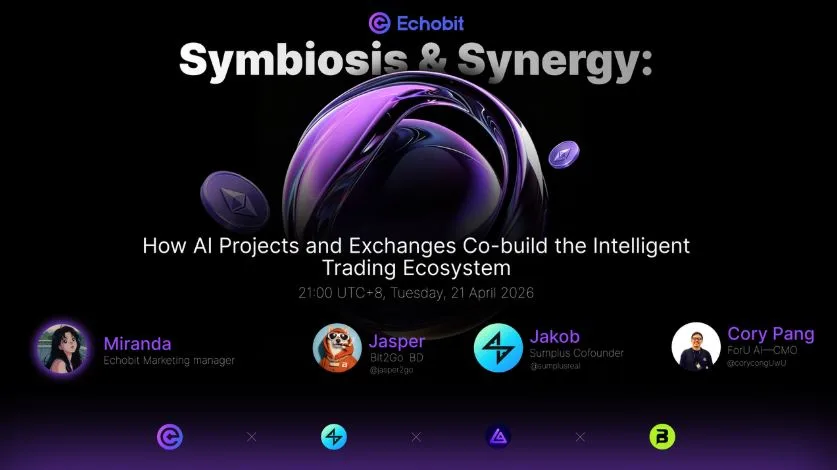
As the AI Agent narrative continues to gain momentum across the crypto industry in 2026, Echobit recently hosted an X Spaces AMA that brought together builders from multiple segments of the ecosystem to examine a critical question: what does intelligent trading actually look like in practice, and what still stands in the way.
The discussion, themed “Symbiosis & Synergy: How AI Projects and Exchanges Co-build the Intelligent Trading Ecosystem,” moved beyond speculative hype and focused instead on real-world execution, structural constraints, and the evolving relationship between exchanges and AI-native projects. With participation from contributors across AI infrastructure, agent execution, and product ecosystems, the session provided a grounded view of where the market stands today.
From Automation to Accountability: What AI Agents Can—and Cannot—Do
A central takeaway from the conversation was that AI agents have already proven their value in execution-heavy tasks, such as continuous market monitoring, rule-based trading, and multi-step on-chain operations, where consistency and speed offer clear advantages over human traders.
However, speakers emphasized that while execution capabilities are rapidly maturing, decision-making remains a fundamentally unresolved layer. The idea of fully autonomous AI systems generating profits without oversight was broadly dismissed as premature, as the real constraint is not technical feasibility but accountability. Once AI systems move from analysis into direct capital allocation, questions of responsibility emerge, particularly in scenarios involving losses.
This distinction between execution and judgment is becoming a defining boundary in the current phase of AI trading development, shaping how products are designed and how far automation is allowed to go.
Between Collaboration and Tension: Exchanges and AI Projects
The relationship between AI projects and exchanges was described as both cooperative and structurally complex. On one hand, exchanges provide liquidity, user access, and distribution channels, while AI projects contribute narrative momentum and new forms of engagement that can drive activity.
On the other hand, the rise of increasingly capable AI agents introduces long-term questions about dependency. As agents become more effective at interacting directly with on-chain systems and executing trades autonomously, the traditional role of exchanges as primary gateways may evolve. Rather than being the sole interface for users, exchanges could become one layer within a broader, automated financial stack.
What remains notably underdeveloped is a shared framework for trust and coordination, particularly in evaluating agent reliability, managing risk, and standardizing interaction between systems. Without this layer, both ecosystems face similar bottlenecks in scaling adoption.
Infrastructure vs. Experience: Where the Real Opportunity Lies
Another key theme of the discussion centered on strategic positioning. While some leading platforms have leaned toward developer-first approaches—focusing on building infrastructure for AI agents and automated systems—the conversation highlighted that this is only part of the equation.
Although attracting developers helps establish control over the underlying infrastructure, the more complex challenge lies on the user side, where individuals must navigate an increasingly crowded environment of tools, signals, and automated systems. The real friction point is no longer access, but decision-making: determining what to trust, what to use, and how to act.
As a result, future competitive advantage is likely to emerge from a combination of robust infrastructure and effective user-layer solutions that simplify trust and selection, rather than from either approach in isolation.
From Interface to Intent: Redefining the Trading Experience
One of the more tangible directions discussed during the AMA was the shift from manual operation to intent-based interaction. Instead of navigating interfaces and executing trades step by step, users are beginning to define goals, risk parameters, and strategies, leaving the system to handle execution.
This transition reframes trading as an outcome-oriented activity rather than a process-driven one, significantly reducing the cognitive load associated with constant market monitoring. While automation is expected to handle an increasing share of operational tasks, participants agreed that the final confirmation layer—where capital is actually deployed—remains, at least for now, under human control.
The result is not full autonomy, but a hybrid model in which AI handles execution efficiency while humans retain strategic oversight.
The Missing Piece: Trust as Infrastructure
Across all topics, one theme consistently resurfaced: the absence of a standardized trust layer. While the technical capabilities of AI agents are advancing rapidly, the mechanisms required to ensure reliability, transparency, and accountability across systems are still underdeveloped.
This gap affects not only user confidence but also the ability of exchanges and AI projects to integrate more deeply. Without clear standards for evaluating agent behavior and managing risk, seamless collaboration remains difficult to achieve.
Echobit’s Position in the Emerging Agent Ecosystem
Within this broader context, Echobit is positioning itself around the concept of bridging intent and execution through its recently introduced EchoAgent feature, which allows users to interact with trading systems using natural language while maintaining confirmation-based control over final actions.
Rather than pursuing full automation, this approach reflects a more incremental model in which usability, transparency, and user control are prioritized alongside efficiency gains. It also aligns with the industry’s current stage, where execution technology is ready, but trust infrastructure is still evolving.
As the AI Agent era continues to unfold, the discussion highlighted that the defining question is no longer whether intelligent systems will shape trading, but how platforms and users will build the frameworks needed to trust and operate within them, a challenge that players like Echobit are actively beginning to address.
Echobit Official Links: Twitter | Facebook | LinkedIn | Youtube