
Electrically Insulated Bearings: A Buyer’s Guide to Specs, Brands and Sourcing
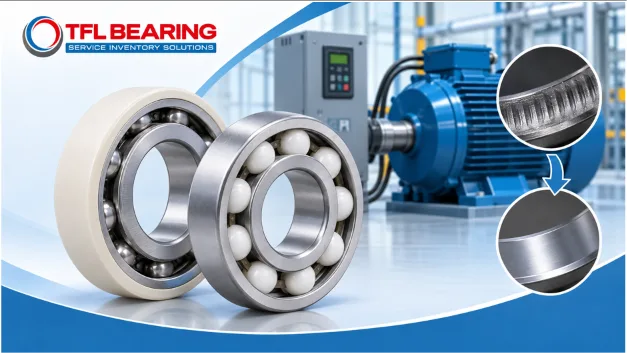
Buying electrically insulated bearings comes down to four choices: coated or hybrid, which ring carries the insulation, what voltage rating you need, and who you buy from. Get those right and an insulated bearing can stop the electrical damage that kills motor bearings on variable frequency drives (VFDs). Get one wrong and you pay a premium for a part that fails on the same schedule as the cheap one it replaced.
The stakes are real. SKF puts the risk of bearing damage at transient voltages above 0.5 V, or current density above 0.1 A/mm² in the rolling contact, and a drive fed motor can pass that on day one. A technical paper on AC motor bearing currents reports that bearings with current damage and vibration can fail in under six weeks.
This guide is for maintenance buyers and OEMs who need to spec and source insulated bearings without guesswork. Distributors and motor rebuilders will get the most from the RFQ checklist.
Do you actually need insulated bearings?
Not every VFD motor does. Small motors often do fine with a shaft grounding ring, which gives current an easier path to ground than the bearing. Insulated bearings become the better buy as motors get bigger.
Aerovent’s guide on VFD shaft current recommends an insulated non drive end (NDE) bearing for motors above NEMA frame 404T. On those frames, current tends to circulate in a loop through both bearings, and one insulated bearing breaks the loop. Insulating only the drive end is a common mistake, because the coupled machine can give current a path around it.
If the driven load has its own bearings, such as a gearbox or pump, insulating one motor bearing may not be enough. A study from the Zurich University of Applied Sciences found that two insulated bearings, or a shaft grounding ring, each prevented discharge damage in its test motors.
The clearest sign you’re buying for the right reason is the old bearing itself. Evenly spaced ridges across the outer race, a pattern called fluting, mean current damage. A standard replacement will fail the same way.
Coated or hybrid: where the money goes
This is the biggest cost decision on the order.
| Coated insulated bearing | Hybrid ceramic bearing | |
| How it works | Ceramic layer on the outer or inner ring | Ceramic balls or rollers, steel rings |
| Typical use | Industrial motors and generators | High speed spindles, high frequency drives |
| Relative price | Lower | Higher, and the gap widens in big sizes |
| Main risk | Coating chips if fitted badly | Higher upfront cost |
For most industrial motors, a coated bearing is the value choice. Hybrids make sense when speed or switching frequency is high enough to justify the extra spend. Engineers on the Eng-Tips forum note that insulated bearings get expensive in larger sizes, so on very large motors many plants pair one insulated NDE bearing with a grounding ring on the drive end instead of insulating both.
Within coated bearings, the coating position also affects price and performance. An outer ring coating suits all common housing types and is the standard option. SKF says an inner ring coating gives stronger protection against current damage, which is worth paying for on drives with heavy high frequency current.
The main brands, and why equivalents matter
Each major maker sells its own insulated range under its own name. SKF has INSOCOAT, NTN has MEGAOHM, FAG offers current insulated bearings, and NSK and NKE both sell ceramic coated lines. Insulated ranges from independent makers sit alongside them, often at lower cost.
The key fact for buyers: coated electrically insulated bearings follow the same ISO dimensions and tolerances as standard bearings. A 6316 is a 6316, whichever brand coats it. That’s what makes cross-referencing possible. If one brand quotes a long lead time on an urgent motor rebuild, an equivalent part from another maker can fit the same shaft and housing.
Equivalent does not mean identical, though. Breakdown voltage and moisture sealing can differ between ranges, so compare the spec sheet, not just the part number.
What drives the price of an insulated bearing
Quotes for the same nominal size can vary a lot. The main factors:
- Size: larger bearings cost more to coat, and the premium over a standard bearing grows with size.
- Type: hybrid ceramic costs more than coated.
- Coating position: inner ring coated versions are less common than outer ring ones.
- Brand: a branded part usually costs more than an equivalent from an independent maker.
- Quantity and mix: bundling several sizes into one order can cut freight and handling costs per piece.
Don’t let price be the only filter. One failed motor usually costs far more in downtime than the gap between two bearing quotes.
How to write an RFQ that gets accurate quotes
Vague requests get vague quotes. Include these details so every supplier quotes the same part:
- Bearing number with full suffix, such as the SKF VL0241 suffix for an outer ring coating.
- Coating position: outer ring, inner ring, or hybrid.
- Minimum breakdown voltage. 1,000 V DC is the usual baseline, and SKF says its upgraded INSOCOAT coating handles 3,000 V DC.
- Minimum insulation resistance. For reference, SKF INSOCOAT cylindrical roller bearings list at least 50 MΩ.
- Radial internal clearance (C3 is common on motor bearings) and cage material.
- Quantity and delivery date, plus whether equivalent brands are acceptable.
Point six saves the most money. Allowing equivalents opens the quote to more suppliers and often shortens lead time.
How to check a supplier before you order
Ask these questions before you place a first order:
- Can you supply test data for breakdown voltage and insulation resistance on this batch?
- How are the bearings sealed and packed against humidity? Aluminum oxide coatings absorb water, and SKF seals its coating with resin because moisture can weaken insulation before fitting.
- Can you prove where branded parts came from? Counterfeit bearings are a known problem in the trade.
- Do you inspect goods before shipment, and can I see the report?
- Can you cross-reference my old part numbers to equivalents?
A supplier who answers all five clearly is usually a safe first order. One who dodges the test data question is not.
Quick answers
How much more do insulated bearings cost than standard bearings?
It depends mostly on size and type. The premium grows with bearing size, and hybrid ceramic types cost more than coated ones.
Can I replace a standard bearing with an insulated one without changing the motor?
Yes for coated types, because they share ISO dimensions and tolerances with standard bearings. Fit them with care, since a chipped coating lets current through.
Should I buy branded or equivalent insulated bearings?
Branded parts suit OEM warranty work. For maintenance and rebuilds, an equivalent with matching electrical ratings and clearance often gives the same protection at lower cost.
Before you send your next order
Take the bearing number from your last failed VFD motor and build one RFQ with the six details above. Send it to at least two suppliers and ask each for batch test data. Compare the quotes on test data and lead time first, and on price last.
This guide was contributed by the team at Shandong TFL Bearing Co., Ltd., a bearing sourcing partner based in Jinan, China, that supplies OEMs and distributors worldwide.